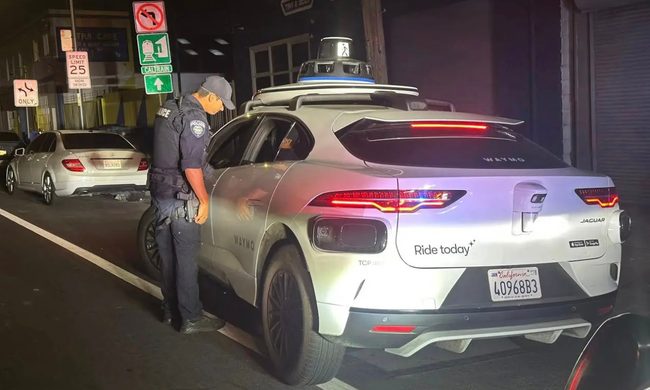
Even if autonomous vehicles perform as well as perfect human drivers who see and react quickly and correctly to objects and events, that isn’t good enough if the sensors cannot “see.” Bad road conditions, confusing tire tracks, inclement weather, or poor visibility all can interfere with the performance of conventional sensor-based systems, according to WaveSense.
The company claims localizing ground-penetrating radar (LGPR) technology is necessary to navigate any road in any condition in any weather. The WaveSense technical team developed the core LGPR technology at the Massachusetts Institute of Technology Lincoln Laboratory. In 2013 the first LGPR application was for military vehicles deployed in locations where there were few marked roads.


LPGR surpasses the best human driving by sending very-high-frequency (VHF) electromagnetic pulses 10 feet into the ground to build “highly-specific maps” of road subterranean composition. The pulses are safe for humans and are not affected by rain, fog, dust, and snow.
“Ground-penetrating radar measures reflections from objects and changes in soil properties deep in the ground, like pipes, roots, rocks, and dirt,” according to the WaveSense website. “Every inch of road has a unique subterranean composition, which allows WaveSense to build a highly-specific map.”
As a vehicle equipped with LPGR moves down a roadway, the data it reads is matched in five-dimensional space with continuously updated maps in WaveSense’s cloud storage.
Conventional camera, radar, and lidar-based autonomous driving systems are stymied when they cannot see lane markers or other location clues. Civilian GPS systems are accurate only to approximately three meters, almost 10 feet, which isn’t much of a confidence-builder if you’re traveling on a desolate, snow-drifted road. According to WaveSense, LPGR maintains 4-centimeter in-lane accuracy — about 1.6 inches — at 60 mph regardless of weather or road conditions.
Combining LPGR subsurface data with vehicle-mounted cameras, Lidar, radar, and conventional GPS systems may seem like overkill, but WaveSense describes it as “a complete toolkit to work with when making driving decisions.”
WaveSense says such fused systems “see in 4D.” Vehicles that include localizing ground-penetration radar to add the subterranean fourth dimension t0 3D-aware conventional autonomous driving systems with A.I.-trained algorithms are the best hope for the top-priority promise of self-driving vehicles: Safety.
Continuous error-checking across the aggregated technologies would add another layer of security to the complex system.