  1. Home
  2. Emerging Tech
  3. News

This underwater robot could soon autonomously hunt predatory lionfish

Add as a preferred source on Google
Worcester Polytechnic Institute

When you think about big problems technologists are working to solve, the first thing that comes to mind probably isn’t wiping out a species of invasive predatory fish. But maybe it should be, because here at Digital Trends we previously covered a surprising number of tech solutions to the lionfish problem — ranging from smart apps to a vacuum-inspired approach which sucks up the poisonous fish using jets of water. Now students at Worcester Polytechnic Institute (WPI) are working to develop an underwater robot capable of autonomously hunting and harvesting these creatures.

Lionfish represent a major problem in places like Florida’s Atlantic coast, where they arrived a quarter-century ago. Their venomous dorsal fins can trigger pain, nausea, and breathing difficulties in humans. More crucially, however, they have enormous appetites and are capable of rapidly diminishing local fish populations. They also breed at an astonishing rate, with females able to lay around 30,000 eggs every four days.

Recommended Videos

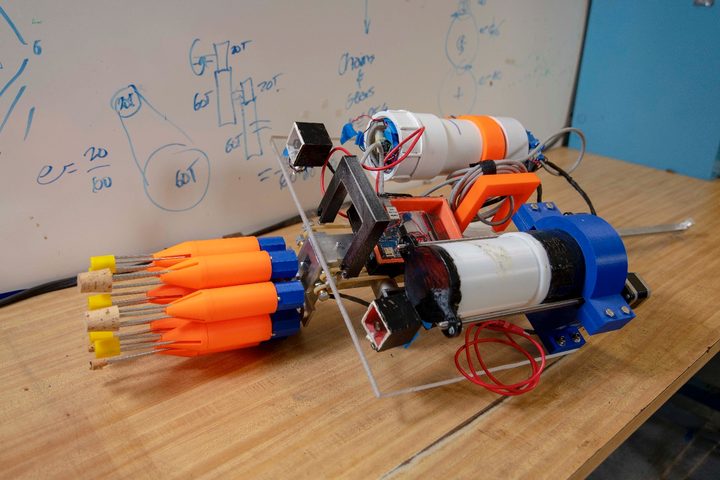
The robot developed at WPI consists of a computer vision system and lionfish harvesting tech. The computer vision system uses a TensorFlow neural network to recognize lionfish.
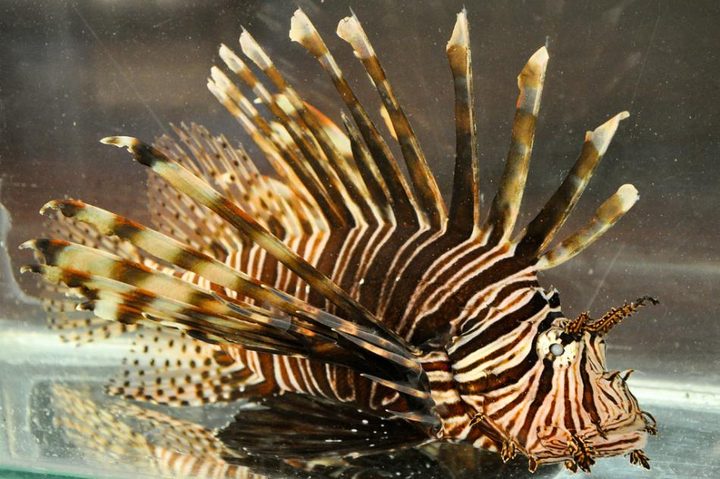
Image used with permission by copyright holder

“The prototype harvesting system has a single spear shaft and a revolving piece that holds eight spear tips,” Craig Putnam, senior instructor in Computer Science and Associate Director of WPI’s Robotics Engineering Program, told Digital Trends. “The spear itself is cocked using a ratchet mechanism that stretches elastic bands. The next available spear tip is then rotated into position in front of the cocked spear, ready for the next shot. After each shot, the spear is re-cocked and the next tip is rotated into position. The spear tips themselves float: They stay in the speared fish and are buoyant enough so as to float the tip and the lionfish that was speared up to the surface for collection.”

Although the technology has so far only been tested in the university’s pool, it could one day be used in the open ocean. It could be deployed to hunt autonomously, before returning to the surface when it needs to be recharged or after a set period of time. The robots could potentially be privately owned and used as a fishing tool to harvest fish, which may then be sold. (Lionfish happen to taste great!)

“This year’s MQP (major qualifying project) will primarily be focusing on navigation and path planning,” Putnam continued. “The robot ideally should be able to autonomously descend to an appropriate depth, plot a search pattern, and start searching for Lionfish. It should be able to do all this without running into the reef or targeting anything but lionfish. There is a lot of work to be done, but these are all solvable problems.”


Luke Dormehl
I'm a UK-based tech writer covering Cool Tech at Digital Trends. I've also written for Fast Company, Wired, the Guardian…
AI agent reportedly carried out an entire ransomware attack on its own
AI didn't just write malware. It apparently clocked in for work.
Cybersecurity

Cybersecurity researchers say they have documented what could be the first ransomware attack carried out almost entirely by an autonomous AI agent, marking a significant shift in how cyberattacks could be conducted in the future. According to cloud security firm Sysdig, they have uncovered a ransomware operation dubbed JadePuffer that appears to have relied on a large language model (LLM) agent to perform nearly every stage of the attack without continuous human intervention.

If confirmed, the incident suggests AI is moving beyond writing malicious code and into actively planning, adapting, and executing cyberattacks in real time.

Read more
The Washington Post predicted how tech will advance 50 years ago and the success rate is humbling
The Washington Post predicted 2026 tech in 1976. It got a lot right.
Representative Image

Fifty years ago, when floppy disks were cutting-edge and the personal computer revolution had barely begun, The Washington Post attempted a remarkably ambitious exercise: predict what life in 2026 would look like. Some of those predictions now read like science fiction. Others feel surprisingly ordinary because they have become part of everyday life.

In a retrospective published for America's 250th anniversary, the newspaper revisited science editor Thomas O'Toole's 1976 article Inventing the Future, comparing its forecasts with today's technological reality. The results reveal that while predicting exact timelines is nearly impossible, identifying long-term scientific trends can be remarkably accurate.

Read more
Australian government warns doctors over AI scribing tools as privacy and safety concerns grow
AI medical scribes face regulatory scrutiny in Australia amid safety concerns
Representative Image

The Australian government is urging healthcare professionals to exercise caution when using AI-powered medical scribing tools, as regulators examine whether stronger safeguards are needed around one of healthcare's fastest-growing technologies, according to a report by The Guardian.

AI scribes have rapidly gained popularity by recording, transcribing, and summarising doctor-patient conversations into clinical notes, reducing the administrative burden on healthcare workers. However, government officials now warn that the technology's rapid adoption has outpaced oversight, raising questions around patient privacy, informed consent, and the accuracy of medical records.

Read more