  1. Home
  2. Emerging Tech
  3. News

This awesome robot patrols the Atlantic Ocean, sucks up invasive lionfish like a vacuum

Add as a preferred source on Google

Off the eastern coasts of the United States and in seas throughout the Caribbean, a beautiful but destructive creature creeps along, disrupting every habitat it inhabits. The lionfish is a relatively new resident in the Atlantic, likely having been released by fish hobbyists about 30 years ago. But the invasive species quickly spread and now occupy waters as far north as Rhode Island and as far south as Panama.

“The problem with the lionfish is it’s like Darwin’s nightmare,” marine biologist Oliver Steeds told PBS NewsHour last August. With vicious spines and an appetite to match, lionfish have no natural predators in the Atlantic so they easily take over. And, once they do, they’re practically impossible to control. Steeds is the mission direction of Nekton, the organization behind Robotics in the Service of Environment (RSE) a nonprofit that’s developing a lionfish exterminator.

Recommended Videos

After months in development, RSE has now launched a Kickstarter campaign to help fund its Guardian LF1 robot and its fight against the lionfish.
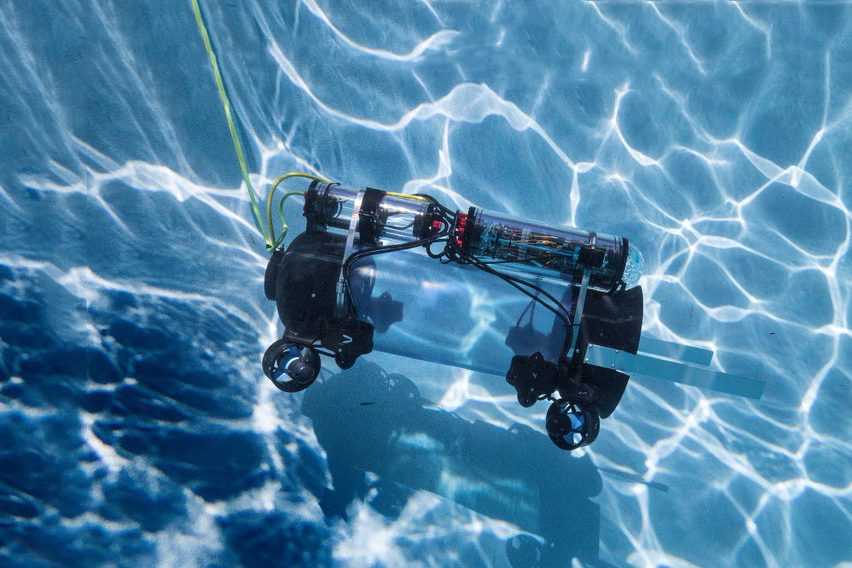
ATYCBY 4-23-2017
Guardian LF1 – Lionfish catching robot Image used with permission by copyright holder

The Guardian is a tethered robot made up of eight thrusters that allow it to perform a number of complex maneuvers while remaining stable in undersea currents. Two rods at the front of the device are designed to administer a low, controlled voltage that temporarily stuns the fish while jets of water suck the prey into a holding tube. Once collected from the tube, the lionfish can be culled and used for food — apparently they’re delicious.

In fact, a number of projects have been encouraging people to hunt and eat lionfish for years. Florida even had an app for that. The problem is, while spear fisherman can get to them in the shallows, most lionfish live at depths of around 200 feet, which is too deep for the average diver. RSE’s Guardian solution is designed specifically to get to these depths.

In supporting the project, backers can get rewards that include a lionfish fishing permit ($10), a lionfish cookbook ($25), and an “Eat ’em to Beat ’em” sweatshirt ($65).


Dyllan Furness
Former Contributor
Dyllan Furness is a freelance writer from Florida. He covers strange science and emerging tech for Digital Trends, focusing…
AI agent reportedly carried out an entire ransomware attack on its own
AI didn't just write malware. It apparently clocked in for work.
Cybersecurity

Cybersecurity researchers say they have documented what could be the first ransomware attack carried out almost entirely by an autonomous AI agent, marking a significant shift in how cyberattacks could be conducted in the future. According to cloud security firm Sysdig, they have uncovered a ransomware operation dubbed JadePuffer that appears to have relied on a large language model (LLM) agent to perform nearly every stage of the attack without continuous human intervention.

If confirmed, the incident suggests AI is moving beyond writing malicious code and into actively planning, adapting, and executing cyberattacks in real time.

Read more
The Washington Post predicted how tech will advance 50 years ago and the success rate is humbling
The Washington Post predicted 2026 tech in 1976. It got a lot right.
Representative Image

Fifty years ago, when floppy disks were cutting-edge and the personal computer revolution had barely begun, The Washington Post attempted a remarkably ambitious exercise: predict what life in 2026 would look like. Some of those predictions now read like science fiction. Others feel surprisingly ordinary because they have become part of everyday life.

In a retrospective published for America's 250th anniversary, the newspaper revisited science editor Thomas O'Toole's 1976 article Inventing the Future, comparing its forecasts with today's technological reality. The results reveal that while predicting exact timelines is nearly impossible, identifying long-term scientific trends can be remarkably accurate.

Read more
Australian government warns doctors over AI scribing tools as privacy and safety concerns grow
AI medical scribes face regulatory scrutiny in Australia amid safety concerns
Representative Image

The Australian government is urging healthcare professionals to exercise caution when using AI-powered medical scribing tools, as regulators examine whether stronger safeguards are needed around one of healthcare's fastest-growing technologies, according to a report by The Guardian.

AI scribes have rapidly gained popularity by recording, transcribing, and summarising doctor-patient conversations into clinical notes, reducing the administrative burden on healthcare workers. However, government officials now warn that the technology's rapid adoption has outpaced oversight, raising questions around patient privacy, informed consent, and the accuracy of medical records.

Read more