  1. Home
  2. Emerging Tech
  3. Outdoors
  4. News

Autonomous package-delivery robots are ready to steal your mailman’s job

Add as a preferred source on Google
Starship Technologies

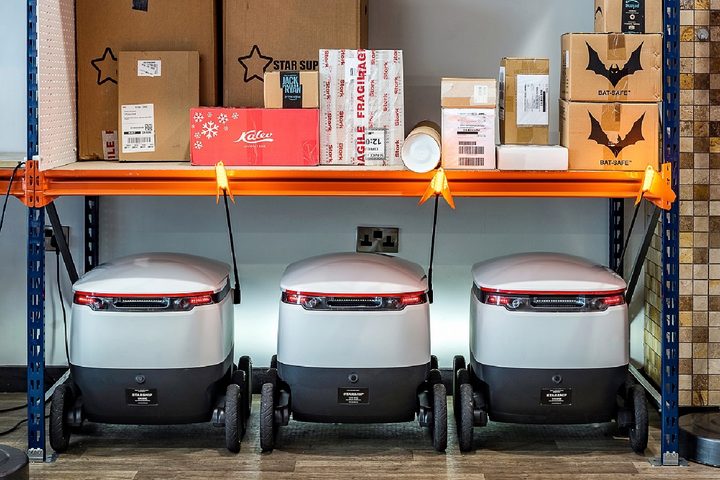
The machines are here, and they’re going door to door in a neighborhood near you. Well, that’s if you live in the Bay Area in California or the city of Milton Keynes in the U.K. But don’t worry, this isn’t some Terminator-style robot army ready and willing to enslave humanity; these robots simply want to deliver packages for you.

Autonomous delivery robot manufacturer Starship Technologies claims this represents the world’s first commercial rollout of autonomous package-delivery robots in the world. An army of hundreds of wheeled delivery bots are due to commence delivering packages directly to customers’ front doors.

Recommended Videos

What makes Starship Technologies’ delivery robots interesting isn’t simply the fact that they make us feel like we’re living in the future. They also promise to cut down on package theft in cases where packages are left unattended. That’s because customers can use an app to say when and where they want their package delivered, and then keep an eye on the delivery robot’s progress in real time. Customers will pay as little as $10 per month for the service.

“We’re excited that, thanks to our technology, local communities across the globe will never miss a home delivery again,” said Lex Bayer, Starship’s CEO, in a statement. “Today, more than ever, people lead busy and diverse lives. The hassle of needing to rearrange your life for a delivery will become a thing of the past. No more having to switch your working-from-home day, reschedule meetings, visit a locker, drive to a post office, or contact a courier — all because of a missed delivery. Starship gets packages to consumers when and where they want them. This is the only service of its kind available in the world today, and it works around your lifestyle.”

Starship Robot Delivery in Sunnyvale, CA

This isn’t the first time Starship’s autonomous delivery bots will take to the street. The robots are already being used for deliveries in places like college campuses. Earlier this year, the company raised an additional $25 million, which its co-founder told Digital Trends would go toward expanding its fleet to more than 1,000 robots. The newly announced delivery service in San Francisco will commence before the end of the year; it has already kicked off in the U.K.

Although Starship is certainly on the cutting edge when it comes to this kind of technology, it’s not the only startup working in this space. In both Germany and Norway, the national postal services are busy introducing their own delivery robots, which will be delivering mail and packages to customers in the very near future.


Luke Dormehl
I'm a UK-based tech writer covering Cool Tech at Digital Trends. I've also written for Fast Company, Wired, the Guardian…
Yet another study says AI is bad for elections, and the rabbit hole gets worse
AI may be an election bomb waiting for someone to light the fuse
Voters cast their ballots on Election Day

Another election, another study has concluded that asking an AI chatbot for political guidance is a spectacularly bad idea. Research conducted during Hungary’s 2026 parliamentary election found that ChatGPT and Google Gemini offered not just inaccurate but also inconsistent and unreliable voting advice. The chatbots misclassified voter profiles, overlooked relevant parties, recommended parties absent from the ballot, and sometimes produced materially different answers when given the same information repeatedly.

AI keeps failing the voter test

Read more
Samsung’s humanoid robot ambitions are real, but factories come first
Samsung’s new robotics division has humanoids in its sights, although its immediate business is far more practical factory automation
Robot Touch Human Finger

Samsung wants a place in the humanoid race, but its new robotics push begins with machines built for factories rather than homes.

The CEO-led RX robotics division will initially focus on manufacturing robots. Samsung has separately identified humanoids as a priority, although it hasn’t announced a commercial model or explained where one fits into the division’s immediate plans.

Read more
The future of AI may depend on this one behind-the-scenes change
Running Claude on Android.

Whenever a new AI model arrives, it's easy to get caught up in the bells and whistles. We talk about how much smarter it is, how quickly it answers questions, or how realistic its images have become. But here's the thing: none of that matters much if the AI can't reliably work with the apps and services people use every day.

That's why an upcoming update to the Model Context Protocol (MCP) caught my attention. It isn't a new chatbot or a fancy AI model. In fact, most people will never even know it's happening. But it could quietly make the AI ecosystem a lot healthier. If you've never heard of MCP before, don't worry. Think of it as a shared language that lets AI assistants safely talk to apps like Gmail, Slack, calendars, databases, and countless other services. Instead of every company inventing its own way to make those connections, MCP gives everyone a common rulebook.

Read more