  1. Home
  2. Emerging Tech
  3. Cars
  4. News

Australian ‘virtual fence’ halves roadkill on one deadly stretch of road

Add as a preferred source on Google
Courtesy of the Save the Tasmanian Devil Program

Anyone who has ever driven along a stretch of road outside of a built-up area will have seen the grisly evidence of animals killed by passing traffic. In the U.S., for example, an estimated 1 million vertebrates are run over each day, a rate of approximately one every 11.5 seconds. These collisions cause a threat to both animals (obviously), but also to drivers. Two hundred human deaths take place annuals from vehicle-wildlife collisions, in addition to the numerous injuries caused.

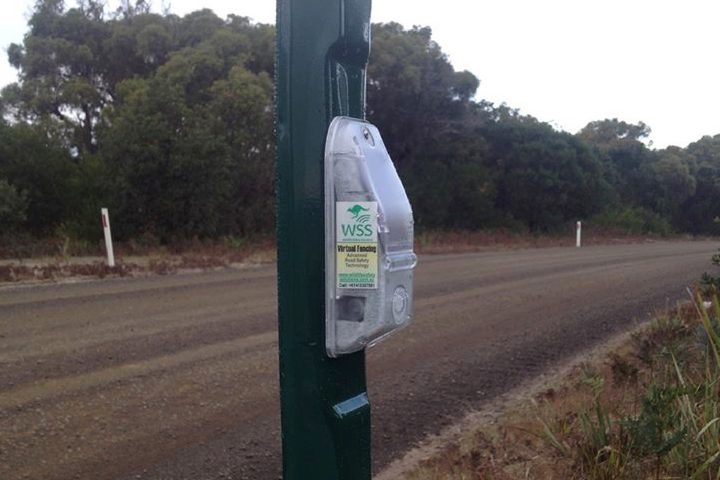
In the Australian state of Tasmania — home to one of the highest roadkill rates in the world — researchers are exploring a new technological solution to this problem. It involves a “virtual fence” system, consisting of alarm units mounted on posts along the side of a three-mile stretch of road. These alarm units, around 80 feet apart, emit sounds and flashing lights to warn animals when a car is approaching. These do not distract drivers because the sound and light are directed to the edge of the road. They are also only loud and bright enough to be noticeable to wildlife in the immediate vicinity.

Recommended Videos

“The virtual fence technology involves small devices, approximately the size of a mobile phone, mounted on a pole on the side of the road which are triggered by car headlights when they hit a sensor in the device,” Samantha Fox, the researcher who led the project, told Digital Trends. “This sets off blue and yellow flashing lights and a high pitched siren. These together warn local wildlife that a car is coming, and give the animal time to move away from the road.”

Over the course of a three-year trial, the technology has reduced roadkill on one particular road by a massive 50 percent. On this stretch of road alone, this has meant saving the lives of around 200 animals, ranging from wombats to possums.

Fox said that the fences compare favorably to the existing approaches to mitigating roadkill. These approaches have included signs, speed humps, and over and underpasses. All of these have problems, however. People become jaded with signage and start to ignore it. Speed humps, meanwhile, are unpopular with drivers, surprisingly expensive to install, and can come unstuck from the road over time. Over and underpasses fare better, but require considerable construction efforts and only target a certain area. Virtual fences, on the other hand, are cheaper than alternatives, easy to install, and can cover large stretches of road.

A paper describing the project was recently published in the journal Australian Mammalogy.

Luke Dormehl
I'm a UK-based tech writer covering Cool Tech at Digital Trends. I've also written for Fast Company, Wired, the Guardian…
Starlink V5 is here, and it’s lighter, smarter, and far more efficient
The next-generation satellite internet kit promises improved efficiency while maintaining high-speed connectivity.
Starlink V4 vs V5

Not every hardware upgrade needs to be about speed. With Starlink V5, SpaceX is betting that a lighter design and lower power consumption matter just as much. The company has officially introduced its next-generation Starlink V5 kit, featuring a smaller and lighter design with significantly improved power efficiency.

Smaller, lighter, and far more efficient

Read more
Frontier joins the Starlink club with high-speed in-flight internet
The carrier plans to roll out SpaceX's satellite-powered Wi-Fi across its fleet starting in 2027.
Frontier Starlink partnership featured

If there's one thing budget airlines aren't exactly known for, it's great onboard Wi-Fi. In Frontier Airlines' case, it hasn't offered in-flight internet at all. That's about to change. Frontier Airlines has announced a partnership with SpaceX's Starlink to bring high-speed, low-latency internet across its fleet. Installations will begin in early 2027, making Frontier the first ultra-low-cost carrier in the United States to adopt Starlink's satellite-powered connectivity.

Streaming, browsing, and even gaming at 35,000 feet

Read more
OpenAI’s first hardware product sounds more like a companion than a speaker
The AI company is reportedly building a mobile home device that understands context and proactively helps users.
OpenAI press image

For months, rumors have suggested that OpenAI's first hardware product could be a wearable AI device, or perhaps even the beginning of its long-term smartphone ambitions. As it turns out, the company's first gadget may be something far simpler, yet arguably far more ambitious. It will help control smart-home appliances, play media, answer questions, respond to messages, and tap into the range of capabilities offered by OpenAI's ChatGPT, according to people familiar with the matter.

OpenAI's first AI device could end up being a speaker, following plenty of hype that the company is actually working on a wearable AI device and might even launch a smartphone down the road. According to a Bloomberg report, the speaker will serve as a human-like AI companion that will integrate directly with the smart home ecosystem.

Read more