1. Home
  2. Emerging Tech
  3. News

Brightest quasar ever seen discovered by Hubble, may be star-producing machine

Add as a preferred source on Google

The brightest quasar even seen in the early Universe has been observed with the Hubble Space Telescope. The quasar was identified using a technique called strong gravitational lensing, and it gives a glimpse into how galaxies were born when the Universe was young.

A quasar is a very bright galactic nucleus, a type of supermassive black hole which lies at the center of a galaxy and which is surrounded by a gaseous accretion disk. When the gases in the accretion disk fall towards the black hole because of its gravity, they are heated to very high temperatures and release enormous amounts of energy as visible light and other wavelengths.

Recommended Videos

The quasar identified by Hubble is called J043947.08+163415.7 and is giving off huge amounts of light. It is as bright as 600 trillion Suns and the supermassive black hole at its center is several hundred million times as massive as our Sun. Scientists were surprised by finding such a bright quasar: “That’s something we have been looking for for a long time,” lead author Xiaohui Fan of the University of Arizona said in a statement. “We don’t expect to find many quasars brighter than that in the whole observable Universe!”
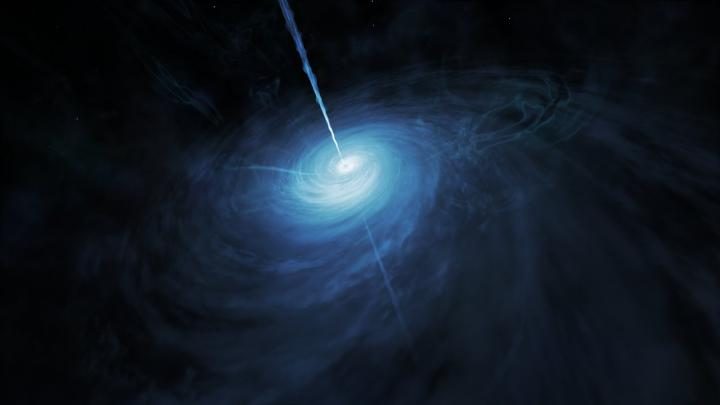
This artist’s impression shows how J043947.08+163415.7, a very distant quasar powered by a supermassive black hole, may look close up. This object is by far the brightest quasar yet discovered in the early Universe. ESA/Hubble, NASA, M. Kornmesser

The quasar was identified using a technique called gravitational lensing, which was possible as there is a dim galaxy which is located almost exactly between Earth and the quasar. The gravity of this dim galaxy bends the light emitted by the quasar, making it appear three times larger and fifty times as bright as it would be normally, allowing Hubble to detect it. You can see how the mass of a galaxy in between Earth and an object of observation creates the lensing effect in this video:

Gravitational lensing of distant quasar

The findings are important because they suggest that quasars may produce stars at a much faster rate than previously believed. This particular quasar may be producing up to an incredible 10,000 stars per year, although it is hard to be precise because of the effect of the gravitational lensing. “Its properties and its distance make it a prime candidate to investigate the evolution of distant quasars and the role supermassive black holes in their centers had on star formation,” co-author Fabian Walter of the Max Planck Institute for Astronomy, Germany, explained in a statement.


Georgina Torbet
Georgina has been the space writer at Digital Trends space writer for six years, covering human space exploration, planetary…
Yet another study says AI is bad for elections, and the rabbit hole gets worse
AI may be an election bomb waiting for someone to light the fuse
Voters cast their ballots on Election Day

Another election, another study has concluded that asking an AI chatbot for political guidance is a spectacularly bad idea. Research conducted during Hungary’s 2026 parliamentary election found that ChatGPT and Google Gemini offered not just inaccurate but also inconsistent and unreliable voting advice. The chatbots misclassified voter profiles, overlooked relevant parties, recommended parties absent from the ballot, and sometimes produced materially different answers when given the same information repeatedly.

AI keeps failing the voter test

Read more
Samsung’s humanoid robot ambitions are real, but factories come first
Samsung’s new robotics division has humanoids in its sights, although its immediate business is far more practical factory automation
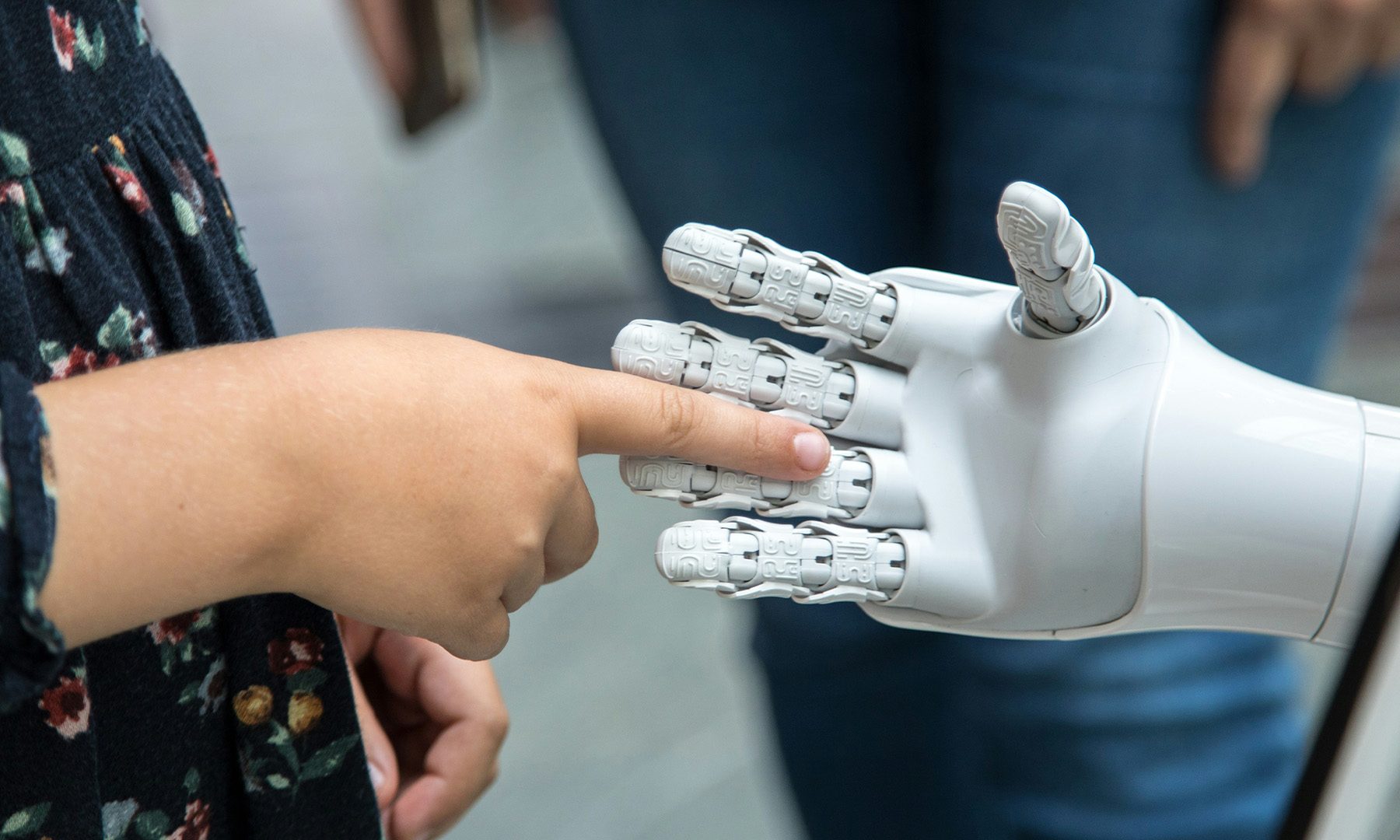
Robot Touch Human Finger

Samsung wants a place in the humanoid race, but its new robotics push begins with machines built for factories rather than homes.

The CEO-led RX robotics division will initially focus on manufacturing robots. Samsung has separately identified humanoids as a priority, although it hasn’t announced a commercial model or explained where one fits into the division’s immediate plans.

Read more
The future of AI may depend on this one behind-the-scenes change
Running Claude on Android.

Whenever a new AI model arrives, it's easy to get caught up in the bells and whistles. We talk about how much smarter it is, how quickly it answers questions, or how realistic its images have become. But here's the thing: none of that matters much if the AI can't reliably work with the apps and services people use every day.

That's why an upcoming update to the Model Context Protocol (MCP) caught my attention. It isn't a new chatbot or a fancy AI model. In fact, most people will never even know it's happening. But it could quietly make the AI ecosystem a lot healthier. If you've never heard of MCP before, don't worry. Think of it as a shared language that lets AI assistants safely talk to apps like Gmail, Slack, calendars, databases, and countless other services. Instead of every company inventing its own way to make those connections, MCP gives everyone a common rulebook.

Read more