1. Home
  2. Emerging Tech
  3. Health & Fitness
  4. News

Tiny medical microrobots can shape-shift to navigate through your insides

Add as a preferred source on Google
Smart microrobots that can adapt to their surroundings

Taking a note out of the playbook of the classic 1966 sci-fi movie Fantastic Voyage, researchers from the Swiss Federal Institute of Technology Lausanne (EPFL) and ETH Zurich in Switzerland think the best way to deal with problems in the human body is to inject patients with tiny intelligent entities that can swim, crawl, and otherwise navigate through the body doing whatever’s required of them.

Recommended Videos

With that in mind, they have developed adaptable microrobots that are able to change shape to get around. The hope is that these origami-inspired shape-shifting robots could one day be used for performing surgery or deliveries drugs wherever required. While not the only example of tiny medical robots we’ve covered, this nonetheless sounds like one of the most exciting.

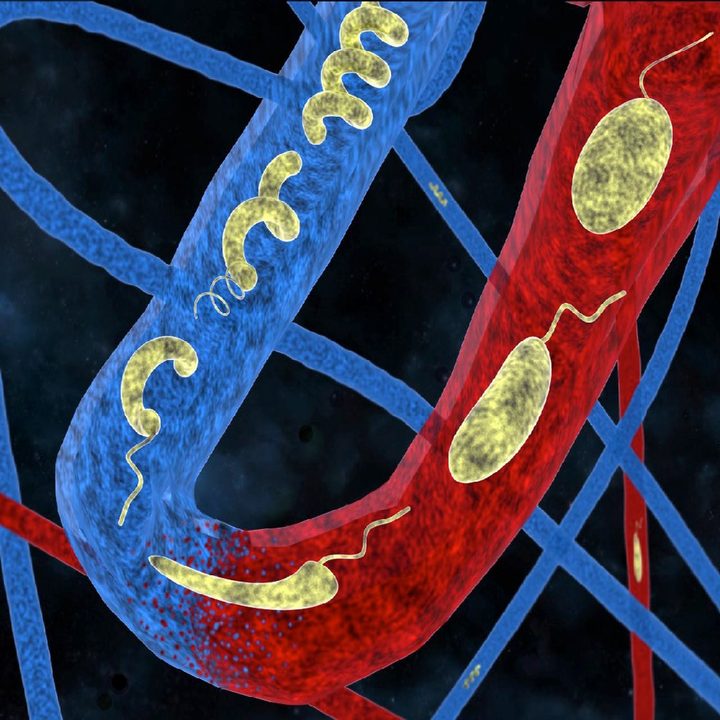
“We developed tiny — smaller than 1 mm — microrobots that are flexible and can change their shape based on changing environmental conditions,” Bradley Nelson,pProfessor of Robotics and Intelligent Systems at ETH Zurich, told Digital Trends. “The microrobots are made of a polymer with biocompatible magnetic particles embedded in them so that, when exposed to an externally generated magnetic field, [they are able to] move through their environment.”
EPFL

The microrobots are modeled on bacteria’s ability to show what the researchers term as “remarkable plasticity” in response to changing physical and chemical conditions. It’s therefore another example of nature-inspired biomimicry in action, albeit this time on a much smaller scale than we’re usually used to seeing. As an illustration of how the robots are able to adapt, they utilize a body shaped like a tube and a flat tail for paddling when moving through liquid with a low level of viscosity. Meanwhile, a helix shape is more appropriate for moving through a thicker, stickier, more viscous solution. The robots can be controlled either using an electromagnetic field or, autonomously, by moving through cavities based on fluid flow.

“We are [currently] integrating these microrobots with small catheters so that they can be released near disease sites,” Nelson said. “Some aspect of this technology will be commercialized in the future, but there is still work to do before viable business plans can be realized.”

A paper describing the work, titled “Adaptive locomotion of artificial microswimmers,” was recently published in the journal Science Advances.

Luke Dormehl
I'm a UK-based tech writer covering Cool Tech at Digital Trends. I've also written for Fast Company, Wired, the Guardian…
Claude can now join your Slack channels and work alongside your team
Laptop running Claude Fable

For years, AI assistants have been siloed. You open ChatGPT, Claude, Gemini, or Copilot, type a prompt, get an answer, and move on. Anthropic's new Claude Tag feature takes a different approach. Instead of making employees jump into a separate AI chat every time they need help, it brings Claude directly to where many teams already spend their day: Slack.

Add Claude to a channel, grant it access to needed tools, and tag @Claude for help — whether analyzing data, writing reports, reviewing code, or investigating incidents. But Claude Tag isn't just another chatbot integration. Its key differentiator is that Anthropic positions it as a digital coworker for your team, enabling seamless collaboration where multiple users can jointly interact with the same AI within their work environment.

Read more
Getty Images accused AI of wholesale theft. It’s now an official ChatGPT image partner.
Advertisement, Shop, Clothing

The AI industry's most fascinating stories often come from unlikely alliances, and this is certainly one of them. Getty Images, a company that has spent years raising concerns about how AI models are trained and how creative work is used, is now officially partnering with OpenAI.

The new agreement will allow Getty Images' licensed content to appear across ChatGPT's search and discovery experiences. That means users may begin seeing Getty's professionally licensed photos and visual assets integrated into ChatGPT responses, adding more visual context to searches and AI-generated answers. Getty says the goal is to make AI-powered search more useful and trustworthy by relying on high-quality, licensed content rather than the murky sourcing practices that have sparked countless debates across the AI industry.

Read more
Timekettle’s new X1 Meeting Hub does real-time translation for 50 people and fits in your pocket
Fifty participants, five languages, one 199-gram hub, and no booth required.
Electronics, Screen, Computer Hardware

Professional conference interpretation setups are notoriously painful. Dedicated booths, trained interpreters, bulky hardware, and a bill at the end of every month that makes you rethink whether the meeting was even required in the first place. 

Timekettle wants to collapse all of that into a single hub that weighs 199 grams (less than modern flagship smartphones). The company just launched the X1 Meeting Interpreter Hub. 

Read more