1. Home
  2. Emerging Tech
  3. News

Groundbreaking new technique can turn plastic waste into energy-dense fuel

Add as a preferred source on Google
Chemical Conversion of Plastic Waste into Fuel

The world has a plastic problem. According to the United Nations, upward of 8 million tons of plastics makes its way into the oceans each year. Exactly how you get rid of this has been the subject of plenty of investigation. Efforts have focused on everything from reducing the use of plastics in packaging to using drones to help spot plastic-clogged waterways from the sky. Researchers from Purdue University have a different idea, however: They want to turn it into fuel.

Recommended Videos

To achieve this, they have pioneered a new chemical conversion process, capable of converting more than 90 percent of polyolefin waste — the polymer behind widely used plastic polyethylene — into high-quality gasoline or diesel-like fuel. The results could be a game-changer.

“We have developed a method to convert polyolefin waste, which include Type 2 (HDPE), Type 4 (LDPE and LLDPE), and Type 5 (PP), into various useful products,” Nien-Hwa Linda Wang, a professor in Purdue’s Davidson School of Chemical Engineering, told Digital Trends. “The conversion is achieved using subcritical or supercritical water, which can convert plastic waste into oil, fuels, or gas, depending on the processing conditions. Some impurities in the plastic waste is converted into oil or extracted into the processing water. Both conversion and extraction are achieved in the same process.”
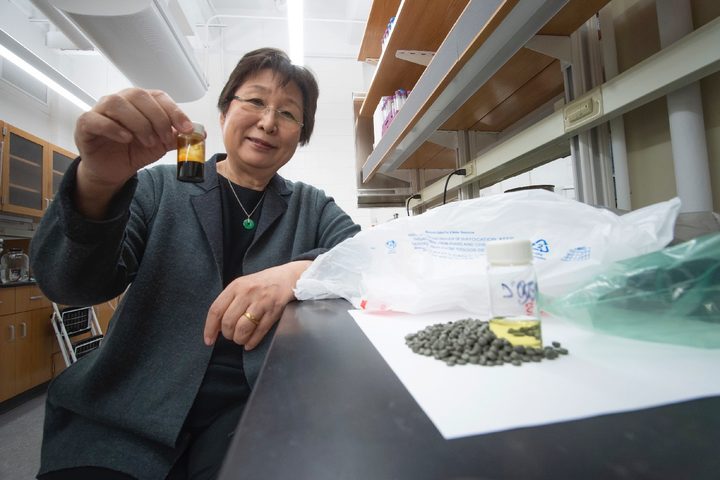
Image used with permission by copyright holder

To carry out their process, the researchers heated water up to extremely high temperatures of around 850 degrees Fahrenheit under high pressure. When the purified plastic waste was added to the supercritical water, it transformed into oil after a process lasting upward of an hour.

Wang said that she sees no reason why this laboratory demonstration should not be turned into an economical large-scale process — although there’s still more work to be done.

“We have [had] great success for converting polyolefin waste,” Wang said. “Further research is still needed to produce higher quality products with lower processing costs for the polyolefin waste. We have not yet had any research funding to test this technology for converting other types of plastic waste or for converting complex waste mixtures. We hope to raise funding to test this technology at a pilot scale. Successful results at pilot scale will motivate industry to commercialize this technology.”

A paper describing the work was recently published in the journal Sustainable Chemistry and Engineering.

Luke Dormehl
I'm a UK-based tech writer covering Cool Tech at Digital Trends. I've also written for Fast Company, Wired, the Guardian…
Starlink V5 is here, and it’s lighter, smarter, and far more efficient
The next-generation satellite internet kit promises improved efficiency while maintaining high-speed connectivity.
Starlink V4 vs V5

Not every hardware upgrade needs to be about speed. With Starlink V5, SpaceX is betting that a lighter design and lower power consumption matter just as much. The company has officially introduced its next-generation Starlink V5 kit, featuring a smaller and lighter design with significantly improved power efficiency.

Smaller, lighter, and far more efficient

Read more
Frontier joins the Starlink club with high-speed in-flight internet
The carrier plans to roll out SpaceX's satellite-powered Wi-Fi across its fleet starting in 2027.
Frontier Starlink partnership featured

If there's one thing budget airlines aren't exactly known for, it's great onboard Wi-Fi. In Frontier Airlines' case, it hasn't offered in-flight internet at all. That's about to change. Frontier Airlines has announced a partnership with SpaceX's Starlink to bring high-speed, low-latency internet across its fleet. Installations will begin in early 2027, making Frontier the first ultra-low-cost carrier in the United States to adopt Starlink's satellite-powered connectivity.

Streaming, browsing, and even gaming at 35,000 feet

Read more
OpenAI’s first hardware product sounds more like a companion than a speaker
The AI company is reportedly building a mobile home device that understands context and proactively helps users.
OpenAI press image

For months, rumors have suggested that OpenAI's first hardware product could be a wearable AI device, or perhaps even the beginning of its long-term smartphone ambitions. As it turns out, the company's first gadget may be something far simpler, yet arguably far more ambitious. It will help control smart-home appliances, play media, answer questions, respond to messages, and tap into the range of capabilities offered by OpenAI's ChatGPT, according to people familiar with the matter.

OpenAI's first AI device could end up being a speaker, following plenty of hype that the company is actually working on a wearable AI device and might even launch a smartphone down the road. According to a Bloomberg report, the speaker will serve as a human-like AI companion that will integrate directly with the smart home ecosystem.

Read more