The idea of an artificial intelligence that watches from the skies, seeking out wrongdoing, sounds all a bit sci-fi dystopia. Actually, it describes a new deep learning A.I. being developed to help detect farms that are illegally polluting waterways.
“According to the [Environmental Protection Agency], agriculture is the leading contributor of pollutants to the waterways of the United States,” Daniel E. Ho, co-lead author on the project, told Digital Trends. “Intensive livestock agriculture facilities — known in the United States as Concentrated Animal Feeding Operations (CAFOs) — are responsible for roughly 40% of U.S. livestock production. But environmental monitoring and enforcement has been hampered by the lack of systematic knowledge about these facilities. Some environmental interest groups and one state authority hence resorted to manually scanning satellite images to identify CAFO locations, a process that can take over three years for a single state. Our research addresses this problem by training a machine learning model to recognize CAFO facilities from high-resolution satellite imagery.”above
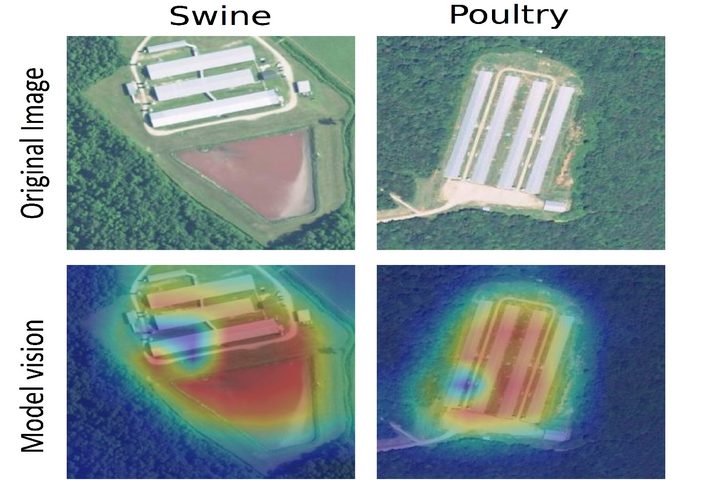
The data used to train the neural network was a combination of census data from environmental interest groups in North Carolina and publicly available satellite images. The A.I. was trained to identify features like outdoor manure pits, which can suggest possible pollutants. In the future, it may be further developed to detect actual pollution of waterways.
Ho isn’t necessarily who you would expect to be behind an initiative like this. A legal scholar, he is a law and political science professor at Stanford University. So how did he come to be involved?
“I came across the topic after teaching a module on livestock production for a class at Stanford,” he explained. “We covered largely the legal questions about how CAFOs are regulated under the Clean Water Act, but many [were] surprised by the basic lack of knowledge about CAFOs. Our research team then began to examine whether there were ways to leverage the major advances in image recognition to solve this problem.”
Development of the system was done in collaboration with research assistants to validate the training data, along with Stanford computer science students who brainstormed relevant computer vision techniques for searching for facilities.
“We view the current version very much as a proof of concept, but we believe such a system could be deployed in partnership with environmental interest groups or regulatory bodies with a bit more engineering effort,” Cassandra Handan-Nader, a graduate student who worked on the project, told Digital Trends. “The system is not intended to be fully autonomous. To the contrary, we envision models like ours playing a supporting role to humans engaging in environmental monitoring tasks.”
A paper describing the work was recently published in the journal Nature Sustainability.