1. Home
  2. Smart Home
  3. News

Alexa, Google, Siri put their bilingual skills to the test in translation battle

Add as a preferred source on Google

Your smart assistant can do more than turn the lights on and off and set appointments in your calendar. It can also do it in a host of other languages. The translation functionality is most often used to find out how to say specific phrases in other languages, but have you ever wondered about how accurate your smart assistant actually is? One Hour Translation, one of the largest online translation agencies in the world, put together a list of 60 of the most well-known phrases in the world and compared the translating capability of the Amazon Echo, the Google Home, and Apple’s Siri. They translated the phrases from English into French, Spanish, Chinese, and German.

The results are surprising. Google Home beat out the competition in translating all languages except Chinese, a victory that went to the Amazon Echo. The smart assistant translations were given to professional translators and ranked on a score of 1 to 6. The graph below shows the average translation score of each device.
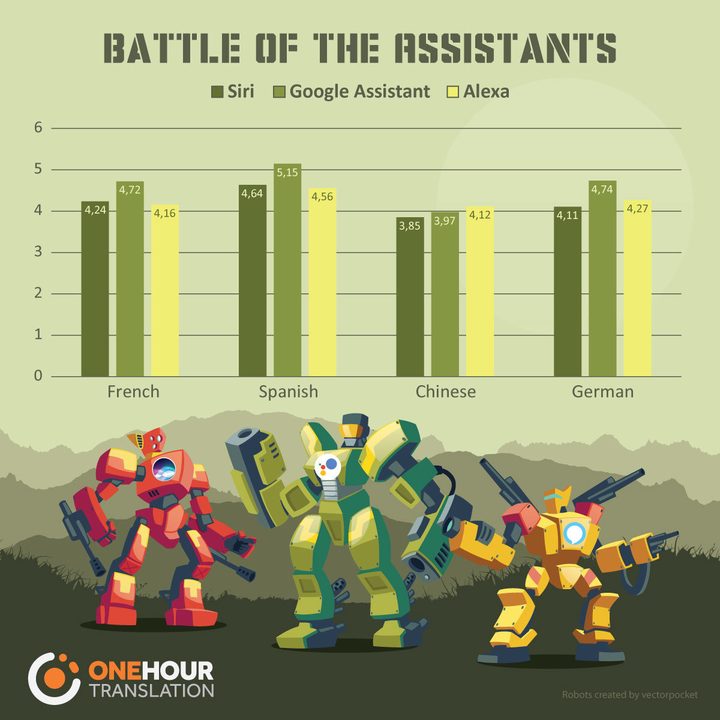
Image used with permission by copyright holder

The Google Home scored an average of 4.72 in French, while Alexa scored 4.16 and Siri scored 4.24. For Spanish, Google Home scored 5.15, while Alexa scored 4.56 and Siri scored 4.64. The Google Home only averaged 3.97 for Chinese, while Alexa scored 4.12 and Siri scored 3.85. Finally, Google Home ranked the highest for German with a score of 4.74, with Alexa coming in at 4.27 and Siri at 4.11.

Recommended Videos

The phrases included famous movie quotes like The Godfather’s “I’m going to make him an offer he can’t refuse” and lines from well-known speeches like Neil Armstrong’s “One small step for man, one giant leap for mankind.” The variance in the translations is based on the type of NMT, or neural machine translation technology, that each smart device uses. Alexa uses Microsoft Translator for its automatic translations, while Google Home makes use of Google’s proprietary technology.

Automatic translation is still a tricky business due to the incredible number of potential meanings a given phrase has. No sentence is a direct translation — variables like context, dialect, and other factors have to be taken into account. However, One Hour Translation is working with multiple NMT providers to improve the efficacy of automatic translations in the future.

Patrick Hearn
Former Technology Writer
Patrick has written about tech for more than 15 years and isn't slowing down anytime soon. With previous clients ranging from…
Apple’s long-delayed smart home plans may finally start to take shape this fall
Bloomberg says Apple's long-awaited home hub, along with updated Apple TV and HomePod mini models, could roll out over the coming months.
An Apple HomePod 2023 on a media stand.

Apple's long-rumored smart home ambitions may finally be ready for prime time. According to Bloomberg's Mark Gurman, Apple is preparing to launch three new home products over the coming months, including a Siri AI-powered smart home hub, a refreshed Apple TV 4K, and an updated HomePod mini. The report pegs the Apple TV and HomePod mini for release this fall, while the new smart home hub is expected to arrive sometime "between October and early next year".

The wait for Apple's AI-powered home may be over soon

Read more
Top Smart Home Upgrades Worth Making Before Your Summer Break
From outdoor monitoring to smarter front-door security, these EZVIZ devices combine smart protection with daily convenience
Person, Security, Electronics

Summer often brings a welcome change of routine for homeowners across Europe. Family holidays, weekend getaways, and longer days spent outdoors mean more time away and fewer opportunities to stay connected to what's happening back at the property. While it's a season for slowing down and enjoying the warmer months, everyday responsibilities don't simply pause. Deliveries still arrive, visitors may stop by unexpectedly, and trusted family members, cleaners, or pet sitters may occasionally need access while you're away.

Modern smart home technology makes those situations easier to manage. Today's connected devices can do far more than record footage or send motion alerts. They can help homeowners monitor outdoor spaces around the clock, stay informed about important activity, communicate with visitors remotely, and manage entry without needing to be physically present. Instead of constantly checking in or wondering whether everything is running smoothly back home, the right setup can provide greater visibility, convenience, and peace of mind throughout the season.

Read more
EZVIZ Sets a New Benchmark for Battery Powered Home Surveillance
Because every property deserves protection without compromise
Person, Security, Tape

Battery-powered smart cameras have become one of the fastest-growing categories in home monitoring. Once valued primarily for their seamless installation, today's models combine advanced visual technology, AI-powered intelligence, and dependable long-term performance that rivals many traditional wired systems. As innovations such as Always On Video 2.0 and solar charging continue to improve everyday usability, battery cameras are becoming the preferred choice for homeowners seeking flexible, comprehensive outdoor protection.

This shift has also raised expectations. Modern users want more than clear video. They expect smart detection, reliable monitoring, seamless smart home integration, and solutions that adapt to different property sizes and lifestyles. As one of the world's leading smart home camera brands, EZVIZ has responded by building one of the industry's most comprehensive portfolios of battery-powered cameras. The lineup is designed to serve every living situation, whether for renters or owners of apartments, condominiums, or villas. From accessible options for everyday monitoring to advanced multi-lens systems for larger and more demanding environments, the portfolio reflects a strong focus on innovation, user-centric design, and real-world needs.

Read more