
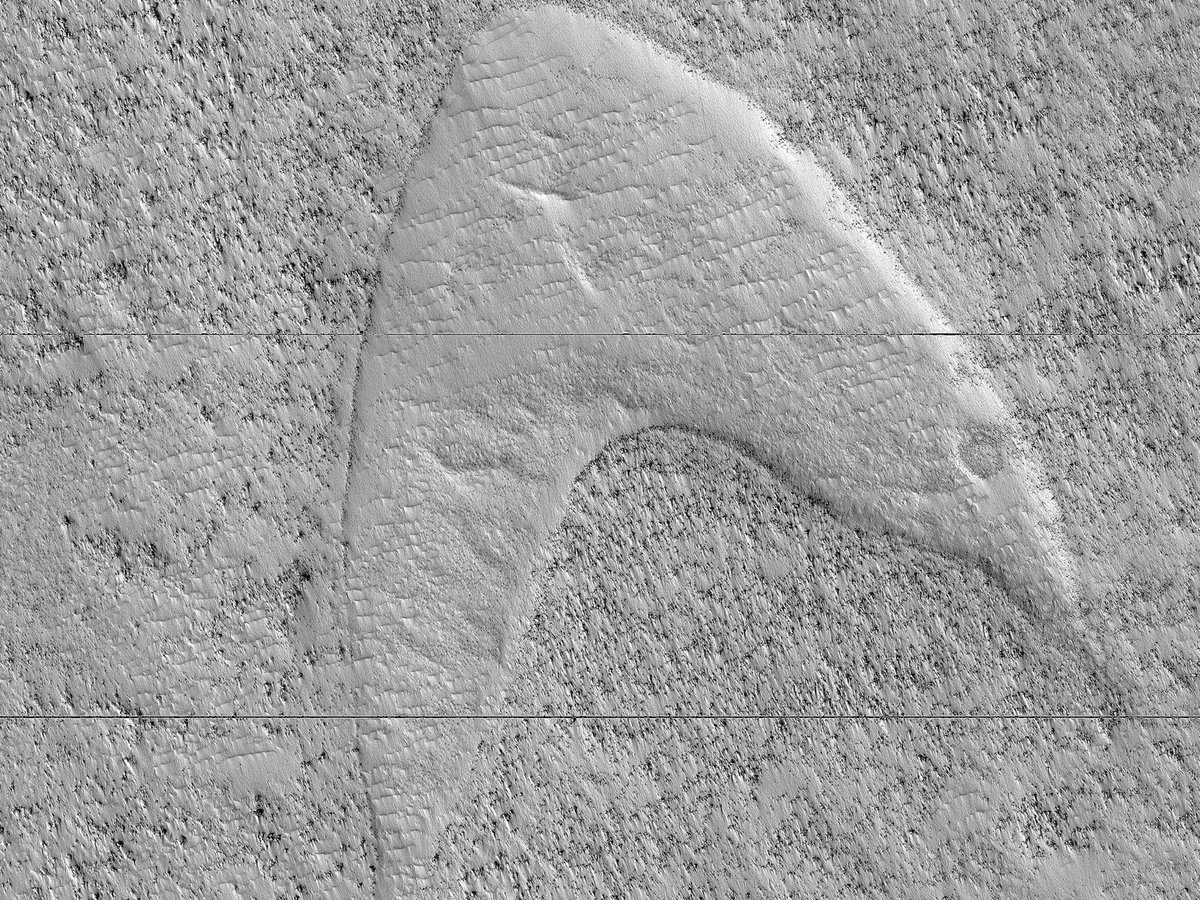
The Mars Reconnaissance Orbiter (MRO) has been boldly going to Mars, and now it has spotted something where no man has gone before: a structure on the planet’s surface which looks suspiciously like the Star Trek logo.
Apparently the shape was not a sign from the Federation of the future, however, but was created by rather more down-to-Mars forces. It was caused by an interaction of dust dunes, erupting lava, and strong winds.
“Long ago, there were large crescent-shaped (barchan) dunes that moved across this area, and at some point, there was an eruption,” planetary scientist Dr. Ross Beyer explained in a statement. “The lava flowed out over the plain and around the dunes, but not over them. The lava solidified, but these dunes still stuck up like islands. However, they were still just dunes, and the wind continued to blow. Eventually, the sand piles that were the dunes migrated away, leaving these ‘footprints’ in the lava plain. These are also called ‘dune casts’ and record the presence of dunes that were surrounded by lava.”
The High-Resolution Imaging Science Experiment (HiRISE) camera which captured the image is part of the suite of instruments aboard the MRO, NASA’s orbiting data-gathering satellite which launched in 2005. The MRO first studied whether there was water on Mars in the past by taking high-resolution photographs of the planet’s surface and analyzing minerals for clues as to where there could have been lakes or seas thousands of years ago.
Recently the MRO has also been helping out with the Mars rover missions, assisting in confirming InSight’s successful landing on the planet and mapping out the route that Curiosity will travel over the next several years.
The HiRISE instrument had some problems last year when it started capturing blurry images. In addition, the MRO was experiencing battery issues which meant that HiRISE could only capture low-quality images. Fortunately the NASA team was able to fix both issues. The blurring was fixed by adjusting the thermal control system (TCS), which is designed to keep the telescope cool, so that it was on all the time. This keeps temperatures more constant and removed the blurring caused by different temperature gradients.
In future, to address the battery issue further, the orbiter may need to be moved so that it is in sunlight for more of the day. This would allow it to operate using solar power during the day and only use its batteries for a shorter time at night. But for now the orbiter can continue to gather more data about Mars — as the ancient Starfleet motto goes, Ad Astra Per Aspera.



