  1. Home
  2. Emerging Tech
  3. News

SpaceX’s Starhopper test rocket successfully completes its first hop

Add as a preferred source on Google
SpaceX's Starhopper
SpaceX

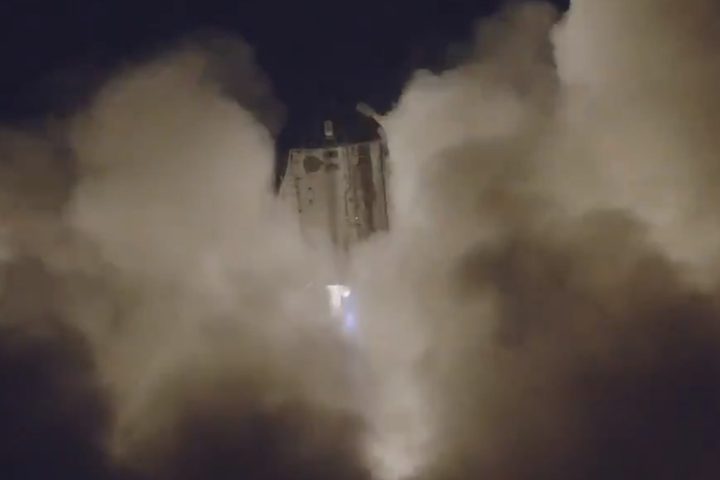
SpaceX successfully launched a test prototype of its future Starship rocket, called Starhopper, on Thursday. The test version of the rocket was launched from a location in Texas and was able to hover in the air for a few seconds before it returned to the ground and landed.

That might not sound all that impressive, but it was the first time SpaceX was able to get the rocket off the ground using its next-generation rocket engine called Raptor.

Recommended Videos

The spacecraft is called Starhopper specifically because it was designed to do those short takeoffs and landings, or “hops.”

STARHOPPER'S FIRST HOP!!!!

The launch happened a day after the company had to abort a test launch of the rocket. On Wednesday, the rocket’s engine appeared to fire up, but then flames and smoke appeared at the top of the spacecraft and SpaceX scrapped the test.

Commenting during a livestream Wednesday, SpaceX engineer Kate Trice said “As I mentioned before, this is a development program — today was a test flight designed to test the boundaries of the vehicle.”

A similar test last Tuesday evening also ended in flames.

Starship, the big brother to the Starhopper vessel being tested, is ultimately expected to be used as a commercial spacecraft. Unlike some other spacecraft, the vessel is expected to be entirely reusable. When completed, it will be able to take off and land multiple times, similar to an airplane.

Engine cam pic.twitter.com/3cWHU50353

— Elon Musk (@elonmusk) July 26, 2019

Thursday evening’s test took roughly 15 seconds.

Another test of the vessel is expected to happen in a week or two. Thursday’s test had the vessel fly 65 feet in the air. The next test will attempt to have Starhopper fly considerably higher, 650 feet in the air.

Thursday was a banner day for SpaceX. Along with the successful Starhopper test, the company launched its Dragon spacecraft into orbit using a Falcon 9 rocket from Cape Canaveral Air Force station in Florida earlier in the afternoon. The ship contains about 5,000 lbs of supplies and experimentation equipment bound to arrive at the International Space Station on Saturday. That launch went off without a hitch after SpaceX was forced to scrap a planned launch on Wednesday due to bad weather.

SpaceX hopes to have Starship ready for commercial flights by 2021.

Emily Price
Former Digital Trends Contributor
Emily is a freelance writer based in San Francisco. Her book "Productivity Hacks: 500+ Easy Ways to Accomplish More at…
Starlink V5 is here, and it’s lighter, smarter, and far more efficient
The next-generation satellite internet kit promises improved efficiency while maintaining high-speed connectivity.
Starlink V4 vs V5

Not every hardware upgrade needs to be about speed. With Starlink V5, SpaceX is betting that a lighter design and lower power consumption matter just as much. The company has officially introduced its next-generation Starlink V5 kit, featuring a smaller and lighter design with significantly improved power efficiency.

Smaller, lighter, and far more efficient

Read more
Frontier joins the Starlink club with high-speed in-flight internet
The carrier plans to roll out SpaceX's satellite-powered Wi-Fi across its fleet starting in 2027.
Frontier Starlink partnership featured

If there's one thing budget airlines aren't exactly known for, it's great onboard Wi-Fi. In Frontier Airlines' case, it hasn't offered in-flight internet at all. That's about to change. Frontier Airlines has announced a partnership with SpaceX's Starlink to bring high-speed, low-latency internet across its fleet. Installations will begin in early 2027, making Frontier the first ultra-low-cost carrier in the United States to adopt Starlink's satellite-powered connectivity.

Streaming, browsing, and even gaming at 35,000 feet

Read more
OpenAI’s first hardware product sounds more like a companion than a speaker
The AI company is reportedly building a mobile home device that understands context and proactively helps users.
OpenAI press image

For months, rumors have suggested that OpenAI's first hardware product could be a wearable AI device, or perhaps even the beginning of its long-term smartphone ambitions. As it turns out, the company's first gadget may be something far simpler, yet arguably far more ambitious. It will help control smart-home appliances, play media, answer questions, respond to messages, and tap into the range of capabilities offered by OpenAI's ChatGPT, according to people familiar with the matter.

OpenAI's first AI device could end up being a speaker, following plenty of hype that the company is actually working on a wearable AI device and might even launch a smartphone down the road. According to a Bloomberg report, the speaker will serve as a human-like AI companion that will integrate directly with the smart home ecosystem.

Read more