  1. Home
  2. Emerging Tech
  3. News

Space telescope to probe the mysteries of dark energy and dark matter

Add as a preferred source on Google

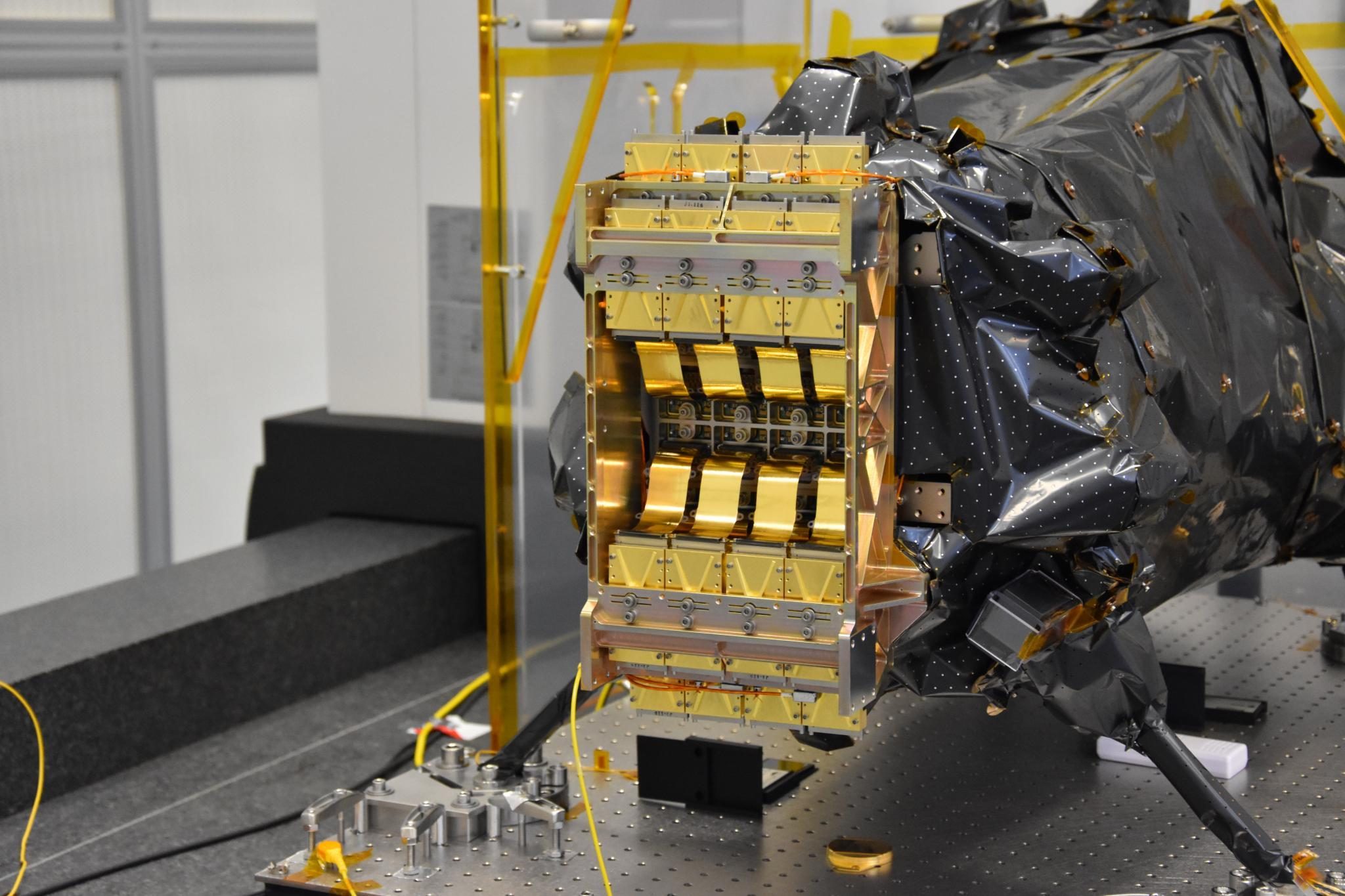
The cryogenic (cold) portion of the Euclid space telescope’s Near Infrared Spectrometer and Photometer (NISP) instrument. NASA led the procurement and delivery of the detectors for the NISP instrument. The gold-coated hardware is the 16 sensor-chip electronics integrated with the infrared sensors. Euclid Consortium/CPPM/LAM

Two of the biggest mysteries in astronomy are dark matter and dark energy. But soon a project from the European Space Agency (ESA), the Euclid mission, will attempt to unravel some of the puzzles over these forces.

Recommended Videos

Dark energy is a force theorized to exist to explain the movements of distant galaxies. When astronomers observe far-off galaxies, they see that they are speeding away from us at a greater speed than would be expected. The universe itself is expanding and is doing so at a faster and faster rate. But we still don’t know why this is, so theorists named the mysterious force affecting the universe dark energy. It is believed that 68% of the universe is composed of dark energy.

To understand more about this phenomenon, the ESA is constructing the Euclid space telescope to perform a survey of billions of distant galaxies, observing their movements. The hope is that with a large sample of galaxies to observe, scientists will be able to narrow down the possible explanations for dark energy.

Euclid will investigate dark matter as well — the theorized particle which makes up roughly 80% of the matter in the universe and which explains the movements of the stars. Dark matter can’t be seen, so Euclid will look for the effects of its gravity on the distant galaxies instead.

In order to create Euclid, the ESA is getting some help from NASA to build highly sensitive components. NASA engineers designed and built 20 pieces of sensor-chip electronics (SCEs) hardware for the telescope which must operate in the freezing temperatures of space, at minus 213 degrees Fahrenheit (minus 136 degrees Celsius). In the image above you can see the gold sensor chips which have been integrated with the infrared sensors.

“Even under the best of circumstances, it is extremely challenging to design and build very sensitive and complex electronics that function reliably at very cold operating temperatures,” Moshe Pniel, the U.S. project manager for Euclid at JPL, who led the team that delivered the sensor-chip electronics, said in a statement. “This truly remarkable team, spread across two NASA centers, accomplished this task under intense schedule pressure and international attention.”

The Euclid telescope is scheduled for launch on a Soyuz ST 2-1b rocket from Europe’s Spaceport in French Guiana in June 2022.

Georgina Torbet
Georgina has been the space writer at Digital Trends space writer for six years, covering human space exploration, planetary…
Starlink V5 is here, and it’s lighter, smarter, and far more efficient
The next-generation satellite internet kit promises improved efficiency while maintaining high-speed connectivity.
Starlink V4 vs V5

Not every hardware upgrade needs to be about speed. With Starlink V5, SpaceX is betting that a lighter design and lower power consumption matter just as much. The company has officially introduced its next-generation Starlink V5 kit, featuring a smaller and lighter design with significantly improved power efficiency.

Smaller, lighter, and far more efficient

Read more
Frontier joins the Starlink club with high-speed in-flight internet
The carrier plans to roll out SpaceX's satellite-powered Wi-Fi across its fleet starting in 2027.
Frontier Starlink partnership featured

If there's one thing budget airlines aren't exactly known for, it's great onboard Wi-Fi. In Frontier Airlines' case, it hasn't offered in-flight internet at all. That's about to change. Frontier Airlines has announced a partnership with SpaceX's Starlink to bring high-speed, low-latency internet across its fleet. Installations will begin in early 2027, making Frontier the first ultra-low-cost carrier in the United States to adopt Starlink's satellite-powered connectivity.

Streaming, browsing, and even gaming at 35,000 feet

Read more
OpenAI’s first hardware product sounds more like a companion than a speaker
The AI company is reportedly building a mobile home device that understands context and proactively helps users.
OpenAI press image

For months, rumors have suggested that OpenAI's first hardware product could be a wearable AI device, or perhaps even the beginning of its long-term smartphone ambitions. As it turns out, the company's first gadget may be something far simpler, yet arguably far more ambitious. It will help control smart-home appliances, play media, answer questions, respond to messages, and tap into the range of capabilities offered by OpenAI's ChatGPT, according to people familiar with the matter.

OpenAI's first AI device could end up being a speaker, following plenty of hype that the company is actually working on a wearable AI device and might even launch a smartphone down the road. According to a Bloomberg report, the speaker will serve as a human-like AI companion that will integrate directly with the smart home ecosystem.

Read more