
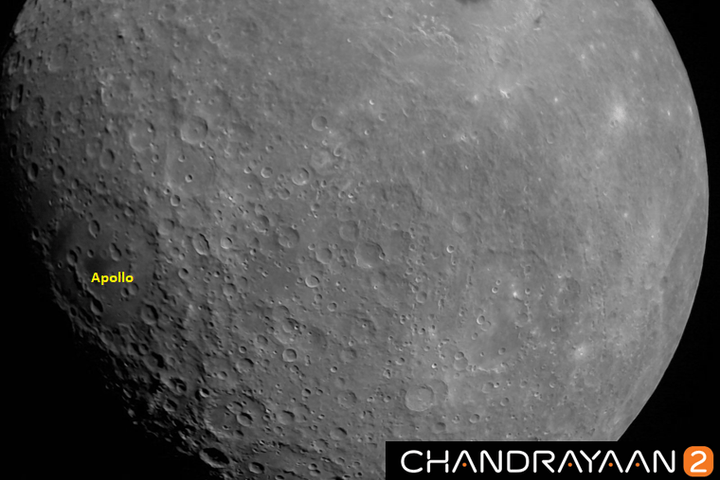
India’s Chandrayaan-2 spacecraft just captured a mesmerizing photo of its view of the moon, just weeks before it lands there.
The spacecraft reached the moon’s orbit on Tuesday after launching on July 22. On Thursday, the Indian Space Research Organisation (ISRO) tweeted the first photo of the moon captured by the uncrewed mission’s spacecraft.
The photo, which was taken at a height of 2,650 km (1,646 miles) above the moon, shows the Apollo crater and the Mare Orientalis.
Chandrayaan-2 is expected to land on the surface of the moon on September 7. The spacecraft’s landing will make India the fourth country in the world to land there.
Take a look at the first Moon image captured by #Chandrayaan2 #VikramLander taken at a height of about 2650 km from Lunar surface on August 21, 2019.
Mare Orientale basin and Apollo craters are identified in the picture.#ISRO pic.twitter.com/ZEoLnSlATQ
— ISRO (@isro) August 22, 2019
The lunar mission will touch down on the moon’s south polar region, making it the first mission to explore the area.The goal is for Chandrayaan-2 to operate on the moon for around a year, performing experiments in the south polar region and looking for any possible signs of water.
“Extensive mapping of lunar surface to study variations in lunar surface composition is essential to trace back the origin and evolution of the Moon. Evidence for water molecules discovered by Chandrayaan-1, requires further studies on the extent of water molecule distribution on the surface, below the surface and in the tenuous lunar exosphere to address the origin of water on Moon,” the ISRO wrote on its website.
The Chandrayaan-1 mission made more than 3,400 orbits around the moon between October 2008 and August 2009. Part of that first mission was to map the moon’s surface. A Twitter user compared the photo taken from Chandrayaan-1 to the one taken today by the second mission and showed just how much technology had improved in a few short years.
Now compare that to the first image of the Moon taken by Chandrayaan-1 on 4th November 2008 from a distance of 311,200 km. We've really come so far! pic.twitter.com/l9ILJKa7uT
— Astro_Neel (@Astro_Neel) August 22, 2019
A second Indian lunar landing mission is planned for sometime in 2024. Chandrayaan-3 will be the result of a partnership between the ISRO and Japan’s JAXA space agency. The mission will further explore the lunar surface by use of a lunar rover and lander.
It’s still unclear if the ISRO will do any sort of live programming for when Chandrayaan-2 touches down on the moon on September 7, but they have been tweeting frequent updates about the mission’s progress on their Twitter.


