  1. Home
  2. Emerging Tech
  3. News

Scientists develop implant to restore sight by stimulating the optic nerve

Add as a preferred source on Google
Promotional image for Tech For Change. Person standing on solar panel looking at sunset.
This story is part of Tech for Change: an ongoing series in which we shine a spotlight on positive uses of technology, and showcase how they're helping to make the world a better place.

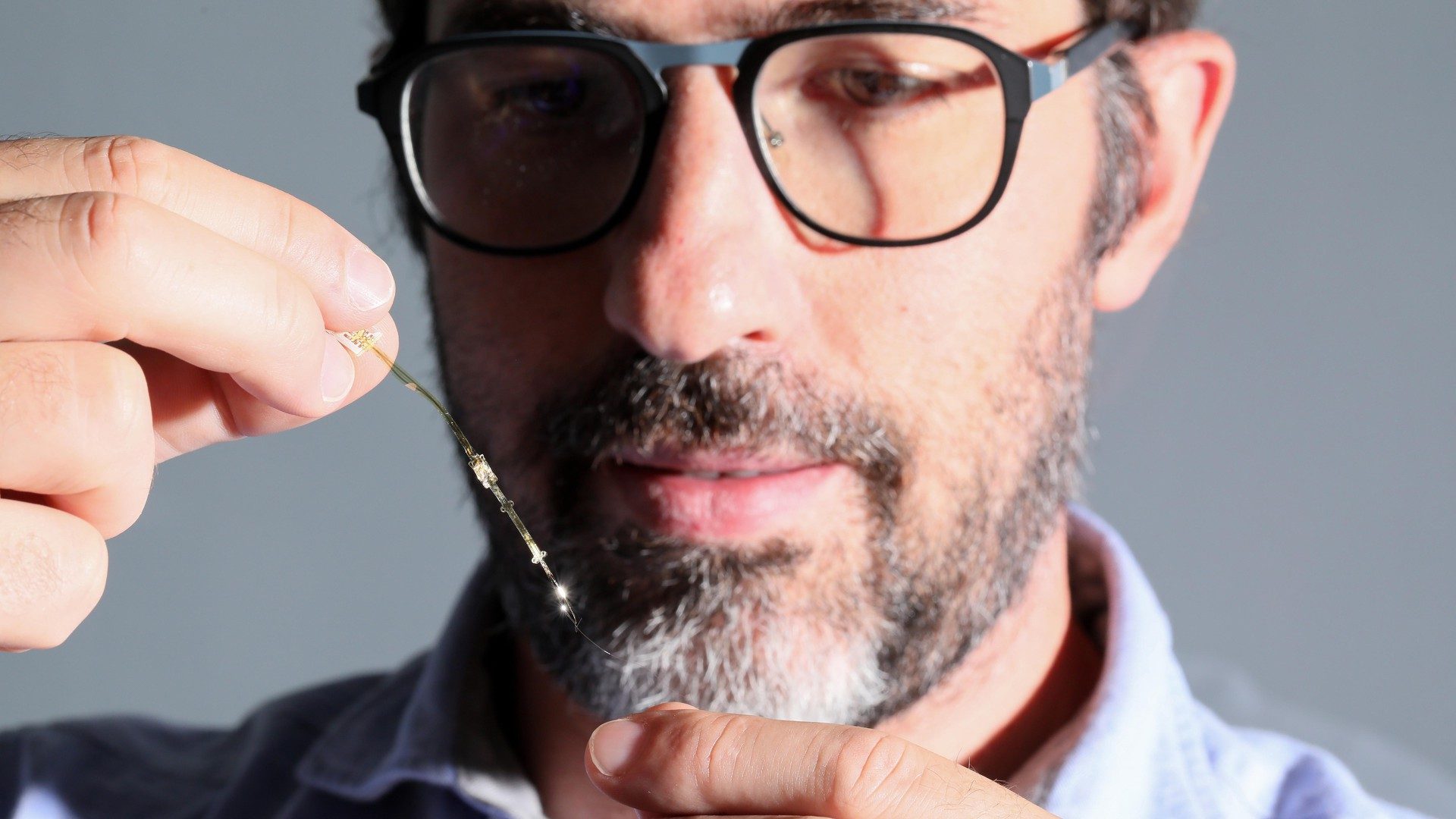
OpticSELINE electrode array for intraneural stimulation of the optic nerve. EPFL/Alain Herzog

Blindness is difficult to treat, in part because it can be caused by so many different issues in the eye, the brain, or the optic nerve connecting the two. But recently, scientists from the Swiss Federal Institute of Technology (EPFL) have developed a technology to directly stimulate the optic nerve, which could be used to restore people’s sight in the future.

Recommended Videos

Previously, researchers have found ways to restore sight by using a camera to capture images and then beam the images to a microchip implanted in the retina, but this requires a fully functioning optic nerve. A different technology bypasses the optic nerve and inputs images directly to the brain, but this system only allows people to see very basic images.

The new technology uses aspects of both of these technologies in that it bypasses the eye and sends information to the brain directly. The development is that the optic nerve itself is stimulated using an implant. The advantage of this approach is that it can be used on a much larger range of people.

“We believe that intraneural stimulation can be a valuable solution for several neuroprosthetic devices for sensory and motor function restoration,” Silvestro Micera, EPFL’s Bertarelli Foundation Chair in Translational Neuroengineering, said in a statement. “The translational potentials of this approach are indeed extremely promising.”

The device developed to stimulate the optic nerve, called OpticSELINE, is an array of 12 electrodes that deliver an electric current. To test how well the implant stimulated the optic nerve, the scientists used it to deliver a current and looked at activity in the brain’s visual cortex. By developing an algorithm to decode the signals from the brain, they could see that each electrode created a unique pattern of activation in the brain. This means that in principle the optic nerve can be stimulated in specific ways to send visual information to the brain.

To make the technology pragmatic, more electrodes will be required. With current technology, between 48 and 60 electrodes could be contained in an OpticSELINE device. This isn’t enough to fully restore sight but could be used to give back some degree of vision to make blind people’s day to day lives easier.

“For now, we know that intraneural stimulation has the potential to provide informative visual patterns,” EPFL’s Medtronic Chair in Neuroengineering Diego Ghezzi said in the same statement. “It will take feedback from patients in future clinical trials in order to fine-tune those patterns. From a purely technological perspective, we could do clinical trials tomorrow.”


Georgina Torbet
Georgina has been the space writer at Digital Trends space writer for six years, covering human space exploration, planetary…
Researchers hid a prompt injection inside a PNG, and AI fell for it
Hacker

AI coding assistants like Claude are becoming every developer's favorite coworker. They can review code, explain confusing functions, and even write entire features with a single prompt. But new research suggests that this growing trust could also become their biggest weakness.

A team of security researchers (professor Sudipta Chattopadhyay and researcher Murali Ediga) has demonstrated an unusual attack that doesn't target the AI model directly. Instead, it targets what the AI doesn't pay enough attention to during code reviews. Rather than hiding malicious instructions in lines of code, the researchers tucked them inside an image file. Since many AI review tools treat images as decorative assets rather than as something worth inspecting, the pull request can appear perfectly harmless and sail through the review.

Read more
AI has already fallen into the wrong hands and they’re using it to make bombs
Logo, Text

Artificial intelligence has quickly become the go-to tool for everything from writing emails and summarizing meetings to helping students study or developers debug code. But the same technology that saves people time can also be misused, and a new report suggests that terrorist organizations are finding ways to do exactly that.

According to a research paper shared with The New York Times ahead of its publication, researchers found evidence that members of Boko Haram have been using popular AI chatbots to support both day-to-day activities and combat-related tasks. Interviews with 27 former members conducted in Nigeria over the past two years suggest that tools such as ChatGPT, Gemini, Claude, Grok, Meta AI, and DeepSeek were used to gather technical information, troubleshoot weapons, and even assist with planning attacks.

Read more
Claude Code can now browse the web without opening Chrome
The desktop app now includes an in-app browser that can read websites, click links, and interact with web apps.
Claude Code Featured

Developers spend a surprising amount of time bouncing between their code editor, browser tabs, API documentation, GitHub issues, and design files. Anthropic thinks Claude Code should simply do all of that without constantly asking users to switch windows. The company has announced a new in-app browser for Claude Code on desktop, allowing its AI coding assistant to open websites, read documentation, inspect designs, and interact with web pages directly from within the application.

A browser built into Claude Code

Read more