1. Home
  2. Emerging Tech
  3. News

Baldness-banishing baseball cap will zap your head until your hair grows again

Add as a preferred source on Google

Plenty of bald or balding people wear hats for vanity or warmth reasons. But in the not too distant future, they might wear hats because it helps their hair to grow back.

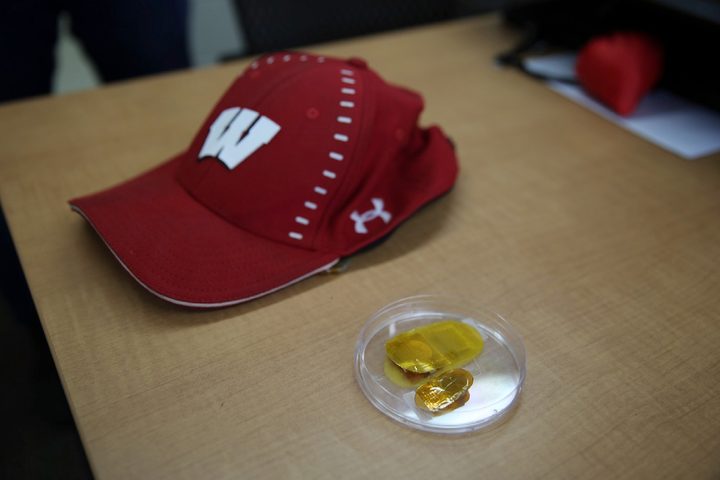
At least that’s the dream of researchers from the University of Wisconsin-Madison, who have developed a baldness-banishing electric patch that could help reverse the effects or balding in men when fitted into a custom-designed baseball cap. The millimeter-thin patch adheres to the scalp and then zaps it with very mild electric pulses generated using the body’s own kinetic energy.

Recommended Videos

“It is a device that automatically [converts random] head movements into regular electric pulses to stimulate hair follicles to grow hairs,” Professor Xudong Wang told Digital Trends. “It is a device called [a] nanogenerator, based on [the] piezoelectric or triboelectric effect, that converts displacements into electrical potential.”
Alex Holloway IV

So far, the researchers have demonstrated how the patch could be used to regrow hair in rats, both shaved rats and those that are hairless due to a genetic deficiency. In both cases, the electric pulses prompted hair beyond that which was achieved with minoxidil lotion and an inert saline solution. The rats grew hair more quickly and thickly while wearing the patch. Under a microscope, the researchers found that the patch appears to work by stimulating natural chemicals that trigger hair growth, including keratinocyte growth factor and vascular endothelial growth factor.

The patch was then tested by Wang on his father, who found similar results. Prompted by this, the researchers have now designed a baseball cap that incorporates the patch. They are currently attempting to get it approved in order to carry out clinical trials.

“A hat will certainly be one convenient form,” Wang said. “Because our device is a wearable system, I think one ideal form is a wearable cap that can be fitted into any hat. People can [then] wear it with their favorable headwear and stimulate hair growth unnoticeably in their daily life.”

A paper describing the work, titled “Self-Activated Electrical Stimulation for Effective Hair Regeneration via a Wearable Omnidirectional Pulse Generator,” was recently published in the journal ACS Nano.

Luke Dormehl
I'm a UK-based tech writer covering Cool Tech at Digital Trends. I've also written for Fast Company, Wired, the Guardian…
Starlink V5 is here, and it’s lighter, smarter, and far more efficient
The next-generation satellite internet kit promises improved efficiency while maintaining high-speed connectivity.
Starlink V4 vs V5

Not every hardware upgrade needs to be about speed. With Starlink V5, SpaceX is betting that a lighter design and lower power consumption matter just as much. The company has officially introduced its next-generation Starlink V5 kit, featuring a smaller and lighter design with significantly improved power efficiency.

Smaller, lighter, and far more efficient

Read more
Frontier joins the Starlink club with high-speed in-flight internet
The carrier plans to roll out SpaceX's satellite-powered Wi-Fi across its fleet starting in 2027.
Frontier Starlink partnership featured

If there's one thing budget airlines aren't exactly known for, it's great onboard Wi-Fi. In Frontier Airlines' case, it hasn't offered in-flight internet at all. That's about to change. Frontier Airlines has announced a partnership with SpaceX's Starlink to bring high-speed, low-latency internet across its fleet. Installations will begin in early 2027, making Frontier the first ultra-low-cost carrier in the United States to adopt Starlink's satellite-powered connectivity.

Streaming, browsing, and even gaming at 35,000 feet

Read more
OpenAI’s first hardware product sounds more like a companion than a speaker
The AI company is reportedly building a mobile home device that understands context and proactively helps users.
OpenAI press image

For months, rumors have suggested that OpenAI's first hardware product could be a wearable AI device, or perhaps even the beginning of its long-term smartphone ambitions. As it turns out, the company's first gadget may be something far simpler, yet arguably far more ambitious. It will help control smart-home appliances, play media, answer questions, respond to messages, and tap into the range of capabilities offered by OpenAI's ChatGPT, according to people familiar with the matter.

OpenAI's first AI device could end up being a speaker, following plenty of hype that the company is actually working on a wearable AI device and might even launch a smartphone down the road. According to a Bloomberg report, the speaker will serve as a human-like AI companion that will integrate directly with the smart home ecosystem.

Read more