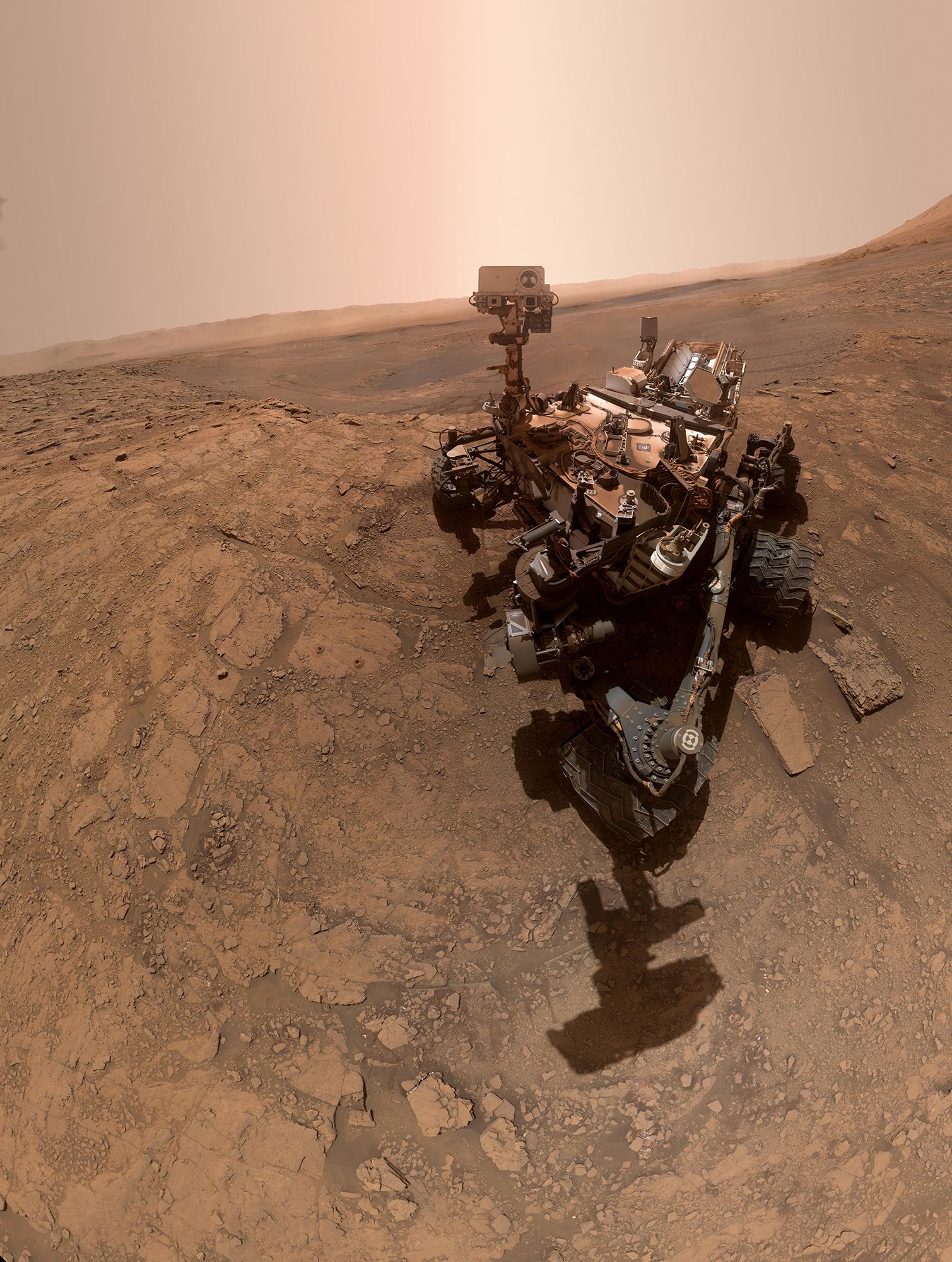
Everyone’s favorite Martian resident, the Curiosity rover, has proudly snapped a new selfie while performing an unusual experiment. The selfie is composed of 57 separate images that Curiosity captured using the camera on the end of its robotic arm. The MastCam has captured haunting images of solar eclipses as seen from Mars and strange new locations like Teal Ridge, but now the rover is imaging itself, as well as the ground immediately surrounding it in a region of Mars called Glen Etive.
The team controlling the rover wanted to image the ground as part of a experiment analyzing the chemical composition of two samples of Martian rock. You can see two small holes to the left of the rover in the image, which are where it drilled into the rock to collect the samples.
Once extracted, the samples are pulverized with the drill and taken inside the rover to the portable lab it carries within it, the Sample Analysis at Mars (SAM). The SAM suite includes a gas chromatograph, a quadrupole mass spectrometer, and a tunable laser spectrometer, which can be used to measure the levels of elements like carbon, oxygen, hydrogen, and nitrogen in a sample.
Typically, SAM uses one of its 74 small cups to heat up samples to see what gases they give off. But in this case, the scientists decided to make use of a limited resource — one of the nine cups filled with a powerful solvent. This solvent can eat through samples and help detect organic compounds relevant to the development of life, in what are called “wet chemistry” experiments.
As there aren’t many solvent cups, the scientists have been holding off on using them until they found an area likely to contain organic compounds. The clay-bearing unit, where Curiosity is currently exploring, is one such area because clay-based rocks preserve chemical compounds well.
“We’ve been eager to find an area that would be compelling enough to do wet chemistry,” SAM principal investigator Paul Mahaffy of NASA’s Goddard Space Flight Center said in a statement. “Now that we’re in the clay-bearing unit, we’ve finally got it.”
Unfortunately, we won’t get to see the results of Curiosity’s experiment until next year. “SAM’s data is extremely complex and takes time to interpret,” Mahaffy explained. “But we’re all eager to see what we can learn from this new location, Glen Etive.”