1. Home
  2. Emerging Tech
  3. News

Want to shake hands with the future? Check out this brain-controlled prosthetic

Add as a preferred source on Google
 

This story is part of our continuing coverage of CES 2020, including tech and gadgets from the showroom floor.

Recommended Videos

There are some moments you just know that you’re staring the future in the face. The moment at CES that gave us that feeling more than any other? Shaking hands with an astonishingly lifelike artificial intelligence-aided prosthetic hand, controlled via the wearer’s brain waves and muscle signals. It felt solid, natural, and… well, pretty much like any other handshake, really.

“The fingers are articulated independently; the pinky curls a little bit more around the palm of your hand,” said Jeremy Kaplan, Editor-in-Chief at Digital Trends. “Exactly like it would if you were shaking hands with someone else. That really stood out to me.”

The BrainCo Dexus prosthetic arm was selected by our editors as the best product at CES 2020. Check out more of our Top Tech of CES Award winners.
Best of CES 2020 Winner
CES 2020

The hand in question is the work of BrainCo, a cutting edge EEG science and robotics startup that the world is almost certainly going to hear a whole lot more about in the years to come. At Digital Trends, we’ve covered plenty of cool prosthetic limb projects. However, it’s incredibly rare to come across one that works as smoothly and intuitively as BrainCo’s prosthetic hand. Not only can it be intuitively controlled, sensing electrical instruction signals from the brain via the residual limb they travel down, but its movement is impressively dexterous. It could be a game-changer for amputees everywhere.

“We’ve developed the world’s most affordable A.I.-powered prosthetic hand,” Max Newlon, president of BrainCo, told Digital Trends. “[It] gives amputees control of the prosthetic just like you or I would control our hands.”
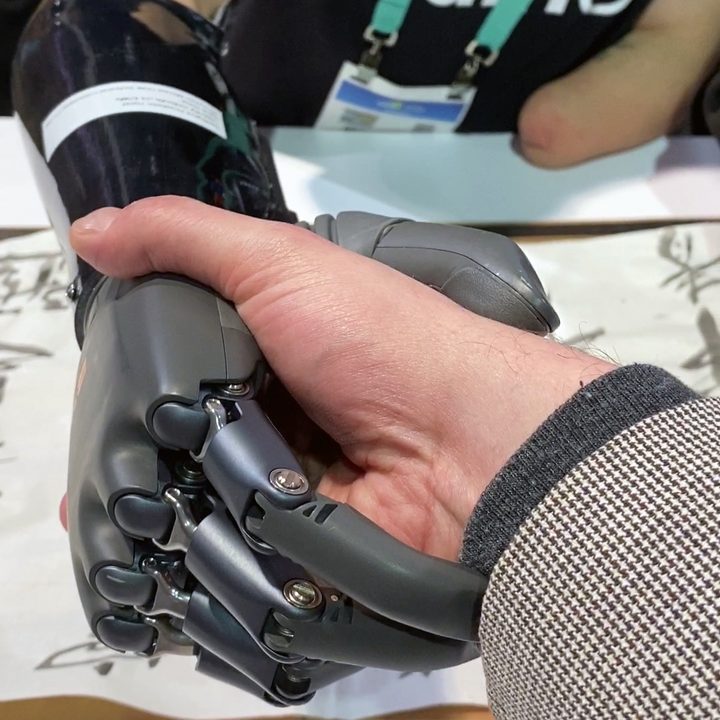
BrainCo Dexus prosthetic arm
BrainCo

The dexterity of the hand allows it to be used for a wide range of tasks. At CES, demos included not just shaking hands, but also fine-grain movements such as writing calligraphy. Heck, it can even be used to play the piano. Users are free to program their own series of gestures and capabilities, which can be done in a short space of time.

In terms of pricing, the unit is expected to cost between $10,000 and $15,000 when it launches later this year. This is a fraction of the price of high-end prosthetic hands — which should enable this to find a wider audience base among those who need it the most. FDA approval is pending.

As much as we can’t get enough of smart televisions, self-driving cars, cool robots, and plenty more, it’s hard to get more exciting than amazing technology which promises to make a real, life-changing difference for users. This is one of them. No wonder Digital Trends awarded it our Top Tech “Tech For Change” CES 2020 prize.

Follow our live blog for more CES news and announcements.

Luke Dormehl
I'm a UK-based tech writer covering Cool Tech at Digital Trends. I've also written for Fast Company, Wired, the Guardian…
Starlink V5 is here, and it’s lighter, smarter, and far more efficient
The next-generation satellite internet kit promises improved efficiency while maintaining high-speed connectivity.
Starlink V4 vs V5

Not every hardware upgrade needs to be about speed. With Starlink V5, SpaceX is betting that a lighter design and lower power consumption matter just as much. The company has officially introduced its next-generation Starlink V5 kit, featuring a smaller and lighter design with significantly improved power efficiency.

Smaller, lighter, and far more efficient

Read more
Frontier joins the Starlink club with high-speed in-flight internet
The carrier plans to roll out SpaceX's satellite-powered Wi-Fi across its fleet starting in 2027.
Frontier Starlink partnership featured

If there's one thing budget airlines aren't exactly known for, it's great onboard Wi-Fi. In Frontier Airlines' case, it hasn't offered in-flight internet at all. That's about to change. Frontier Airlines has announced a partnership with SpaceX's Starlink to bring high-speed, low-latency internet across its fleet. Installations will begin in early 2027, making Frontier the first ultra-low-cost carrier in the United States to adopt Starlink's satellite-powered connectivity.

Streaming, browsing, and even gaming at 35,000 feet

Read more
OpenAI’s first hardware product sounds more like a companion than a speaker
The AI company is reportedly building a mobile home device that understands context and proactively helps users.
OpenAI press image

For months, rumors have suggested that OpenAI's first hardware product could be a wearable AI device, or perhaps even the beginning of its long-term smartphone ambitions. As it turns out, the company's first gadget may be something far simpler, yet arguably far more ambitious. It will help control smart-home appliances, play media, answer questions, respond to messages, and tap into the range of capabilities offered by OpenAI's ChatGPT, according to people familiar with the matter.

OpenAI's first AI device could end up being a speaker, following plenty of hype that the company is actually working on a wearable AI device and might even launch a smartphone down the road. According to a Bloomberg report, the speaker will serve as a human-like AI companion that will integrate directly with the smart home ecosystem.

Read more