  1. Home
  2. Emerging Tech
  3. Cars
  4. News

Lexus concepts envision lunar transport in the year 2220

Add as a preferred source on Google

If you’ve ever found yourself idly wondering what transport of the future will look like — not only on Earth but also on the moon — then Lexus has some concept sketches to feed your imagination.

Lexus worked the design studio ED2 to come up with some visionary concepts of how we could move around in the future. In a project called the Lunar Design Portfolio, designers were invited to create a “lunar mobility concept,” which covered everything from personal transportation for traveling across the moon’s surface to spacecraft for taking us to the moon from Earth.
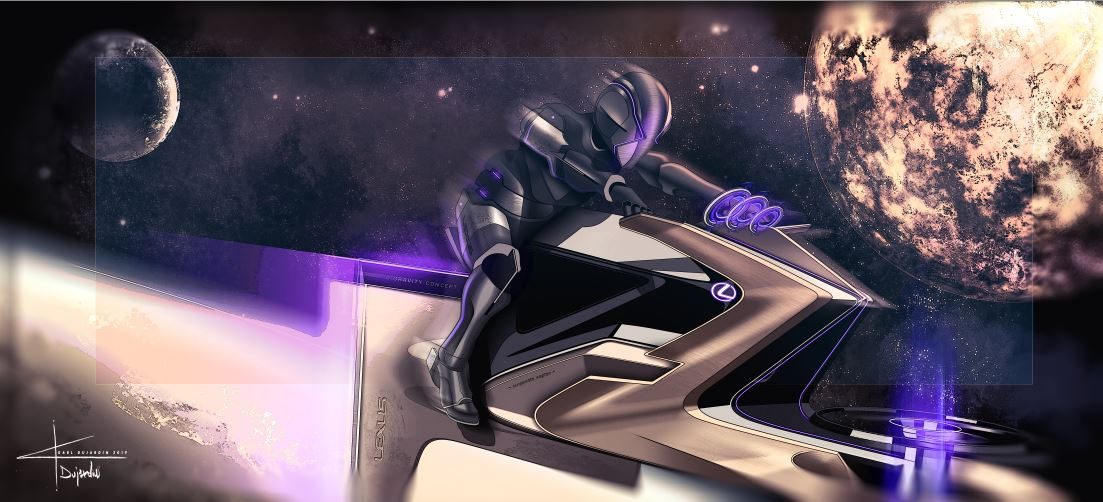
Zero Gravity - K. Dujardin
K. Dujardin

Designer K. Dujardin came up with this “Zero Gravity” levitating motorbike concept, which floats above the ground instead of traveling on wheels. As outlandish as this concept is, it would be marginally easier to achieve technology like this on the moon as opposed to on Earth because the gravity is so much lower. That means less force is required to get a massive object like a bike and a rider to levitate.

Recommended Videos

However, there would be the usual challenges of levitating technology to deal with — particularly issues around maintaining balance and directional control. So don’t expect astronauts to be whipping around the surface of the moon on floating bikes any time soon.
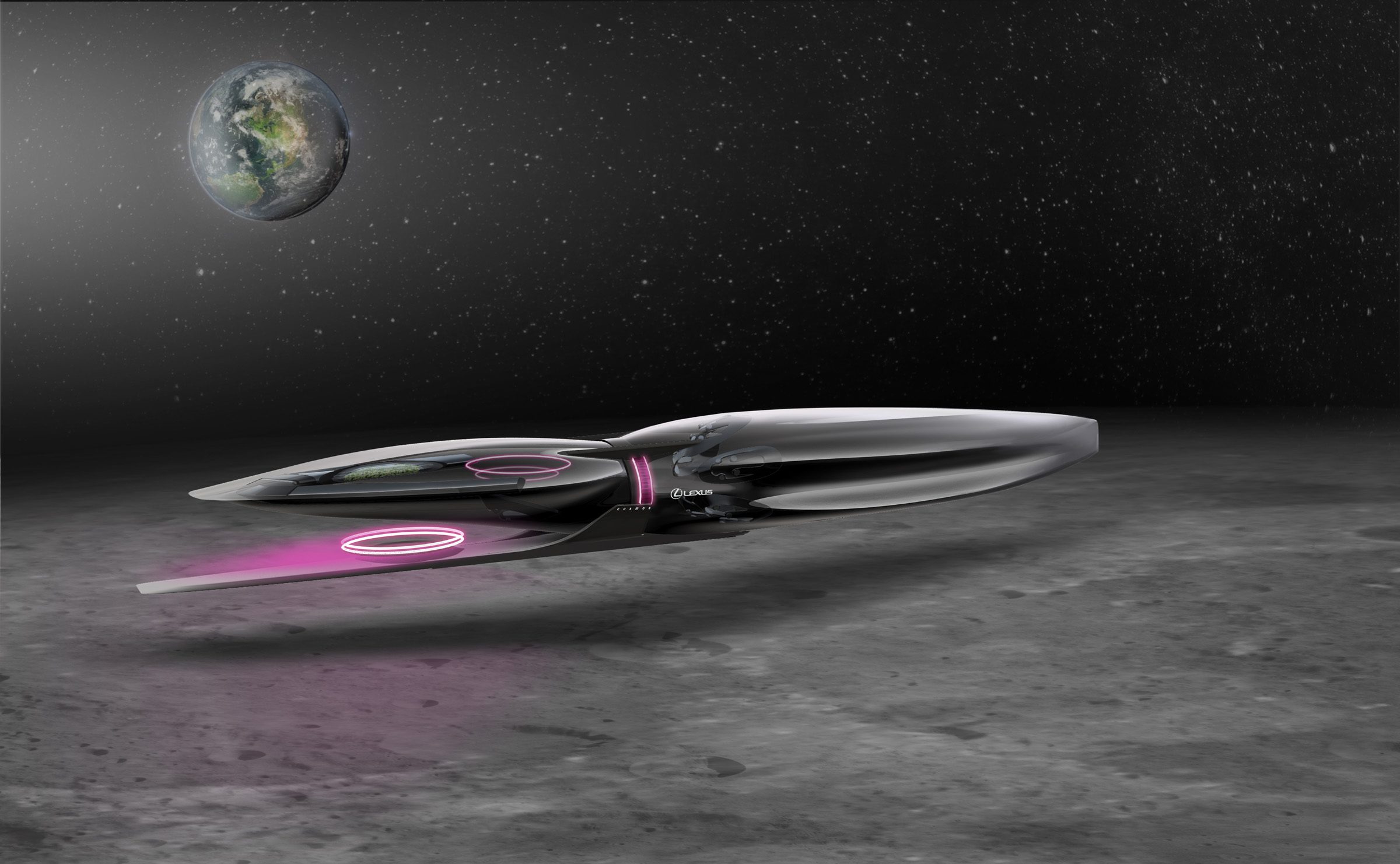
Jean-Baptiste Henry

This transport ship concept by Jean-Baptiste Henry is designed to move both through space and across the lunar surface. The squid-like shape would have large panels of sculpted glass so people inside could enjoy the stunning views of space, making it into a kind of flying observatory as well as a practical transport vehicle.

The concept also invites users to experience and play in a low-gravity environment, with the rear section forming a “space swimming pool” where travelers could relax and contemplate the stars as they float weightlessly.
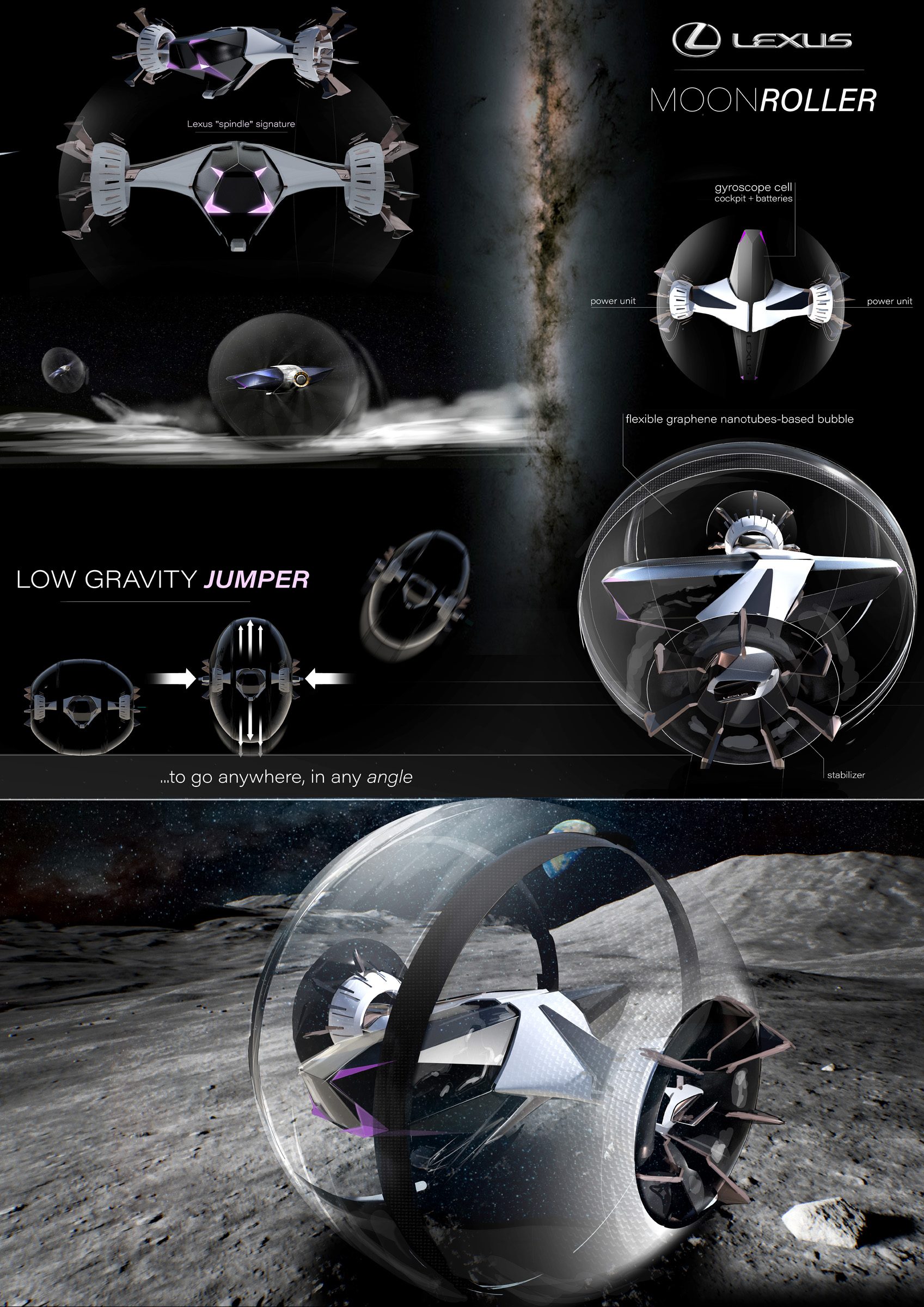
Bouncing Moon Roller, by Julien Marie
Julien Marie

There’s also a bouncing moon roller designed by Julien Marie, in which a rider is protected by a sphere made of flexible graphene nanotube material which acts as a bubble to provide breathable air and an easy way to move over rough terrain. The sphere can bounce and roll over obstacles like rocks, craters, and hills, and is able to move at any angle to navigate the moon’s surface.

These concepts remain a long way from anything that is possible with current technology, but they do provide some ideas about what transport could look like in the far future. To see more of these concepts, you can head to the Lexus website.

Georgina Torbet
Georgina has been the space writer at Digital Trends space writer for six years, covering human space exploration, planetary…
This spinning drone hides in plain sight using a visual illusion
This drone doesn't turn invisible. It tricks your brain into thinking it has.
Phantom Twist

For decades, engineers have chased the dream of an invisible drone. The usual approaches have involved transparent materials, camouflage coatings, or complex optical systems that bend light around an object. Researchers at Northwestern University decided to take a completely different route. Instead of hiding the drone itself, they chose to fool the human eye.

The result is Phantom Twist, an experimental drone that spins so rapidly it almost disappears into the background. It's not technically invisible, but to anyone watching, it looks more like a faint blur than a flying machine.

Read more
This smart knitted fabric can flip switches, count your steps, and even change shape
Grandma's knitting just entered its Iron Man era
Representative Image

For most of us, knitting brings to mind sweaters, scarves, and perhaps an ambitious grandmother determined to make winter more fashionable. Researchers at Harvard University, however, have a far more futuristic vision. They've transformed ordinary knitted fabric into a programmable material capable of changing shape, acting as an electrical switch, sensing movement, and potentially forming the foundation of tomorrow's wearable technology.

The research, published in Advanced Functional Materials by scientists at the Harvard John A. Paulson School of Engineering and Applied Sciences (SEAS), demonstrates how machine-knitted textiles can "snap" between multiple stable shapes without relying on motors or rigid mechanical parts.

Read more
Starlink V5 is here, and it’s lighter, smarter, and far more efficient
The next-generation satellite internet kit promises improved efficiency while maintaining high-speed connectivity.
Starlink V4 vs V5

Not every hardware upgrade needs to be about speed. With Starlink V5, SpaceX is betting that a lighter design and lower power consumption matter just as much. The company has officially introduced its next-generation Starlink V5 kit, featuring a smaller and lighter design with significantly improved power efficiency.

Smaller, lighter, and far more efficient

Read more