In the last decade, hunting for distant exoplanets has become a large focus of astronomy, with projects like NASA’s planet-hunting satellite TESS locating many new planets, including some potentially habitable ones, and the European Space Agency’s CHEOPS satellite recently launched to search for even more.
But once we have located an exoplanet, how can we learn more about it? It’s almost impossible to image distant planets as they are so dim compared to the light given off by their stars. So a team of astronomers from the Netherlands Institute for Radio Astronomy has come up with a way to examine the interactions of planets and their stars to discern what kind of environments the planets might have.
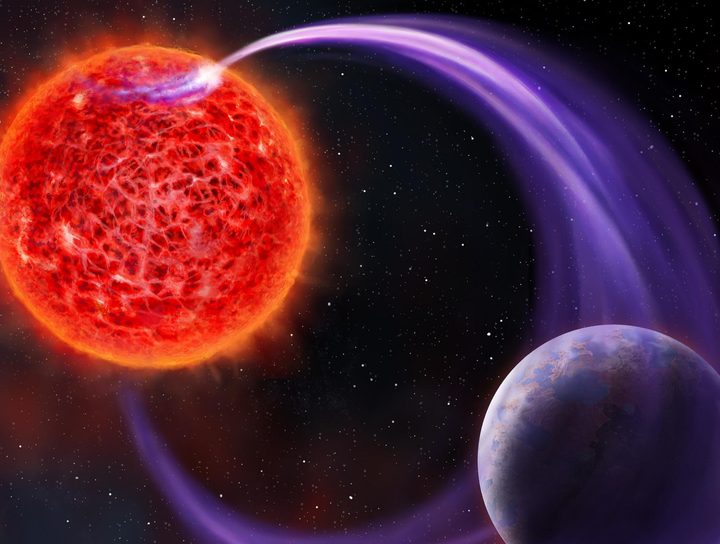
The method uses a highly sensitive radio telescope called the Low Frequency Array (LOFAR) to see the radio emissions given off when a planet’s atmosphere interacts with the magnetic field of the red dwarf star that it orbits. “The motion of the planet through a red dwarf’s strong magnetic field acts like an electric engine much in the same way a bicycle dynamo works,” Dr. Harish Vedantham, the lead author of the study and a Netherlands Institute for Radio Astronomy (ASTRON) staff scientist, explained in a statement.”This generates a huge current that powers aurorae and radio emission on the star.”
By searching for these radio emissions, the astronomers can locate planets with an atmosphere which are close enough to their host red giants to be potentially habitable.
In our solar system, we don’t see radio emissions like this because our sun has a weaker magnetic field and the planets are located farther away. However, there is a similar interaction effect seen between Jupiter’s magnetic field and its moon Io. This interaction generates radio emissions which are louder than those generated by the sun at low frequencies.
“We adapted the knowledge from decades of radio observations of Jupiter to the case of this star,” Dr. Joe Callingham, ASTRON postdoctoral fellow and co-author of the study, said. “A scaled-up version of Jupiter-Io has long been predicted to exist in the form of a star-planet system, and the emission we observed fits the theory very well.”
The team will now use this method to search for similar emissions from other red dwarf stars. They believe they may be able to locate up to 100 such systems within 15 light-years of Earth.
“The long-term aim is to determine what impact the star’s magnetic activity has on an exoplanet’s habitability, and radio emissions are a big piece of that puzzle,” said Dr. Vedantham. “Our work has shown that this is viable with the new generation of radio telescopes, and put us on an exciting path.”
The findings are published in the journal Nature Astronomy.