1. Home
  2. Space
  3. News

Amateur astronomer discovers a brand new spot on Jupiter

Add as a preferred source on Google

Jupiter may be best known for its “eye,” also known as the Great Red Spot, but this is just one of many enormous spots on its surface. Now, the eye has been joined by a new surface feature, discovered by an amateur astronomer.

The famous Great Red Spot can be seen in the upper left of the image, and in the middle is the new feature which has not been observed before. It was first spotted by Clyde Foster of Centurion, South Africa, who noticed it while looking at Jupiter through his telescope using a filter sensitive to the absorption of methane gas. Two days later, on June 2, NASA’s Juno spacecraft flew near the area and was able to image the spot in beautiful detail. In honor of its discoverer, the feature has been named “Clyde’s Spot.”
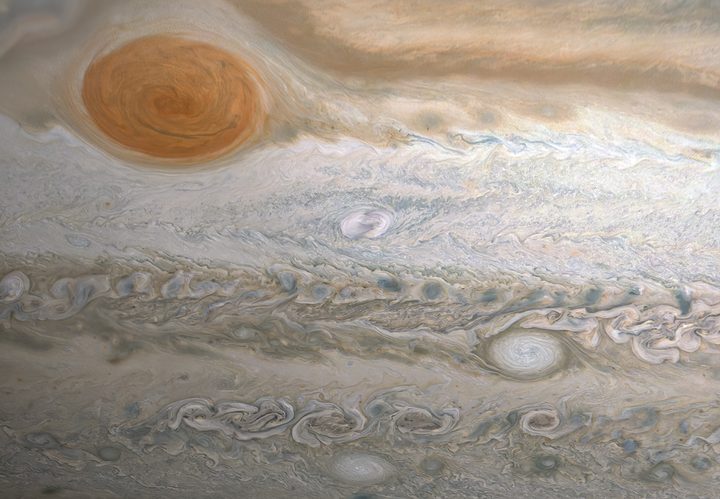
This image from NASA’s Juno spacecraft captures several storms in Jupiter’s southern hemisphere
This image from NASA’s Juno spacecraft captures several storms in Jupiter’s southern hemisphere. Some of these storms, including the Great Red Spot at the upper left, have been churning in the planet’s atmosphere for many years, but when Juno obtained this view of Jupiter, the smaller, oval-shaped feature at the center of the image was brand new. Image data: NASA/JPL-Caltech/SwRI/MSSS Image processing by Kevin M. Gill © CC BY

NASA’s Juno team believes that the spot is a cloud of material erupting through the upper layers of the atmosphere, which happens periodically at this particular latitude.

Recommended Videos

This image was created by citizen scientist Kevin M. Gill, using the data from the Juno spacecraft’s JunoCam. Members of the public can download raw JunoCam images and do their own image processing, and are invited to upload their images to the Juno website.

According to NASA, Gill’s image above is “a map projection that combines five JunoCam images taken on June 2, 2020, between 3:56 a.m. PDT (6:56 a.m. EDT) and 4:25 a.m. PDT (7:25 a.m. EDT). At the time the images were taken, Juno was between about 28,000 miles (45,000 kilometers) and 59,000 miles (95,000 kilometers) from the planet’s cloud tops at latitudes of between about 48 degrees and 67 degrees south.”

The Juno spacecraft was launched in 2011 and arrived in orbit around Jupiter in 2016. In its time it has had to perform some dramatic maneuvers to keep its mission going, having originally been planned to operate only until 2018. With its extended lifespan, the mission is continuing to gather data about Jupiter including information about its atmosphere, composition, and chaotic magnetic field.

Georgina Torbet
Georgina has been the space writer at Digital Trends space writer for six years, covering human space exploration, planetary…
China’s answer to SpaceX’s reusable rockets literally catches boosters in a net
SpaceX catches boosters on legs. China just used a net.
Ammunition, Missile, Weapon

SpaceX's playbook for recovering a rocket booster generally involves legs, a precisely controlled vertical landing, and either a concrete pad or a drone ship. 

China just managed to pull off something similar, but in a slightly different way, and on July 10, it tested the method as well.

Read more
Dimming the sun sounds unhinged, but this new study on El Niño makes a surprisingly good case for it
A natural test case, Australia's worst-ever wildfire season, suggests the idea deserves serious consideration.
Nature, Outdoors, Sky

When I first saw "scientists propose dimming the sun," I rolled my eyes. It sounds like a science fiction movie cooked up after watching many climate documentaries. But a new study, published on July 8, 2026, in the journal Science Advances, seems to have a genuinely compelling argument.

A Super El Niño is currently forming in the Pacific, feared to be the most intense in decades. It could escalate floods, wildfires, and extreme heat events worldwide. However, Researchers at UC San Diego's Scripps Institution of Oceanography, led by climate scientists Kate Ricke and Jessica Wan, are now proposing one of the most interesting solutions I’ve come across.

Read more
You can now walk through space and gaze into a black hole at this VR exhibit
Smithsonian Starstruck lets you drift past dying stars and see the origin point of the universe for as little as $18 a person.
Smithsonian Starstruck featured

Most planetarium shows ask you to sit still and look up. The Smithsonian's new VR exhibit takes a different approach, letting visitors walk through the vast expanse of the universe, drifting past stars, planets, and a black hole to get a physical sense of its true scale.

A $29 ticket to the edge of the galaxy

Read more