Panasonic has officially announced the Lumix S5, a lightly teased and heavily leaked full-frame mirrorless camera that brings many of the capabilities of the Lumix S1 and S1H to a smaller and friendlier form factor. At $2,000 (body only), it is the cheapest S-series camera yet, but carries over several professional features from its larger siblings.
Weighing 25 ounces, not only is it more than half a pound lighter than the S1, but it’s a hair under the Lumix GH5, a camera that uses a much smaller Micro Four Thirds sensor. Fortunately, Panasonic did not sacrifice build quality to get there. The S5 is built on a full magnesium-alloy chassis with a weather-sealed body. It has a robust hand grip, dual SD card slots, and a fair amount of direct-access control, although the top LCD display has vanished.
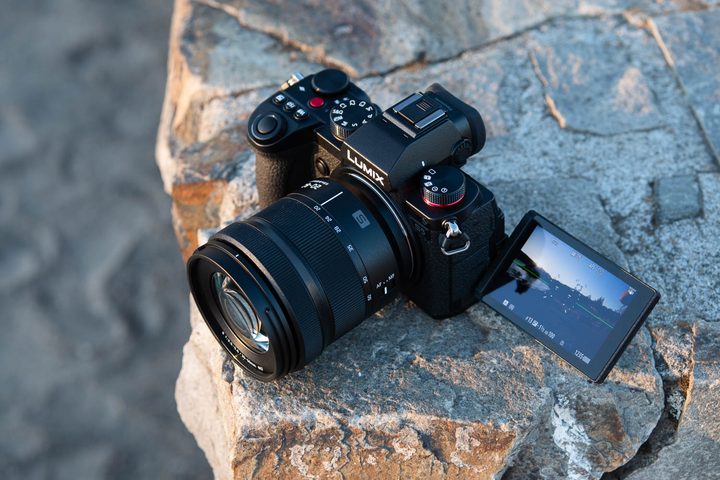
If we’re making a fuss about the physical design, that’s because it is, by and large, the most important feature of the S5. Prior S-series models were gargantuan, even larger than most DSLRs, and the S5’s slimmed-down body will go a long way to putting an L-mount camera in more hands.
As for what’s inside, it’s mostly all tech we’ve seen before. The 24-megapixel full-frame sensor is straight out of the S1, while the camera’s video modes largely mimic what’s available in the S1H, including full-width 4K/30 or cropped 4K/60 from an APS-C region of the sensor. In-body image-stabilization also returns and the 96MP high-resolution mode arrives along with it, but stabilization performance is slightly downgraded to 6.5 stops when paired with a stabilized lens (thanks mainly to the smaller chassis giving the sensor stabilizer less room to move around).
What’s new is the autofocus processing, which now works much better in continuous mode. Subject recognition has also been greatly improved, now able to detect smaller subjects, including faces that take up just 2.5% of the frame. Added support for head-detection joins face- and eye-detection, which improves tracking for human subjects who turn away from the camera. If you’re wondering whether these improvements could be brought to the S1 cameras via firmware update, the answer is yes. That update is coming later this year.

Autofocus does still rely on contrast-detection and Panasonic’s Depth from Defocus technology. While photo performance has been significantly boosted, video performance is not expected to keep up with faster phase-detection systems found on competing cameras from Sony and Canon.
In many ways, the S5 looks like a very strong alternative to the S1 and even the S1H, but it does have a few shortcomings. Still photographers give up shooting speed, as the S5 tops out at 7 frames per second, or just 5 with continuous autofocus. The S1’s beautiful, 5.76-million-dot electronic viewfinder has also been replaced with an underwhelming, 2.36-million-dot version.
On the cinema side, many of the pro-level features in the S1H are missing here, including high-bitrate all-intraframe codecs. But you can still shoot 10-bit 4:2:2 video with full V-Log, so it should be easy to match S5 and S1H footage.
However, Panasonic has already announced a firmware update for the S5 that will bring many of the missing video features to it by the end of the year. These include DCI aspect ratios, the option to display shutter angle instead of shutter speed, and even a vectorscope. All-intraframe codecs won’t make the cut, but, somewhat shockingly, 5.9K RAW video output will.
Yes, you read that correctly: The $2,000 S5 will have the same video quality as the $4,000 S1H, so long as you’re willing to use an external HDMI recorder. That is huge news for independent filmmakers.
So how does the Panasonic Lumix S5 perform? Digital Trends has been shooting one over the past few days and you can read about our experience in our full review.