1. Home
  2. Space
  3. News

Hundreds of volcanoes spew sulfur into the atmosphere of Jupiter’s moon Io

Add as a preferred source on Google

Jupiter’s moon Io is a dramatic place — even though it’s just 1,131 miles across, or just a bit bigger than Earth’s moon, it hosts over 400 active volcanoes, some of which are as large as 124 miles across. These volcanoes spew out sulfur gases that freeze on the moon’s chilly surface and give it its distinctive yellow and orange color.

Another odd feature about Io is that it has an atmosphere, albeit an extremely thin one. At a billion times thinner than Earth’s atmosphere, it’s barely there, but it does exist and is composed mostly of sulfur from the volcanoes. But researchers weren’t sure about how exactly this atmosphere formed, so recent research has used Earth-based telescopes to examine this puzzle.

Recommended Videos

“It was not known which process drives the dynamics in Io’s atmosphere,” lead author Imke de Pater of the University of California, Berkeley, explained in a statement. “Is it volcanic activity, or gas that sublimates from the icy surface when Io is in sunlight? What we show is that, actually, volcanoes do have a large impact on the atmosphere.”
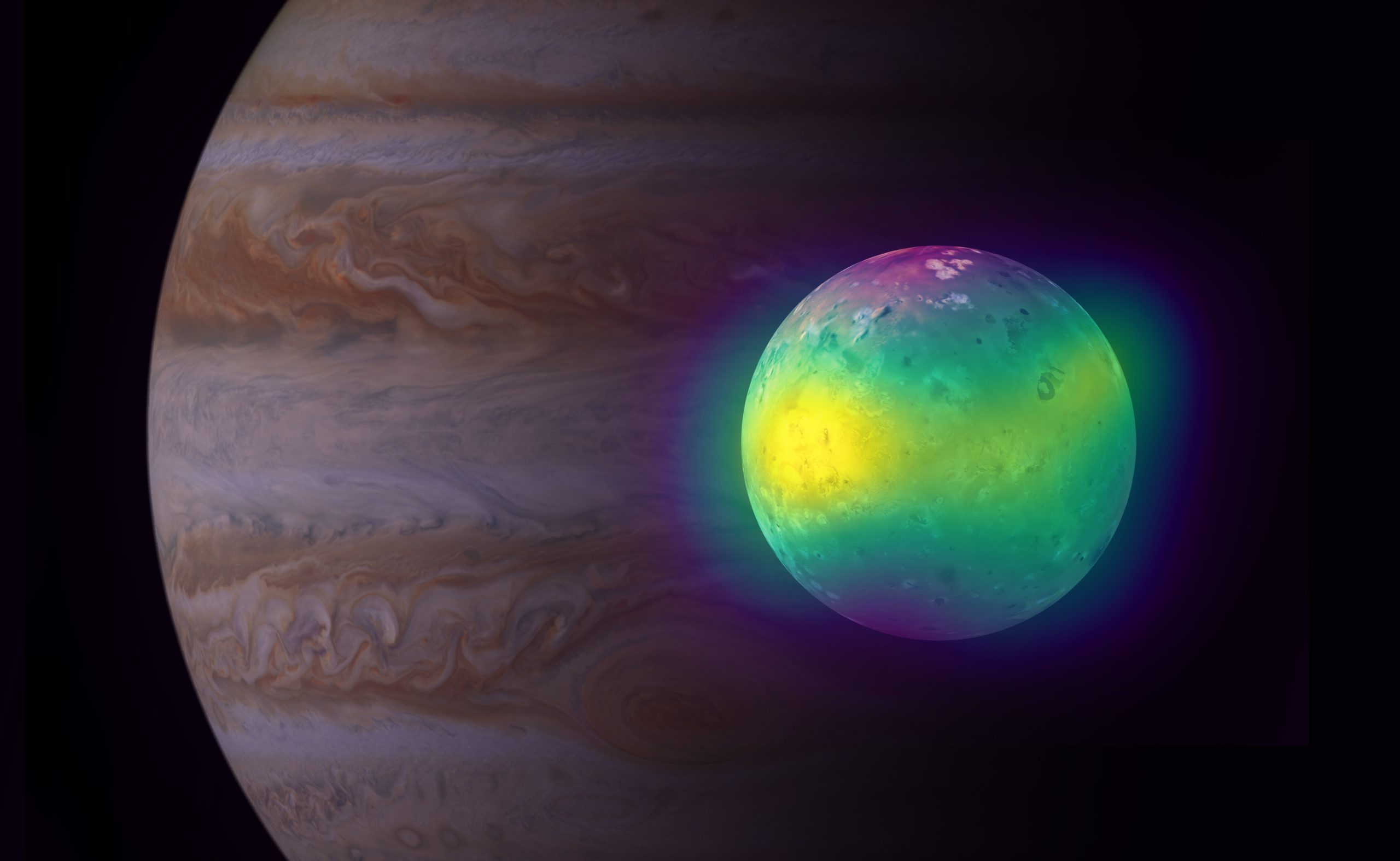
Composite image showing Jupiter's moon Io in radio (ALMA), and optical light (Voyager 1 and Galileo). The ALMA images of Io show for the first time plumes of sulfur dioxide (in yellow) rise up from its volcanoes. Jupiter is visible in the background (Cassini image).
Composite image showing Jupiter’s moon Io in radio (ALMA), and optical light (Voyager 1 and Galileo). The ALMA images of Io show for the first time plumes of sulfur dioxide (in yellow) rise up from its volcanoes. Jupiter is visible in the background (Cassini image). ALMA (ESO/NAOJ/NRAO), I. de Pater et al.; NRAO/AUI NSF, S. Dagnello; NASA/JPL/Space Science Institute

The researchers took radio images from the Atacama Large Millimeter/submillimeter Array (ALMA) when Io was moving in and out of the shadow of Jupiter. This change in temperature allowed them to see different states of the sulfur in the atmosphere.

“When Io passes into Jupiter’s shadow, and is out of direct sunlight, it is too cold for sulfur dioxide gas, and it condenses onto Io’s surface,” co-author Statia Luszcz-Cook from Columbia University said. “During that time we can only see volcanically-sourced sulfur dioxide. We can therefore see exactly how much of the atmosphere is impacted by volcanic activity.”

The readings showed that between 30% and 50% of the sulfur in the atmosphere comes directly from the volcanoes. And there was an unexpected bonus finding as well: Another gas, potassium chloride, was also spotted coming from the volcanoes. This gas was only spotted in certain regions, suggesting that different magma reservoirs feed different volcanoes on the surface.

Georgina Torbet
Georgina has been the space writer at Digital Trends space writer for six years, covering human space exploration, planetary…
China’s answer to SpaceX’s reusable rockets literally catches boosters in a net
SpaceX catches boosters on legs. China just used a net.
Ammunition, Missile, Weapon

SpaceX's playbook for recovering a rocket booster generally involves legs, a precisely controlled vertical landing, and either a concrete pad or a drone ship. 

China just managed to pull off something similar, but in a slightly different way, and on July 10, it tested the method as well.

Read more
Dimming the sun sounds unhinged, but this new study on El Niño makes a surprisingly good case for it
A natural test case, Australia's worst-ever wildfire season, suggests the idea deserves serious consideration.
Nature, Outdoors, Sky

When I first saw "scientists propose dimming the sun," I rolled my eyes. It sounds like a science fiction movie cooked up after watching many climate documentaries. But a new study, published on July 8, 2026, in the journal Science Advances, seems to have a genuinely compelling argument.

A Super El Niño is currently forming in the Pacific, feared to be the most intense in decades. It could escalate floods, wildfires, and extreme heat events worldwide. However, Researchers at UC San Diego's Scripps Institution of Oceanography, led by climate scientists Kate Ricke and Jessica Wan, are now proposing one of the most interesting solutions I’ve come across.

Read more
You can now walk through space and gaze into a black hole at this VR exhibit
Smithsonian Starstruck lets you drift past dying stars and see the origin point of the universe for as little as $18 a person.
Smithsonian Starstruck featured

Most planetarium shows ask you to sit still and look up. The Smithsonian's new VR exhibit takes a different approach, letting visitors walk through the vast expanse of the universe, drifting past stars, planets, and a black hole to get a physical sense of its true scale.

A $29 ticket to the edge of the galaxy

Read more