It resembles the cross-section for a turbine jet engine, but what you’re looking at is British audio company, KEF’s latest speaker innovation, which it calls Uni-Core. It’s a new architecture for subwoofers that could pave the way for much smaller enclosures without sacrificing any of the powerful, low-end bass home theater enthusiasts demand.
Uni-Core uses two dual force-canceling drivers with concentrically arranged, overlapping voice coils, that are driven by a single motor to provide what KEF claims is stunning bass performance from a small enclosure. The horizontally-opposed design is highly reminiscent of Devialet’s Heart Bass Implosion technology, which it uses to extract unholy amounts of low-frequency sound from its Phantom line of speakers. Some of the Phantoms are small enough to fit in your hand.
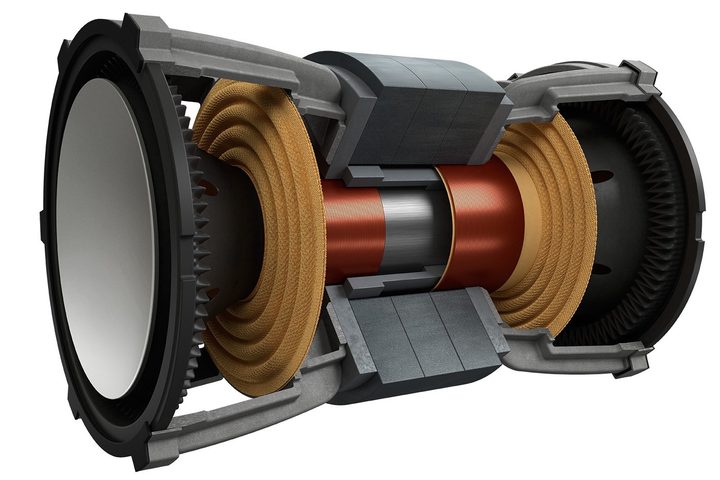
The Uni-Core voice-coils are different sizes but occupy the same physical space within the driver assembly. “To deliver deep and loud bass from a compact product is a big engineering challenge,” KEF’s head of research and development, Dr. Jack Oclee-Brown, said in a press release. “The Uni-core is a breakthrough technology for KEF because it allows us to pack two drivers into a tighter space without compromising their performance.”
That saved space provides the drivers far more excursion than an equivalent-sized, force-canceling design, KEF claims, which unlocks more output and depth from much less space. When Digital Trends asked how, exactly, the Uni-Core design could move as much air as a traditional big-box subwoofer, we were told the details would soon be revealed: Uni-Core technology will be at the heart of a new KEF product that is expected to debut later this month.
If Uni-Core can fulfill its promises, it’s an exciting development in the subwoofer space. For decades, we’ve had to contend with an inescapable rule of low-frequency physics: If you want big, booming sound, you need a big subwoofer. Being able to significantly reduce the size of these cabinets creates aesthetic benefits (who wants to look at a big, ugly box?) but it also creates acoustic benefits. The bigger the box, the fewer the placement options in any given room, but especially in smaller locations. Given that subwoofer placement is half art and half science, the more placement options, the easier it will be to eliminate bass dead-spots, an unfortunate but common side-effect of bouncing low-frequency sounds around a room.
Curious to know when you’ll be able to buy a Uni-Core-equipped subwoofer from KEF? Check back with us over the coming weeks — we’ll have all of the details.