  1. Home
  2. Space
  3. News

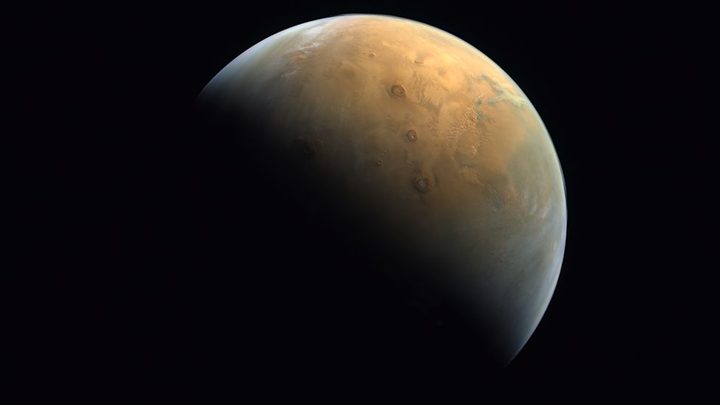
See the Hope mission’s first stunning image of Mars

Add as a preferred source on Google

The Hope Probe's first image of Mars
The Hope probe’s first image of Mars Emirates Mars Mission/Mohamed Bin Zayed

A gorgeous image of our planetary neighbor has been captured by the UAE’s Hope mission to Mars. Snapped from 15,500 miles away from the surface, the image shows some of Mars’s most recognizable features including Olympus Mons, the largest known volcano in the solar system.

Recommended Videos

The mission’s first image was posted on Twitter by the Crown Prince of UAE, Mohammed bin Zayed Al Nahyan. “The transmission of the Hope Probe’s first image of Mars is a defining moment in our history and marks the UAE joining advanced nations involved in space exploration,” he shared. “We hope this mission will lead to new discoveries about Mars which will benefit humanity.”

The Hope mission arrived at Mars this week, successfully entering orbit through a difficult braking maneuver. This was the first interplanetary mission by an Arab nation, and with its successful insertion into orbit, the UAE joined a small number of countries that have successfully sent a mission to Mars, including the U.S., the former Soviet Union, India, and Europe.

This list was joined by China later in the week as well, with the successful entering into orbit of the Tianwen-1 mission. NASA’s Perseverance rover is set to land on the red planet this coming week too.

The reason the three missions all launched and are arriving around the same time is due to them using a path between Earth and Mars called the Hohmann transfer orbit. This takes advantage of the point in time at which the two planets are closest together to plot the most efficient course to travel between them.

It’s impressive that both UAE and China succeeded in getting their craft into orbit successfully, as approximately half of all historic missions to Mars have failed due to the many challenges of controlling a spacecraft as it approaches another planet.

Now, the Hope mission can begin its scientific work, which includes studying the martian atmosphere to learn more about how the upper and low atmospheres interact through the planet’s different seasons. It will also investigate atmospheric escape — the phenomenon via which Mars is gradually losing its atmosphere.

Georgina Torbet
Georgina has been the space writer at Digital Trends space writer for six years, covering human space exploration, planetary…
China’s answer to SpaceX’s reusable rockets literally catches boosters in a net
SpaceX catches boosters on legs. China just used a net.
Ammunition, Missile, Weapon

SpaceX's playbook for recovering a rocket booster generally involves legs, a precisely controlled vertical landing, and either a concrete pad or a drone ship. 

China just managed to pull off something similar, but in a slightly different way, and on July 10, it tested the method as well.

Read more
Dimming the sun sounds unhinged, but this new study on El Niño makes a surprisingly good case for it
A natural test case, Australia's worst-ever wildfire season, suggests the idea deserves serious consideration.
Nature, Outdoors, Sky

When I first saw "scientists propose dimming the sun," I rolled my eyes. It sounds like a science fiction movie cooked up after watching many climate documentaries. But a new study, published on July 8, 2026, in the journal Science Advances, seems to have a genuinely compelling argument.

A Super El Niño is currently forming in the Pacific, feared to be the most intense in decades. It could escalate floods, wildfires, and extreme heat events worldwide. However, Researchers at UC San Diego's Scripps Institution of Oceanography, led by climate scientists Kate Ricke and Jessica Wan, are now proposing one of the most interesting solutions I’ve come across.

Read more
You can now walk through space and gaze into a black hole at this VR exhibit
Smithsonian Starstruck lets you drift past dying stars and see the origin point of the universe for as little as $18 a person.
Smithsonian Starstruck featured

Most planetarium shows ask you to sit still and look up. The Smithsonian's new VR exhibit takes a different approach, letting visitors walk through the vast expanse of the universe, drifting past stars, planets, and a black hole to get a physical sense of its true scale.

A $29 ticket to the edge of the galaxy

Read more