A new entry in the Puget Systems benchmark database revealed an early sample of Intel’s upcoming Alder Lake Core i9-12900K, along with an Asus ROG Strix motherboard sporting the new Z690 chipset. The results show the early sample outpacing last-gen’s Core i9-11900K, but falling short of AMD’s Ryzen 9 5950X.
The benchmarks have been removed from the database, but Wccftech claims to have snapped screenshots of the results. The tester appears to have run three trials in PugetBench for After Effects, which tests tracking, rendering, RAM previews, and GPU power in After Effects. The Core i9-12900K averaged an overall score of 1563.
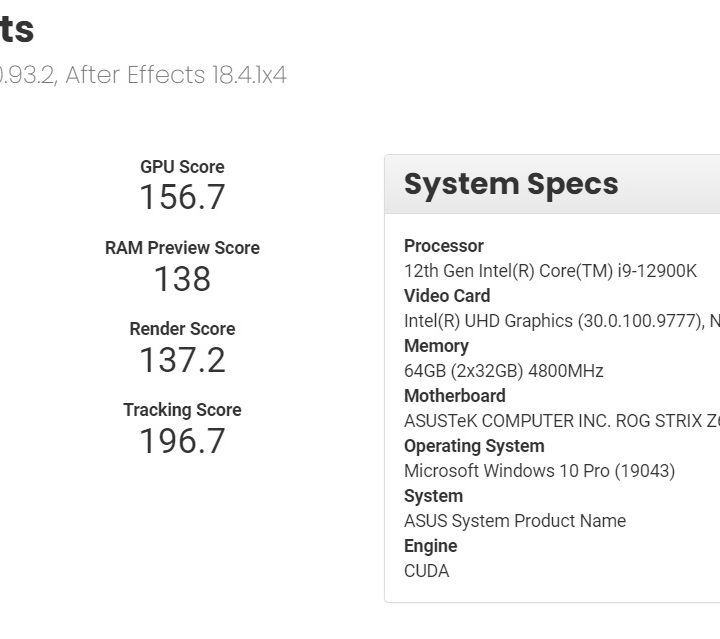
A similarly configured Ryzen 9 5950X rig managed an overall score of 1581, beating out the Core i9-12900K in the tracking and RAM preview scores. Meanwhile, an almost identical machine sporting a Core i9-11900K earned an overall score of 1548.
This isn’t the performance we were expecting, especially after a couple of splashy rumors claiming massive gains for Intel with Alder Lake. This is only a single benchmark, however, and PugetBench for After Effects isn’t the best benchmark for comparing processor performance. It’s more concerned with the GPU, and all three of the rigs mentioned above were tested with an Nvidia RTX 3090, which explains the largely similar scores.
In June, Alder Lake showed up in the GeekBench database, which tests the CPU more directly. However, even in this case, the tester ran GeekBench’s OpenCL test for graphics, not the test for processor performance. Even with a growing list of leaks and rumors, this result from the Puget System database is the closest we’ve seen to a real Alder Lake benchmark.
And right now, AMD’s Ryzen 9 5950X is still winning. However, it’s not entirely a fair battle. Alder Lake uses a hybrid architecture that combines performance (P) cores and efficient (E) cores to improve multithreaded performance and increase efficiency when power matters. This design hinges on a feature called Thread Director, which assigns tasks to cores based on which cores will provide the most benefit.
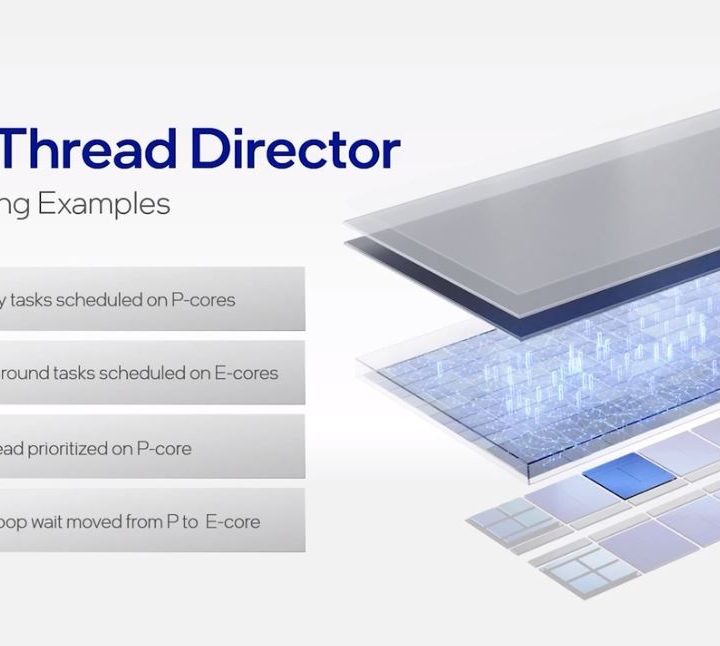
It sounds like a crucial feature for Alder Lake, and one that, according to Intel, will provide noticeable performance increases across applications. Thread Director likely isn’t available on this early sample, and it’s a feature that will provide the most benefit to Windows 11. Once those pieces are in place, the Core i9-12900K might perform better.
It’s important to underline here that these tests used an early version of the Core i9-12900K. We’re not sure what kind of sample it was, but it was not a final retail version. Intel says it can use up to 16 cores (eight P-cores, eight E-cores) and 24 threads with Alder Lake, which are likely the specs of the Core i9-12900K.
Although these results were done with an early sample, the Alder Lake release date is getting close. Intel has confirmed time and again that Alder Lake is set to launch by the end of 2021, and there aren’t a lot of months left. An astute guess points to the processors launching at Intel’s Innovation event, which runs from October 27 to 28, but Intel hasn’t confirmed anything. Hopefully, we’ll see some clearer benchmarks there.