The gloves are off and Google has thrown the first punch. On Tuesday, Google released the results of a detailed investigation it conducted to prove that Microsoft’s Bing is stealing copying search results from the world’s largest search engine. Google claims that Bing is collecting Google search data from its Bing toolbar and using it to improve its own search results. In response, Microsoft fired back saying it does not copy results, but also admitted that it does look at Google results from its toolbar. In defense of that fact, Microsoft claims that Google’s results are only one of 1,000 input streams Bing uses to determine search results.
But pretend you’re Microsoft. Imagine that you own Internet Explorer, the browser 56 percent of all Internet goers use. Now imagine that one of the features you built into your browser gives you access to a constant stream of results from searches made to competitors to your own search engine named Bing. Most importantly, you have access to the search engine results of your biggest competitor, a search engine named Google that holds a dominant 68 percent of the search market. Your own search engine, Bing, has 28.2 percent of the market. You’ve already started using this stream of Google searches to benefit your own search. The question is: how far do you go? How much of Google’s search juice do you bottle and mix with your own?
The experiment
We know now that Bing uses Google results to augment its search. So the real question is: how similar are the results from these two search engines? To find this out, I decided to conduct my own investigation using 10 random terms I thought up from whatever was floating in my head earlier today. This is not a scientific study by any stretch of the imagination. My results may not be typical. They are simply the results Google and Bing provided.
- 10 random words: adoxography (def: writing on a trivial subject), aromatherapy, arpu, best search engine, Digital Trends, “park place,” Sean Sheep (misspelling for Shaun the Sheep), The Rite, welk, and Will Wright. These words have been sorted alphabetically.
- The method: I searched each of these words simultaneously on Google (left) and Bing (right) and scanned the first page of results. Both engines default to 10 results per page, along with a varying number of social, map, news, and other widgets. I looked at Page 1 results in both search engines. Using colored boxes, I marked links that were shared across both Google and Bing.
- Preparation: To search, I used a Google Chrome browser in Incognito mode. I was logged out of both search engines and kept all settings at default. Both search engines seemed to know where I am (Chicago, Illinois), but I did not inform either of my location. I also ensured I was logged out of Facebook in Bing, which appears to have an effect on some results. Search histories on both engines were cleared.
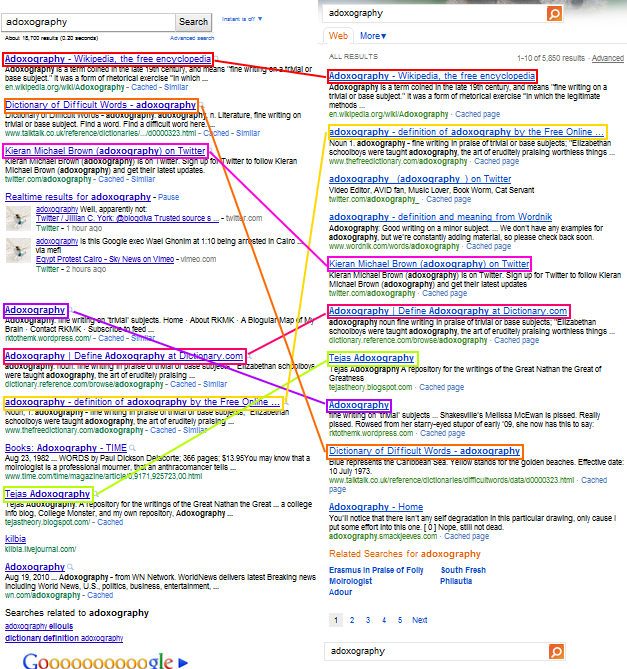
Below are pictures of the actual searches I performed on Google and Bing. Shared links are colored and connected via lines. Browse them them yourself to see just how cozy Google and Bing get, or skip ahead for the conclusion and breakdown.
Word: adoxography
7 out of 10 results are identical. Adoxography means “to write on a trivial subject.” It was the first, and strangest, word that came to mind. The results were astoundingly similar.
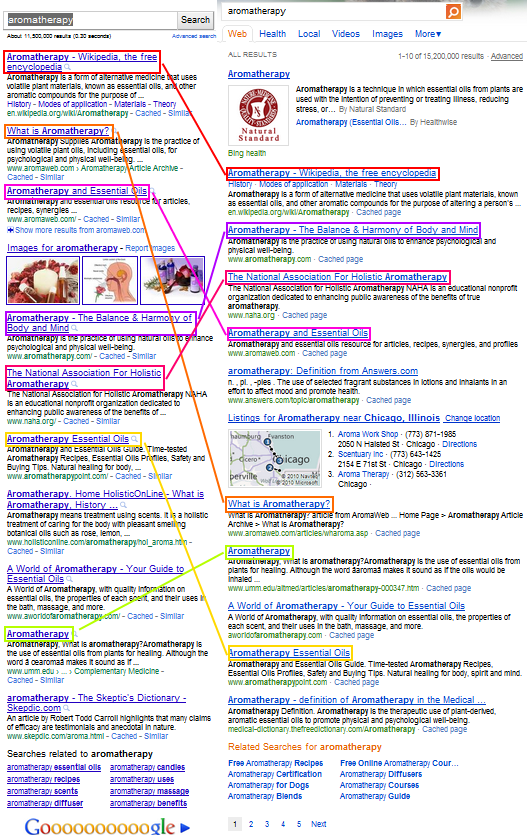
Word: aromatherapy
7 out of 10 results are identical. This word was on a container of soap in my kitchen. Again, the results are in a different order, but are mostly identical. As seems to be the norm, both search engines add their own little image and news widget boxes around the search results to differentiate themselves. Bing was most helpful here.
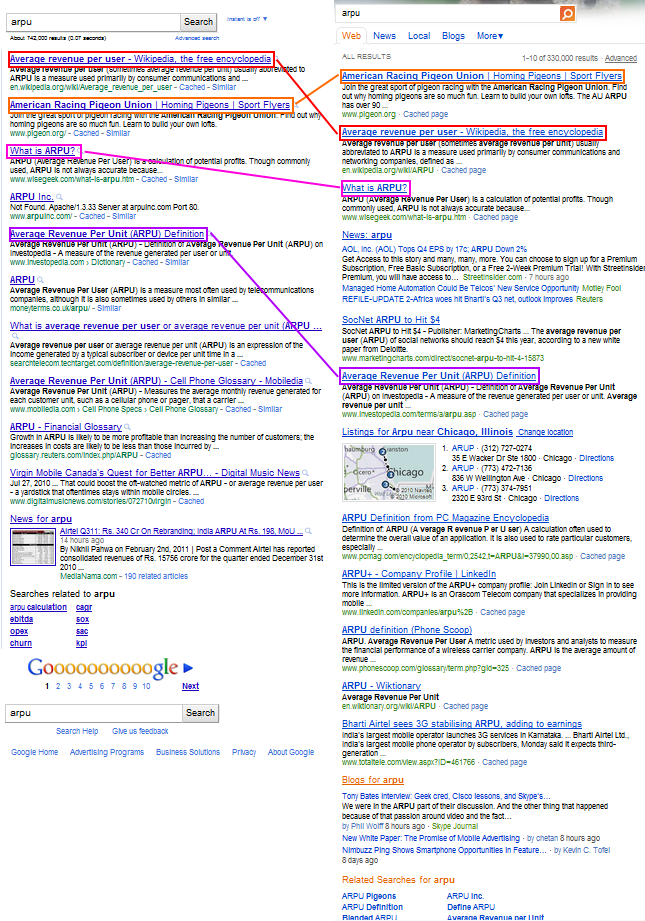
Word: arpu
4 out of 10 identical results. This is a common acronym in the mobile industry. It means “average revenue per user.” Apparently, it can also refer to the American Racing Pigeon Union. I didn’t know pigeons were allowed to organize.
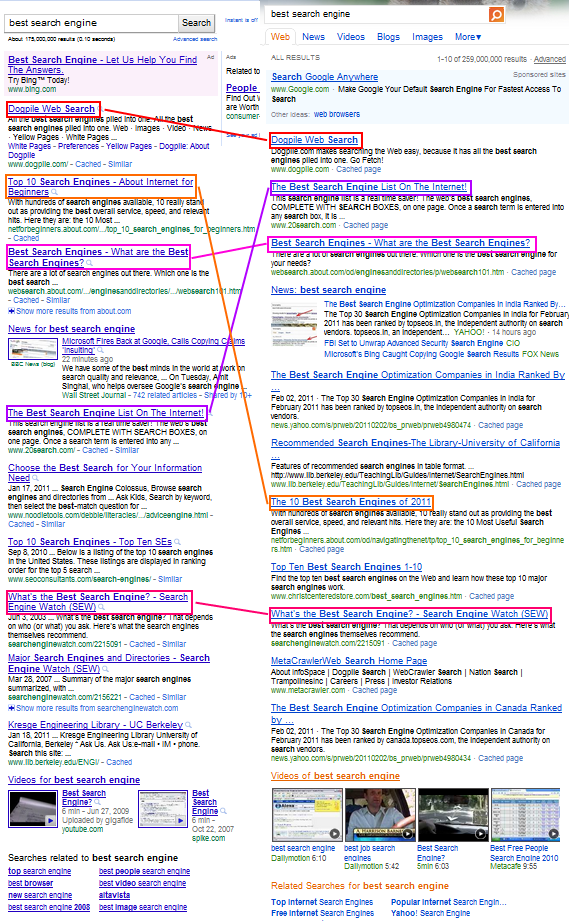
Word: best search engine
5 out of 10 results were identical. You be the judge here. Most interesting to me: Bing and Google advertise on one another.
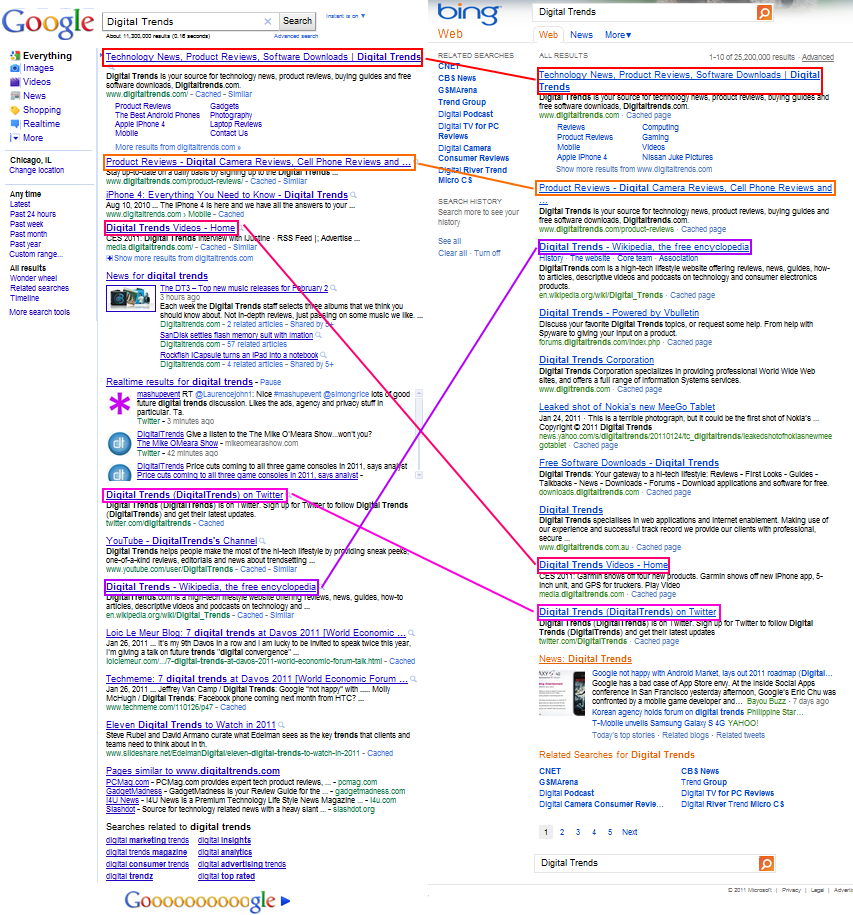
Word: Digital Trends
5 out of 10 results were identical. To kick things off, I vainly searched our own site up on both search engines. The correlations are largely explainable.
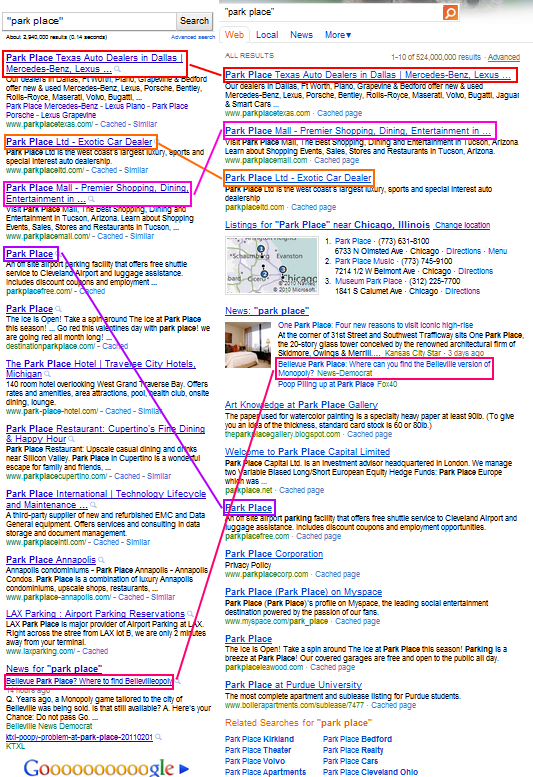
Word: “park place”
5 out of 10 results were identical. I wanted to search with quotes and a place. Monopoly came to mind. These results are strangely similar.
Word: Sean Sheep
2 out of 10 results were identical. This was one of the more obscure searches I did, and I attempted to confuse the engines by misspelling Shaun and omitting “the” from the search. Interestingly, only Bing showed perhaps the most relevant result: SeanSheep.com. Both engines assumed I meant Shaun the Sheep without asking.

Word: The Rite
4 out of 10 results were identical. This word was chosen as it is a recent movie release. Most of the shared results here could probably be logically explained.

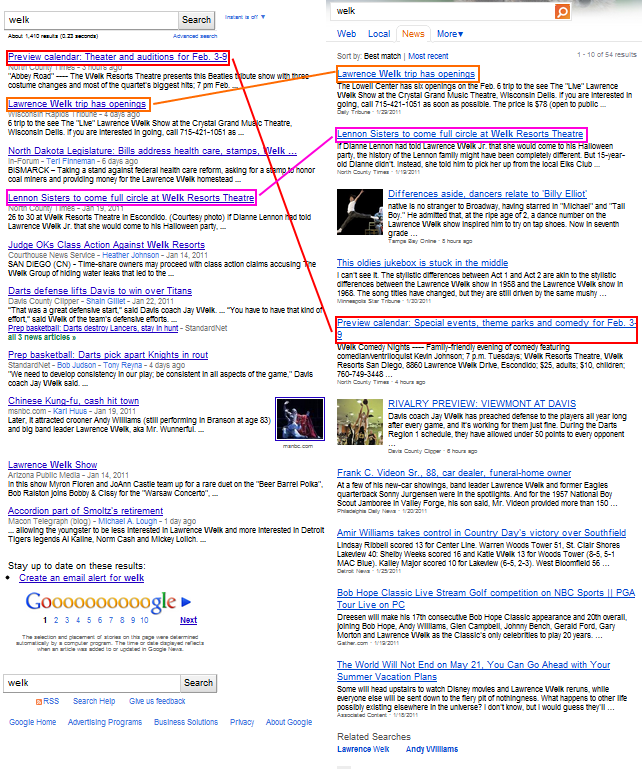
Word: welk
3 out of 10 results were identical. Both search engines assumed I was referring to the Welk Resorts Theatre and/or Lawrence Welk. Neither search engine produced great results.
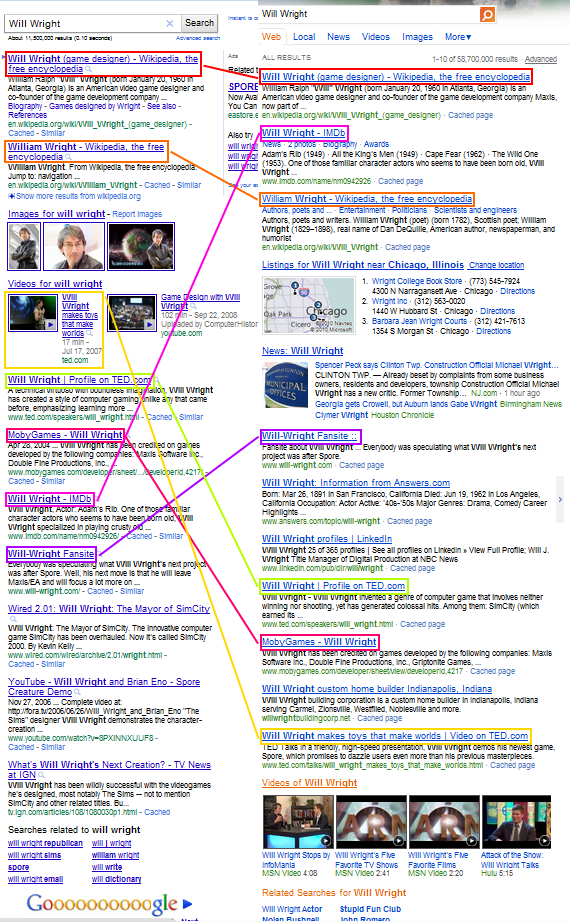
Word: Will Wright
7 out of 10 results were identical. I searched this term to see what results might look like for a famous person. Will Wright is a renowned game designer, best known for SimCity, The Sims, and Spore. Most of these shared links would be expected. IMDB, Wikipedia, etc are large aggregators of content relevant to this search.
Conclusion
Out of the 100 search results returned from Google and Bing, I found 49 shared links between them, meaning about half of all results were duplicated across both websites. Most words had at least 2 (20 percent) matching links between Google and Bing, and for 3 words, 70 percent of all links were duplicated across both search engines. Comparing second page links appeared to lead to even stronger correlations between the two search engines. Many of these similarities can be explained. After all, it is probably smart and natural for both search engines to pull up entries from Wikipedia and other top sites, but some shared links are fairly obscure and precise. There are some strange correlations between Google and Bing. I tried a few more words, some nonsensical, and found that there are, of course, search terms that produce no shared results.
Does any of this mean anything? Have you done your own comparisons between Google and Bing? One of the major things I learned today is that neither Google or Bing are very good at retrieving relevant results. A majority of links returned were to sites I had no interest in. Search, though much better than it was five years ago, is still in its infancy. We’ve got a long way to go.
I’ve always enjoyed revising and editing. It comes with all of the creative elements of writing, and the comfort of knowing that somebody else will do the hard leg work for you. Whether its one tiny metric out of a thousand or the dominant way Bing attains results, it isn’t right for Microsoft to use Google searches for its own benefit. In return, it is wrong if Google has done anything like this as well. However, instead of sniping at one another, it would be nice if both parties would sit down and actually improve the quality of their own products. With content farms like AOL around, we need smart search more than ever.