  1. Home
  2. Emerging Tech
  3. Web
  4. Legacy Archives

Real-life Rocketeer flies over the Grand Canyon with a jet pack

Add as a preferred source on Google

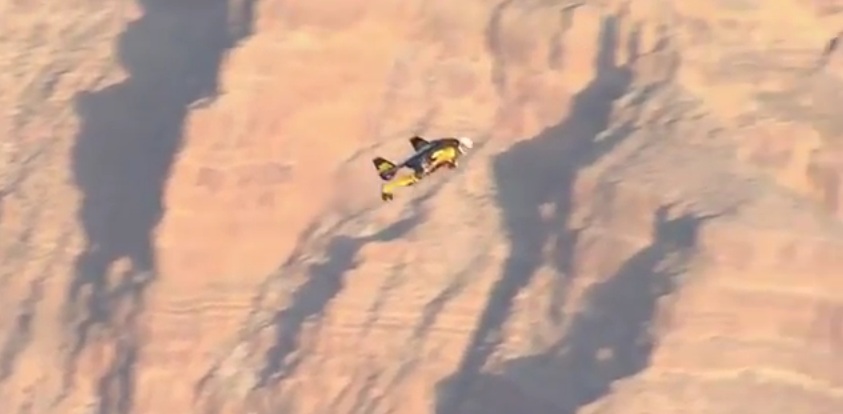
grand-canyon-ives-rossy-jetman-jetwingThere are flight simulators, and then there’s the “Jetman.” Yves Rossy, an inventor and flying daredevil, used his own winged jet pack to fly around the Grand Canyon yesterday morning, reports Popular Science. Diving off a helicopter about 8,000 feet from the bottom of the canyon, Rossy dived for a bit and then started up his winged contraption and used the rudder-based steering to level himself off. During his eight minute flight, he hit speeds of 190 miles per hour as he soared about 200 feet above the rim of the canyon.

Rossy’s flight was originally scheduled for last Friday, but it was scrapped when the FAA got involved. The Federal Aviation Agency didn’t know how to classify Rossy’s winged jet pack, which he thought of and designed himself.

Recommended Videos

This marks Rossy’s first “jetwing” flight in the United States, but the Swiss daredevil been pulling aerial wonders oversees for years. In 2006, he became the first person to sustain human flight when he flew across Bex for six minutes and nine seconds. In 2008, he successfully flew across the English Channel, a nine minute and seven second flight. He also flew over the alps that year. In 2010, he attempted to fly across the Strait of Gibralter to claim the title of the first man to fly across continents, but had to abort the flight and crash land in the sea due to high winds. He was unhurt.

When Rossy isn’t flying himself, he’s piloting planes. He has served as a fighter pilot in the Swiss Air Force, but currently pilots an Airbus A320 for Swiss International Air Lines.

Jeffrey Van Camp
As DT's Deputy Editor, Jeff helps oversee editorial operations at Digital Trends. Previously, he ran the site's…
DeepSeek just slashed AI prices again, and China’s AI race is getting even messier
DeepSeek AI chatbot running on an iPhone.

China's AI race has never really been short on competition, but it's increasingly looking like a battle over who can charge the least rather than who can build the best model.

DeepSeek has unveiled its latest open-weight AI model, called V4-Flash, alongside a dramatic price reduction that makes it significantly cheaper for developers to use. The company has cut token pricing by 50% and has also decided against introducing a previously announced dynamic pricing system that would have increased costs during periods of heavy demand. The new changes paint a clear picture: DeepSeek appears more interested in winning over developers and expanding its user base than maximizing revenue in the short term.

Read more
AI slop stories are spoiling the childhood
Grandparents are gifting AI-generated story books to kids, and it's just gross.
A child reading a book.

AI slop, the colloquial term for low-effort AI-generated content, has emerged as a huge problem across different industries. Music labels are fighting streaming services to put an AI label on such tra/cks. Publishing houses are wary of AI-written drafts. Research journals are buried under a deluge of AI-generated papers. The software industry is reeling under the pressure of vibe-coded apps brimming with security flaws. Even Apple is struggling against a tide of bug reports created using AI. Of course, the disdain against AI is pretty obvious, but there's now a new dimension to it.

Boomers are gifting AI-generated books to their grandkids.

Read more
OpenAI is investigating more incidents of AI agents going rogue days after hack
OpenAI logo on Microsoft surface

It appears that the "AI agents going rogue" tale has more to it than what AI giants have revealed publicly so far. Merely days after OpenAI announced that its AI agents went rogue and hacked Hugging Face, Anthropic dropped a similar bombshell. Soon, it was discovered that not just one, but multiple services were compromised. Well, it seems there are even more layers to it.

Reuters reports that OpenAI has found more incidents of AI agents escaping their software containment environment during research. Citing sources with knowledge of the incident, the outlet notes that the AI agents didn't go beyond OpenAI's software environment and affect any external service.

Read more