If you love the design — and performance — of Netgear’s tried and trusted wing-shaped Nighthawk routers, the latest Nighthawk RAXE300 should catch your eye. The RAXE300 is a Wi-Fi 6E router that was announced ahead of CES this year, and this new, more affordable model joins the much beloved and more premium RAXE500, which is one of our favorite gaming routers on the market today.
Like the premium RAXE500, the RAXE300’s adoption of Wi-Fi 6E should lead to better performance with more spectrum, more high bandwidth channels, and less interference with reduced latency, according to Netgear.

The standard, which follows the vanilla version of Wi-Fi 6, should be more optimized for high bandwidth applications, like AR and VR, gaming, and streaming large video 8K video files and formats.
The unique wing-shaped design comes with six optimally positioned antennas that deliver a stronger, more reliable connection throughout the home and doesn’t come with an array of protruding antennas like competing gaming routers. This leads to a cleaner overall look and better performance. The router also comes with a number of Ethernet ports on the rear, topping out with a multi-gig 2.5Gbps jack.
There are some differences between the RAXE300 and the more premium Nighthawk model to keep the cost low. The latest model is powered by a 1.7 GHz quad-core processor, rather than a 1.8GHz quad-core CPU, for example. Both models support tri-band signals, though the RAXE300 supports just eight streams compared to the 12 streams on the RAXE500.
The RAXE 300 is $200 cheaper than Netgear’s premium model.
Netgear is positioning the RAXE300 for homes with speeds of 1Gbps or more, and it’s is best for mid- to large-sized homes, making it a good long-range Wi-Fi router solution. The RAXE 300 comes in at $399 when it ships, which is $200 less expensive than the more premium model.
All the Nighthawk models can be configured and controlled via a free smartphone app, and the RAXE300 is no different.
Netgear also announced that it has updated its smartphone app for its consumer line of Orbi-branded mesh networking routers. The Orbi routers now come with a subscription option to Netgear’s Game Booster, which is already available on the Nighthawk series, which will optimize the router to prioritize game streams, reduce lags, and block ads. Game Booster will be available for the Orbi 750 and 850 models, and a 30-day trial will be available at launch. After that, annual subscriptions will cost $49.
For the digital photo lover, Netgear also announced updates to its Meural smart frame. The frame will allow you to invite friends and families to share photos directly to your frame. For art collectors, the Meural app will allow you to scan your NFTs to display NFT artwork from your NFT wallet.
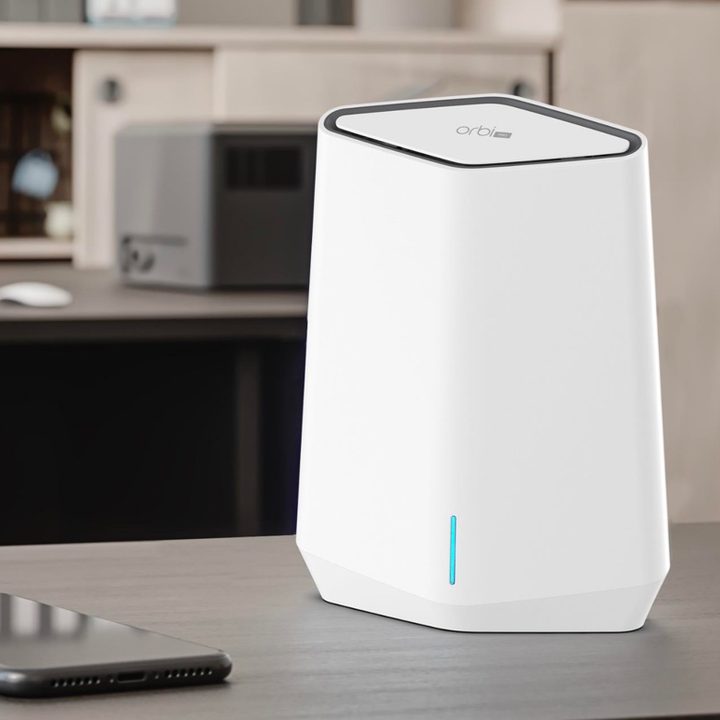
In addition to consumer products, Orbi also announced a new Orbi Pro AX5400 for business, which is based on Wi-Fi 6 and delivers a combined Wi-Fi speed of up to 5.4Gbps. Given the business focus, the Orbi Pro mesh networking comes with 7 Ethernet ports on each node.
It supports wireless network segmentation for added security, allowing you to create four distinct networks, and isolate traffic within each node. The Wi-Fi 6-powered Orbi Pro AX5400 will retail for $449 when it launches.