1. Home
  2. Computing
  3. Trash
  4. News

Miniature high-resolution webcams could soon be coming to laptops

Add as a preferred source on Google

Laptops are about to get even slimmer this year, and they won’t necessarily have to give up webcam quality either.

Immervision has announced a new 8-megapixel webcam sensor targeted at laptops and tablets that measures just 3.8mm thin. The module is being billed as the world’s thinnest camera system for a laptop.
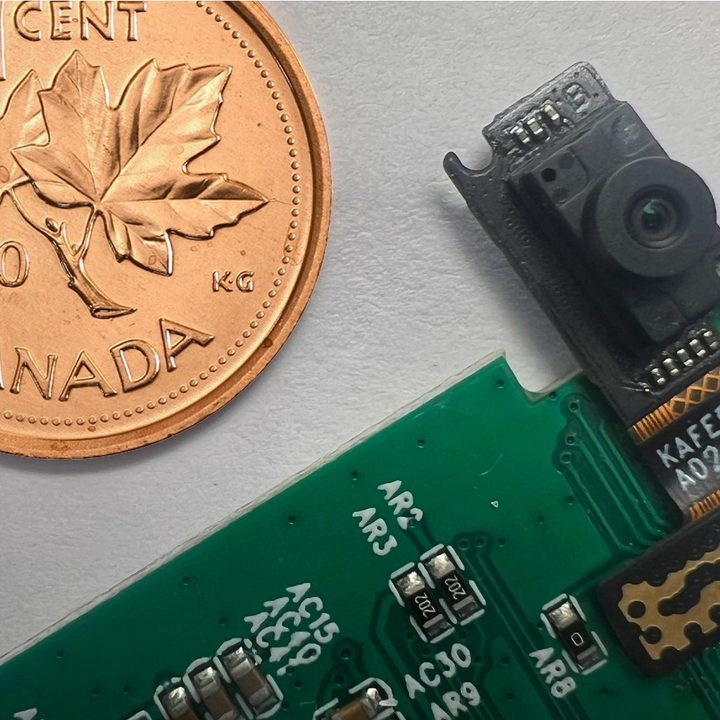
Immervision's new small webcam module, next to a Canadian coin.
Image used with permission by copyright holder

Immervision describes itself as the “world’s leading developer of advanced vision systems combining optics, image processing, and sensor fusion technology.”

“Immervision’s 8 MP ultra-wide-angle lens-and-sensor combination is only 3.8 mm thick and offers a high-quality solution for a variety of applications that require higher resolution, a wide field of view and advanced distortion control,” the company said of its latest tech at the close of CES this year. “This solution can handle a variety of videoconferencing scenarios, capturing larger scenes with optimal image sensor coverage, pixel density, and quality.”

The high megapixel resolution built into Immervision’s camera module comes at a time when the global health pandemic continues to rage on, forcing many people to shift to, or continue with, remote and hybrid work. Improvements to webcam technology will likely help fuel better collaboration and communications between remote teams.

According to Immervision, the challenge with creating a high-resolution camera sensor in a tight space is being able to shrink the lens and camera module while still delivering high image quality. Many companies are unable to do this, as a smaller module oftentimes lead to low resolution, distortion, and diminished performance in low light.

To overcome this, Immervision, combined its hardware and software together to deliver better results.

The Lenovo ThinkPad Z16 with a videoconferencing app open.
Image used with permission by copyright holder

“This miniature camera module can be used in conjunction with Immervision’s Wide-Angle Distortion Correction Dewarping Algorithms, with Face and Body Protection Algorithm, enabling [manufacturers] with an unprecedented, novel, and fresh video call experience,” said Patrice Roulet Fontani, Immervision co-founder and vice president of technology.

The company stated that it is working with laptop manufacturers to bring its camera technology to notebooks, tablets, hybrids, and convertibles. Immervision did not give any estimates as to when we’ll see the new webcam technology pop up.

The rise in videoconferencing has spurred an increase in the number f monitors that now come with a full videoconferencing system built-in. Hopefully, that means we’ll start to see thinner, lighter laptops featuring Immervision’s camera module debut sooner rather than later.


Chuong Nguyen
Silicon Valley-based technology reporter and Giants baseball fan who splits his time between Northern California and Southern…
South Korea wants to give every citizen free, unlimited access to its own AI chatbot
The government-backed service could turn generative AI into public infrastructure instead of another monthly subscription
Electronics, Mobile Phone, Phone

South Korea wants to give every citizen free access to an AI chatbot with no usage limits. That puts the technology closer to a public utility than another premium service demanding a monthly subscription.

The Ministry of Science and ICT announced the AI for Everyone project on July 13. Private companies will build the platform around locally developed models, while a separate AI agent will help people navigate government services. It’s a more practical job than generating emails or settling arguments nobody wanted to research themselves.

Read more
Falling in love with a chatbot is now off limits for kids in China
The crackdown targets emotional AI relationships as regulators worry about the country's record low birthrate.
Replika AI companion app on an iPhone in hand

Ever since AI chatbots arrived on the scene, there has been one aspect that has worried lawmakers and experts a lot: humans forming emotional connections with chatbots. There have been plenty of cases where over-reliance on these AI companions or partners has resulted in medical emergencies, lost lives, and triggered multiple lawsuits against the likes of OpenAI and Meta.

China cracks down on AI companion apps

Read more
Russian hackers keep finding their way into critical networks through neglected routers
A multinational warning says outdated firmware, weak passwords, and insecure settings are giving state-backed attackers an easy opening
A Wi-Fi router next to a laptop.

Russian state-backed hackers have spent more than a decade exploiting a stubborn weakness in critical infrastructure networks. Organizations are still leaving poorly configured and outdated routers exposed to the internet.

In a joint cybersecurity advisory, the NSA, CISA, FBI, and international partners warn that hackers linked to Center 16 of Russia’s Federal Security Service are continuing to target vulnerable networking equipment. Energy, healthcare, and government networks are among the sectors facing the highest risk.

Read more