1. Home
  2. Space
  3. News

Relive NASA’s extraordinary Mars rover landing, one year on

Add as a preferred source on Google

On Friday, February 18, it will be a year to the day since NASA’s Perseverance rover made its extraordinary landing on Mars.

Extraordinary not only for NASA’s feat of successfully landing its most advanced rover to date on the red planet but also for the simply stunning video footage that showed the vehicle in its final stages of descent.

Recommended Videos

Thanks to a multitude of high-definition cameras fixed to the descent stage (also called the skycrane) and Perseverance itself, the video provided the best view ever seen of a human-made object landing on the surface of another celestial body.

The final moments of Perseverance’s six-month voyage from Earth were described by NASA as “seven minutes of terror,” so crucial and challenging was the all-important descent onto Mars’ Jezero Crater.

Exactly a year on, we thought it’d be fun to take another look at the footage showing that incredible landing. It features Mission Control’s audio feed together with the team’s ecstatic celebrations when confirmation of the successful touchdown came through.

Perseverance Rover’s Descent and Touchdown on Mars (Official NASA Video)

The diagram below shows the three sections that made the landing possible, and also shows the position of all of the cameras that captured the final stages of Perseverance’s descent.
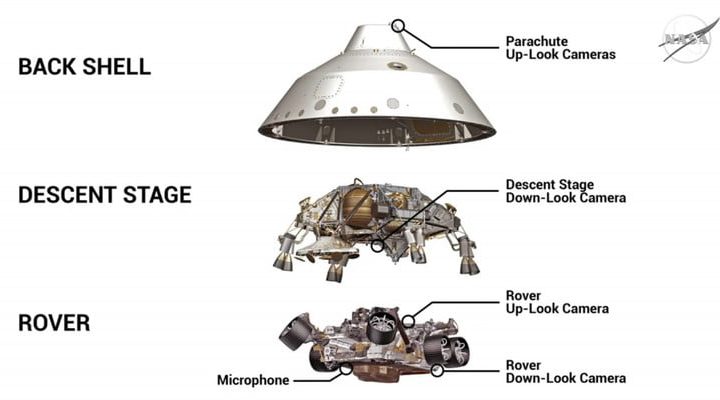
The cameras that captured Perserverance's Mars landing in February 2020.
NASA

The footage starts with the deployment of the parachute linked to the back shell. A short while later, we see the heat shield, which protected Perseverance from its high-speed entry into Mars’ atmosphere, falling to the ground.

Just 2o meters from the surface, Martian dust is kicked up by the descent stage’s thrusters, which enable it to hover as it carefully lowers Perseverance to the ground.

As the rover’s six wheels make contact with Mars for the first time, we see the descent stage release the attached cables and rapidly fly away.

Below is another video of the landing featuring extra footage.

Perseverance Rover’s Descent and Touchdown on Mars (Official NASA Video)

After setting down on Mars, Perseverance beamed back the first 360-degree view of its new surroundings.

NASA’S Perseverance Rover’s First 360 View of Mars (Official)

Since then, NASA’s rover has been exploring Jezero Crater as it searches for signs of ancient microbial life and collects rock samples for return to Earth in a later mission. Perseverance also brought with it Ingenuity, a drone-like helicopter that last April became the first aircraft to achieve powered, controlled flight on another planet.

Trevor Mogg
Contributing Editor
Not so many moons ago, Trevor moved from one tea-loving island nation that drives on the left (Britain) to another (Japan)…
China’s answer to SpaceX’s reusable rockets literally catches boosters in a net
SpaceX catches boosters on legs. China just used a net.
Ammunition, Missile, Weapon

SpaceX's playbook for recovering a rocket booster generally involves legs, a precisely controlled vertical landing, and either a concrete pad or a drone ship. 

China just managed to pull off something similar, but in a slightly different way, and on July 10, it tested the method as well.

Read more
Dimming the sun sounds unhinged, but this new study on El Niño makes a surprisingly good case for it
A natural test case, Australia's worst-ever wildfire season, suggests the idea deserves serious consideration.
Nature, Outdoors, Sky

When I first saw "scientists propose dimming the sun," I rolled my eyes. It sounds like a science fiction movie cooked up after watching many climate documentaries. But a new study, published on July 8, 2026, in the journal Science Advances, seems to have a genuinely compelling argument.

A Super El Niño is currently forming in the Pacific, feared to be the most intense in decades. It could escalate floods, wildfires, and extreme heat events worldwide. However, Researchers at UC San Diego's Scripps Institution of Oceanography, led by climate scientists Kate Ricke and Jessica Wan, are now proposing one of the most interesting solutions I’ve come across.

Read more
You can now walk through space and gaze into a black hole at this VR exhibit
Smithsonian Starstruck lets you drift past dying stars and see the origin point of the universe for as little as $18 a person.
Smithsonian Starstruck featured

Most planetarium shows ask you to sit still and look up. The Smithsonian's new VR exhibit takes a different approach, letting visitors walk through the vast expanse of the universe, drifting past stars, planets, and a black hole to get a physical sense of its true scale.

A $29 ticket to the edge of the galaxy

Read more