  1. Home
  2. Emerging Tech
  3. Web
  4. Legacy Archives

Jellyfish invasions shut down three nuclear power plants

Add as a preferred source on Google

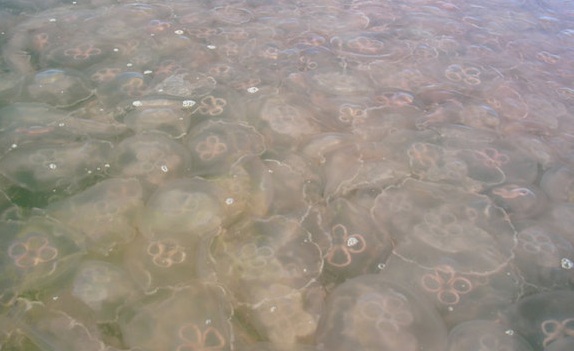
Jellyfish via Life's little mysteriesSeems like jellyfish are the latest critics against nuclear power use. Earlier this week a nuclear power plant on the coast of Israel was forced to shut down due to a jellyfish clog in their cooling system. Two weeks before this incident, two seperate countries had coastal reactors which were clogged similarly. These events are sparking speculation on whether this is a growing trend driven by climate change.

The string of jellyfish surges began with a reactor in Shimane, Japan and in a week’s time two nuclear reactors on the Scottish coast were also crippled by jellyfish in the cooling system. The Scottish Torness nuclear power plants, as well as the Japan and Israel plants pull cold sea water to creating cooling pools for the reactors within. The plants logically have filters (called flumes) to keep marine life out since they rest on the coast, but a possibly global jellyfish bloom is proving too much for these filters to handle.

Recommended Videos

Monty Graham, a jellyfish biologist from the Dauphin Island Sea Lab, told Life’s Little Mysteries, “Jellyfish populations spike and wane with climate variability, so it’s not hard to make the logical leap that if climate is changing long-term, we’ll likely see a population change.”

Graham pointed out dozens of cases where jellyfish blooms caused problems for coastal power plants over the past few decades. A researcher at the Monterrey Bay Aquarium Research Institute also pointed out that that an Australian power plants was forced to shut down completely in 1937. Graham cautions that since researchers have only been tracking jellyfish populations for a short period of the time, they don’t have the data to support whether this is a global trend and the recent incidents could be coincidental. He says that these incidents could even be attributed to the increase on coastal power plants.

To combat the overwhelming numbers of jellyfish, plants are investing in countermeasures including more filters and a jet bubble system which floats jellyfish to the surface away from the cooling system.


Jeff Hughes
Former Digital Trends Contributor
I'm a SF Bay Area-based writer/ninja that loves anything geek, tech, comic, social media or gaming-related.
Your future AR glasses might finally stop making the real world look weird
Researchers have developed a new display technique that keeps virtual objects realistic without dimming the real world.
Samsung AR Glasses

One of the biggest promises of augmented reality is blending digital objects seamlessly into the real world. Ironically, today's AR glasses often make the real world harder to see. Researchers at the Shibaura Institute of Technology (SIT) in Japan, led by Assistant Professor Xiaodan Hu in collaboration with Dr. Yan Zhang and Professor Xubo Yang from Shanghai Jiao Tong University in China, and Professor Kiyoshi Kiyokawa from Japan's Nara Institute of Science and Technology, have developed a new AR display technique that aims to make virtual objects look realistic without reducing visibility of the real world. The study was published in IEEE Transactions on Visualization and Computer Graphics.

The biggest AR problem isn't virtual objects; it's everything around them

Read more
Anti-surveillance clothing is getting cheaper, but don’t expect an invisibility cloak
Affordable shirts now claim to confuse facial recognition, although their protection depends heavily on the camera and software watching you
Chart, Plot, Adult

Anti-surveillance clothing is starting to look less like an art-school experiment and more like something you could actually wear outside. Shirts designed to confuse facial recognition systems now cost about as much as ordinary streetwear, although buying one won’t make you disappear.

The Guardian reports that designers are using face-like prints, unusual cuts and infrared lights to interfere with computer vision. These techniques target specific weaknesses, so their success depends on what happens to be watching you.

Read more
This spinning drone hides in plain sight using a visual illusion
This drone doesn't turn invisible. It tricks your brain into thinking it has.
Phantom Twist

For decades, engineers have chased the dream of an invisible drone. The usual approaches have involved transparent materials, camouflage coatings, or complex optical systems that bend light around an object. Researchers at Northwestern University decided to take a completely different route. Instead of hiding the drone itself, they chose to fool the human eye.

The result is Phantom Twist, an experimental drone that spins so rapidly it almost disappears into the background. It's not technically invisible, but to anyone watching, it looks more like a faint blur than a flying machine.

Read more