Plenty of companies now offer all-in-one soundbars that can reproduce Dolby Atmos, but none are as thin or as powerful, as the Dione — a $2,400 speaker from French audio company, Devialet, that offers 5.1.2-channel sound from almost any source. The Dione can be pre-ordered at Crutchfield, Audio Advice, and Buy at World Wide Stereo , and will start shipping in April.
Devialet has always had a tendency to push the limits with its products, the most famous example being its Phantom wireless speaker — a remarkably compact, $2,000 device that pumps out 750 watts of power and has an earth-shattering bass response. That same spirit appears to be alive and well inside the Dione. From a sheer audio footprint point of view, its 17 drivers (nine full-range units and eight subwoofers) are already more numerous compared to any other single soundbar you can buy, including the awesome $2,500 Sennheiser Ambeo, which rocks 13 discrete drivers.
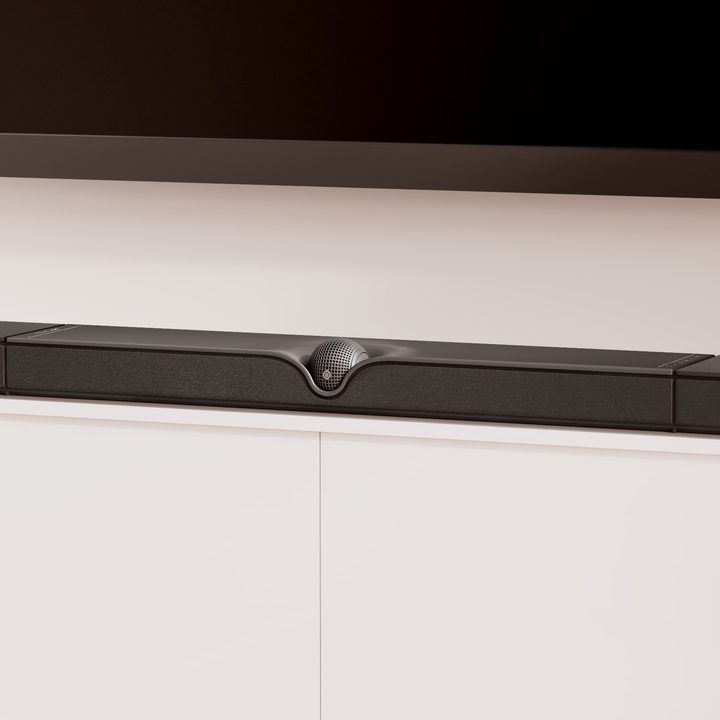
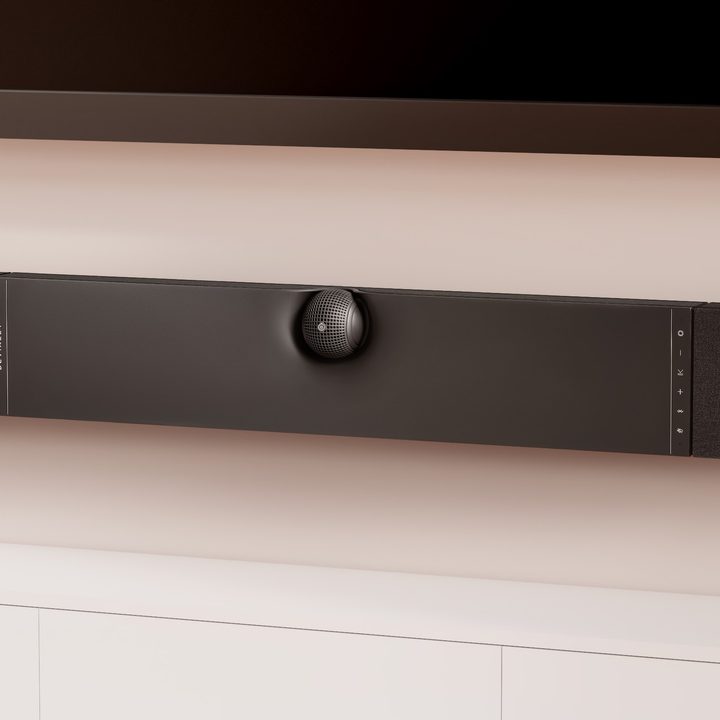
But what’s even more surprising is that the Dione manages to embed all of those speakers into a frame that stands just three inches tall when used in its tabletop mode. For comparison, the Ambeo is 5.3 inches tall, which means it will block the bottom portion of most TVs that aren’t wall-mounted. The Dione can be wall-mounted too, and doesn’t require a special bracket. An internal gyroscope senses the Dione’s change in orientation and adjusts its sound accordingly. Bang & Olufsen’s Beosound Stage soundbar can also be flipped vertically for wall-mount applications, but you need to use its mobile app to set the new position.
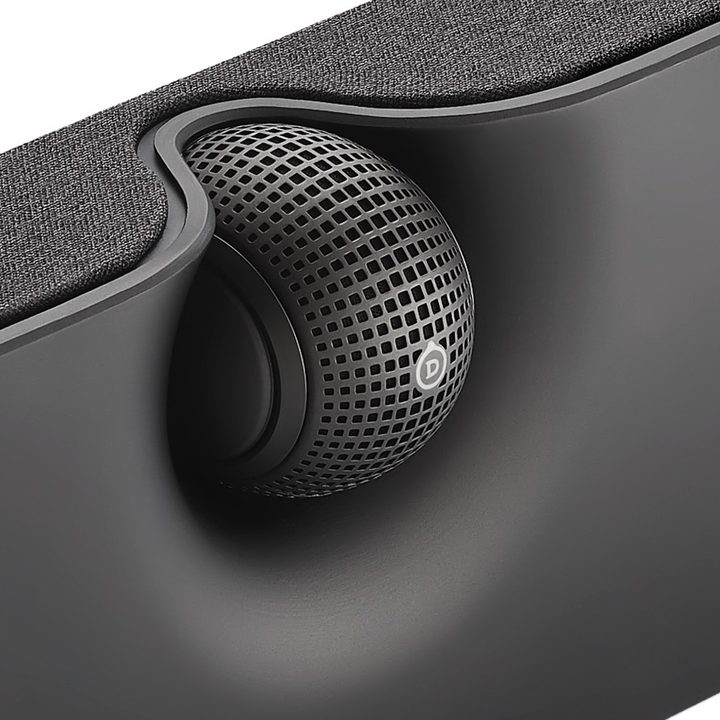
One of its most eye-catching features is its central sphere, which Devialet calls the Orb. It houses the center channel full-range driver and it can rotate 180-degrees to adapt mechanically and acoustically to the position of the soundbar, “maximizing sound restitution no matter where the soundbar is positioned,” according to the company’s press release. The soundbar includes a room calibration feature using built-in microphones to help you get the most from its acoustics, regardless of your room’s size and shape.
In addition to being Dolby Atmos compatible, Devialet uses its own proprietary version of 3D-sound upscaling, called Space. Devialet says this can make any sound source, like 2-channel stereo TV soundtracks, feel like it’s a fully immersive 5.1.2-channel signal. This is further enhanced through the company’s Advanced Dimensional Experience (ADE) technology that uses beamforming to reinforce 3D immersion. The soundbar also uses a custom Devialet digital-to-analog converter (DAC) that supports up to 24-bit/96kHz resolution digital audio, so it should be compatible with hi-res audio. However, in the spec sheet provided by Devialet, no mention was made of specific support for FLAC, WAV, MQA, ALAC, or any other hi-res compatible music formats. Only video-based audio formats are listed: PCM/LPCM, Dolby Digital, Dolby Digital Plus, Dolby TrueHD, Dolby Atmos.
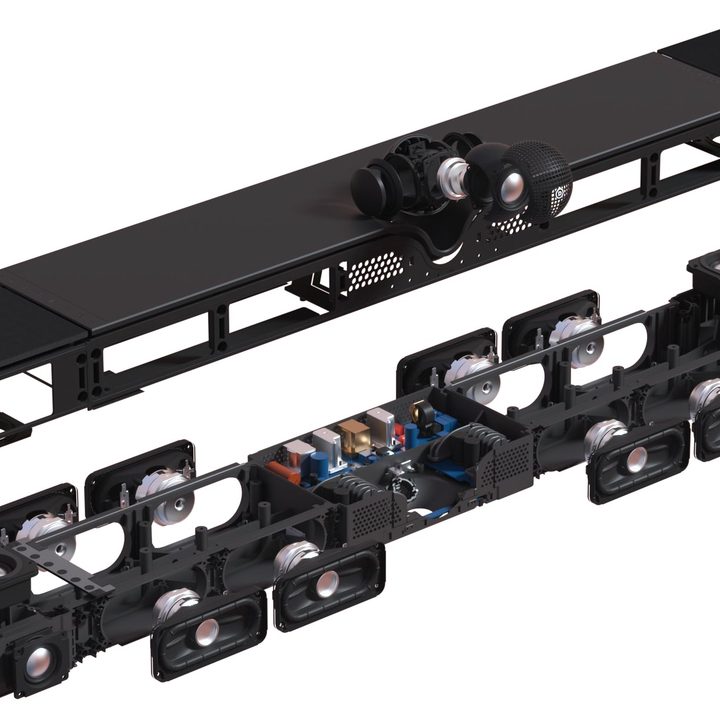
As you can see in the exploded view above, Devialet has arranged all eight subwoofers in a “push-push” configuration, with sound being driven both forward and backward from the soundbar’s enclosure. A set of full-range drivers occupy the furthest sides of the speaker, which project sound to the left and right, where it can be bounced back toward the listener to create virtual surround channels. The same approach is used by the dual up-firing height channel drivers that sit atop the Dione when it’s placed flat. Devialet hasn’t explained how these height drivers work when the Dione is wall-mounted.
As impressive as all of this sounds, it’s worth noting that even though it can replace a 5.1.2 home theater speaker installation, the Dione can’t act as an A/V receiver replacement. With only one HDMI 2.1 ARC/eARC input and one optical input, the soundbar relies entirely on your TV to manage video inputs. All of your devices, like streaming boxes, game consoles, or Blu-ray players, will need to be plugged into one of your TV’s existing HDMI inputs in order to work with the Dione. This is one area where the Sennheiser Ambeo, with its three HDMI inputs, is still further ahead.

Still, the Dione is well-equipped from a wireless connectivity stand point. It has Wi-Fi, Apple AirPlay 2, Spotify Connect, Universal Plug and Play (UPNP), and Bluetooth 5.0 — though Chromecast is conspicuously absent.
Can the Devialet Dione give the Sennheiser Ambeo a run for its money, or is this a case of style over substance? We hope to get a review unit in for testing as soon as possible.