NASA’s sky-watching treats for June include views of a planetary breakup, a famous star cluster, and the Lyra constellation.
Planetary breakup
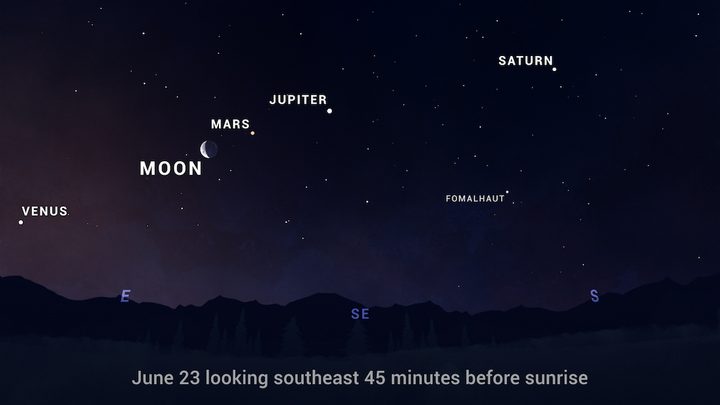
First up, NASA suggests checking out the lineup of Saturn, Mars, Jupiter, and Venus, which we’ve been able to view in the morning sky over recent months. Viewable with the naked eye, the four planets are starting to appear increasingly distant from one another, and Venus and Saturn are set to disappear from view as morning objects for most skywatchers by September.
“Look for this increasingly spaced-out planetary precession in June,” NASA says, adding that you should also look out for the crescent moon when it appears as part of the lineup of celestial bodies on the morning of June 23.
Hercules Cluster
M13, also known as the Hercules Cluster, is a well-known globular star cluster, described by NASA as a “spherical collection of stars, tightly packed together in its centers.”
Hercules is estimated to comprise several hundred thousand stars that are thought to be around 12 billion years old, which means they’re “approaching the age of the universe itself.”
The space agency recommends using a telescope to properly view the Hercules Cluster, though it adds that a pair of binoculars will just about do the job. Failing that, NASA suggests you find out about nearby public observing events run by its Night Sky Network.
In June, the Hercules Cluster can be spotted high in the east in the first couple of hours after dark. Check out the video at the top of this page for informative visuals on how to find it, or use one of the many available astronomy apps to point you in the right direction.
The constellation Lyra
Lyra is one of the smaller constellations and is home to one of the brightest stars.
As per NASA: “Lyra represents a lyre, or harp, played by the musician Orpheus in Greek mythology. In Arab cultures, as well as ancient Egypt and India, Lyra was seen as an eagle. And the Inca of South America saw it as a llama.”
Vega is the brightest star in Lyra, and the fifth brightest star viewable from Earth. In the Northern Hemisphere, Vega is the second brightest star, after Sirius.
Due to its bright appearance, tracking down Vega is the best way to get Lyra in your sights. In the Northern Hemisphere, you’ll spot it halfway up the eastern sky in the first couple of hours after dark. Again, check out the video for a detailed explainer on how to find Lyra, or use your favorite astronomy app.
Though you can see Lyra with the naked eye, NASA says that using a pair of binoculars or a telescope offers a chance to view the others stars in the constellation.
“It’s sometimes described as looking a bit like a diamond ring, with Vega as the diamond,” the space agency says, adding: “And that’s not the only ring in Lyra. It’s also home to the famous Ring Nebula, where a star has blown off most of its outer layers, leaving behind a remnant star known as a white dwarf.”
Ever fancied photographing the night sky? Then check out this Digital Trends article for everything you need to know.