1. Home
  2. Space
  3. News

Hubble Space Telescope snaps sparkling globular cluster near the heart of our galaxy

Add as a preferred source on Google

Stars shine like diamonds in this week’s image from the Hubble Space Telescope, which shows globular cluster Terzan 9.

Located in the constellation of Sagittarius, Terzan 9 is relatively close to the center of the Milky Way. “Globular clusters are stable, tightly bound groups of tens of thousands to millions of stars,” Hubble scientists explain. “As this image demonstrates, the hearts of globular clusters are densely packed with stars. Terzan 9 is dotted with so many glittering stars that it resembles a sea of sequins, or a vast treasure chest crammed with gold.”
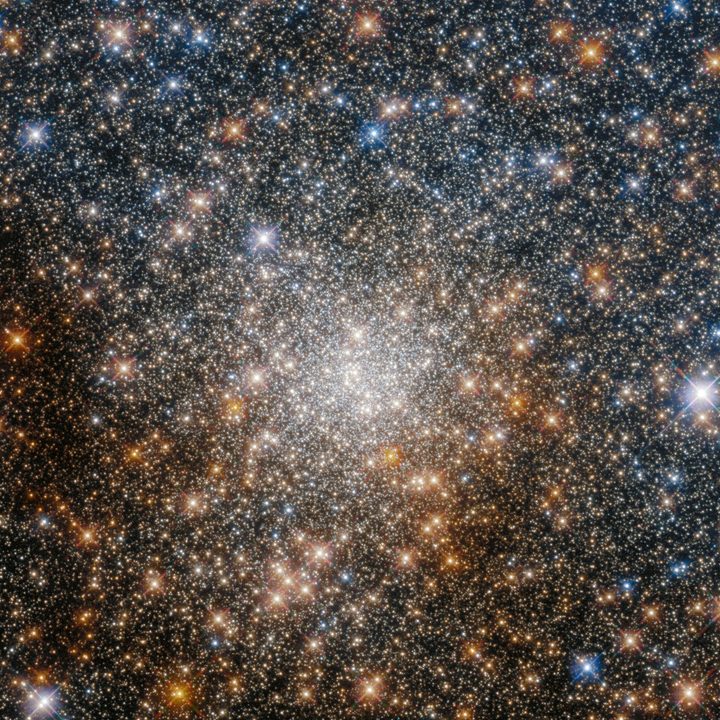
This star-studded image shows the globular cluster Terzan 9 in the constellation Sagittarius, toward the center of the Milky Way.
This star-studded image shows the globular cluster Terzan 9 in the constellation Sagittarius, toward the center of the Milky Way. The NASA/ESA Hubble Space Telescope captured this glittering scene using its Wide Field Camera 3 and Advanced Camera for Surveys. ESA/Hubble & NASA, R. Cohen

The center of the Milky Way, called the galactic bulge, is a region rich with stars. Most of the Milky Way, like most spiral galaxies, is a flat wheel shape, but in the center, the bulge sticks out from that plane. The stars which make up the bulge are different from those lying in the plane, as those in the middle tend to be older and redder.

Recommended Videos

There is also a lot of interstellar dust in the Milky Way’s galactic bulge, which makes it harder to study this region as the dust obscures the view. “This dust makes globular clusters near the galaxy’s center difficult to study, as it absorbs starlight and can even change the apparent colors of stars in these clusters,” the Hubble scientists explain. “Hubble’s sensitivity at both visible and infrared wavelengths allows astronomers to measure how star colors change due to interstellar dust. Knowing a star’s true color and brightness allows astronomers to estimate its age, and thereby estimate the globular cluster’s age.”

Within the galactic bulge, there aren’t only stars. At the center of almost all galaxies like supermassive black holes, which shape the bulges around them. The supermassive black hole at the center of our galaxy, Sagittarius A*, was recently imaged in an international effort that used radio telescopes to detect the glowing gas located around the black hole. The region immediately around this black hole is chaotic and busy, with threads of dust and gas as well as stars and even some strange stretchy bodies called G objects.

Georgina Torbet
Georgina has been the space writer at Digital Trends space writer for six years, covering human space exploration, planetary…
Space is becoming Bezos and Musk’s next data center site, and we have every reason to worry
The AI boom is coming for the night sky
How Vast's space station will look in orbit.

AI data centers already consume vast amounts of electricity and water on Earth, so Silicon Valley has begun looking somewhere considerably more spacious... literally.

Elon Musk's SpaceX and Jeff Bezos' Blue Origin, along with several other companies, have proposed enormous constellations of satellites designed to operate as orbital data centers. However, environmental groups and former space officials are now warning that putting them into orbit at the proposed scale could have severe consequences for Earth's atmosphere and the night sky.

Read more
The first possible exomoon is here, and it makes our Moon look hilariously tiny
Scientists may have found the first exomoon, except this one is the size of Jupiter
This artist’s concept depicts a potential volcanic moon between the exoplanet WASP-49 b, left, and its parent star. New evidence indicating that a massive sodium cloud observed near WASP-49 b is produced by neither the planet nor the star has prompted researchers to ask if its origin could be an exomoon.

We have already discovered more than 6,000 planets outside of our immediate neighborhood. Yet, finding a moon orbiting one of those distant worlds has proved considerably harder. Astronomers may finally have something close to the real deal, but this particular object stretches the word “moon” almost beyond recognition.

Using the European Southern Observatory’s Very Large Telescope in Chile, researchers detected strong evidence for a moon-like object in the CD-35 2722 system. Further observations are still necessary to confirm the discovery, but it could become the first confidently detected natural satellite outside our solar system. There is still one tiny complication though. This moon is apparently massive.

Read more
China’s answer to SpaceX’s reusable rockets literally catches boosters in a net
SpaceX catches boosters on legs. China just used a net.
Ammunition, Missile, Weapon

SpaceX's playbook for recovering a rocket booster generally involves legs, a precisely controlled vertical landing, and either a concrete pad or a drone ship. 

China just managed to pull off something similar, but in a slightly different way, and on July 10, it tested the method as well.

Read more