  1. Home
  2. Emerging Tech
  3. Legacy Archives

Viral video: what happens when two chatbots have a conversation

Add as a preferred source on Google
chatbot
Image used with permission by copyright holder

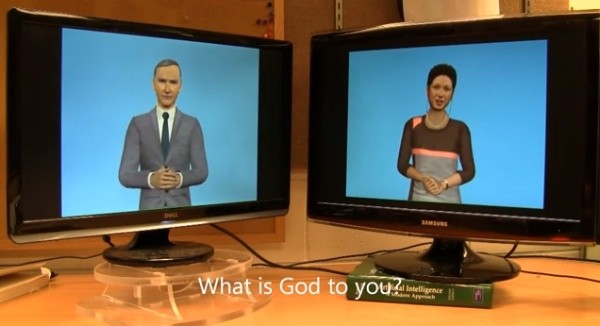
If you’ve ever been bored on the Internet (which, of course, you have), then you may have stumbled into a chat with Cleverbot, one of the various artificial intelligence entities that exist online. Since all the responses from Cleverbot are generated by a computer program, the conversations often take unexpected turns. But what would happen if two of these so-called chatbots talked amongst themselves? 

This brilliant question was put the the test at Cornell University’s Creative Machines Lab, which focuses on the study of “autonomous systems that can design and create other machines — automatically,” according to the description on the lab’s website. To accomplish this, researchers at Creative Machines put two chatbots together, and the result is nothing short of amazing.

Recommended Videos

The project serves as Creative Machine’s submission to the 2011 Loebner Prize Competition in Artificial Intelligence, which takes place this year on October 19 at the University of Exeter in the UK. At stake is a $100,000 grand prize, which goes to the team whose AI has an authentic look and communications capacity to that of a real human. The prize Creative Machine is up for is the Silver Metal prize, which comes with $25,000 in winnings, and is awarded to the team whose AI can hold the most human-like conversation.

Last year’s Loebner Prize went to AI programmer Bruce Wilcox, who created a chatbot named Suzette. 

So, how human-like is the Cornell team’s duo? That depends on what your definition of “human-like” is. If talking over each other, misunderstanding, being mildly offensive and talking about God are all on your list of qualifications, then these chatbots may be winners. Of course, the actual product is slightly less human-like, and much more two-chatbots-talking-to-each-other-like. But the AIs still manage to keep the conversation interesting, which is more than we can say for some people.

(via Engadget)

Andrew Couts
Features Editor for Digital Trends, Andrew Couts covers a wide swath of consumer technology topics, with particular focus on…
Google’s new AI gives robots better balance, smarter hands, and teamwork capabilities
Google just made robots a lot less clumsy and a lot more helpful.
Gemini robotics 2.0

Google DeepMind just brought sci-fi robots closer to reality, and it is very exciting. Building on its original Gemini Robotics model, the company has introduced Gemini Robotics 2, an AI system designed to help robots think, move, and even work together. Unlike most robots today, which rely on pre-programmed routines or someone controlling them remotely, this new system lets robots figure things out on their own when situations get unpredictable.

Can robots finally handle whole-body tasks?

Read more
Remember Samsung’s Ballie home robot? It may finally be inching closer to reality
Leaked app wireframes give the strongest hint yet that Samsung's Ballie home robot, first shown at CES 2020, might still be headed toward an actual release.
Samsung Ballie robot in a room next to a dog feeder.

Samsung's rolling home robot has been the industry's longest-running "will it ever actually ship" joke, and I'll admit I'd mostly given up on it. Now, there's finally a glimmer of hope.

Samsung first unveiled Ballie as a concept at CES 2020. Then, it showed it as a significantly upgraded version four years later. However, the company never confirmed a release date or committed to releasing it at all. 

Read more
Polar is yet another AI browser, but it goes beyond just automating the mundane web chores
Polar wants to turn your browser into an AI-powered productivity tool
Polar AI browser

The AI browser race is entering a new phase. After spending much of 2025 trying to reinvent web search with built-in chatbots, startups are increasingly shifting their attention toward browser agents that can automate repetitive work instead of simply answering questions. The latest company to embrace that transition is Polar, a startup founded by former Perplexity engineer Kevin Zhang, which has raised $5.7 million in seed funding led by Madrona.

Unlike the first generation of AI browsers that targeted everyday consumers, Polar is designed specifically for knowledge workers. Its premise is straightforward: instead of replacing Google Search, the browser aims to eliminate repetitive tasks that professionals perform across dozens of browser tabs every day.

Read more