1. Home
  2. Space
  3. News

NASA’s CAPSTONE satellite maneuver sends spacecraft on its way to lunar orbit

Add as a preferred source on Google

NASA’s CAPSTONE satellite is on its way to orbit around the moon, following a software issue that caused it to lose contact with Earth this week. Launched on June 28, NASA announced it was having communications issues with the satellite on July 5. Communications were re-established by July 6, and now the satellite has performed its first targeting maneuver.

The satellite is testing out an unusual orbit around the moon which could be used for the planned Gateway space station. Called a near rectilinear halo orbit, this curved orbit brings the satellite close to the moon at some times while being further away than others. Its advantage is that it requires very little energy to keep an object in the orbit, making it ideal for a space station. CAPSTONE’s task is to test whether this orbit is a good potential orbit for the future station.
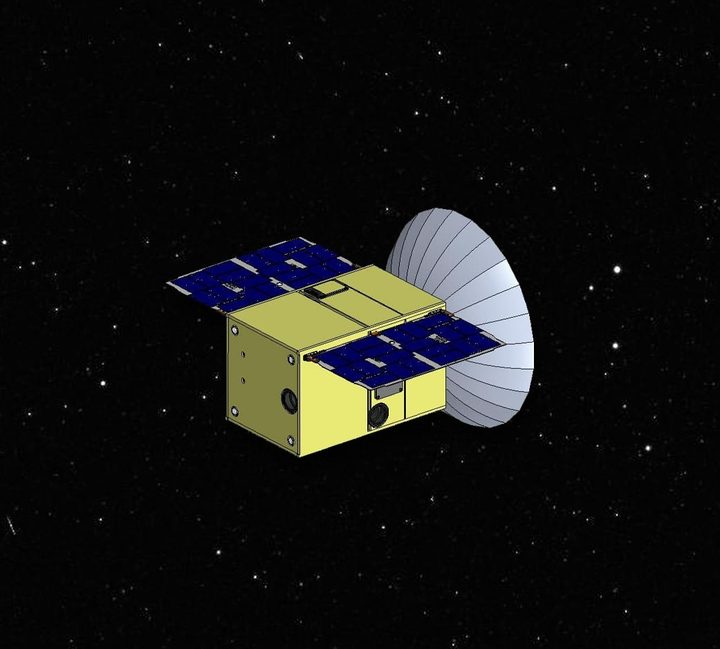
Illustration of the Cislunar Autonomous Positioning System Technology Operations and Navigation Experiment (CAPSTONE). Tyvak Nano-Satellite Systems

To be inserted into this orbit, the satellite has to make a series of maneuvers in which it fires thrusters to adjust its trajectory. The first of these maneuvers was  Thursday morning.

Recommended Videos

“NASA’s CAPSTONE successfully completed its first trajectory correction maneuver, which started at 11:30 a.m. EDT Thursday,” NASA wrote in an update. “This is the first in a series of thruster burns over the next few months to more accurately target CAPSTONE’s transfer orbit to the Moon. The maneuver lasted just over 11 minutes and changed the spacecraft’s velocity by about 45 miles per hour (about 20 meters per second). CAPSTONE’s next trajectory correction maneuver is targeted for Saturday, July 9.”

The transfer the satellite is following is different from the usual Hohmann transfer, in which an object spirals out in its orbit around the Earth until it ends up in orbit around the moon. Instead, CAPSTONE is using a ballistic transfer that follows the gravitational contours of space as affected by the Earth, the moon, and the sun. This method uses very little fuel but takes longer, so CAPSTONE will take several months to reach the moon.

CAPSTONE is scheduled to arrive at its near rectilinear halo orbit around the moon on 13 November this year.


Georgina Torbet
Georgina has been the space writer at Digital Trends space writer for six years, covering human space exploration, planetary…
Elon Musk’ Starlink could soon offer mobile services as a US carrier
Showcase of T-Mobile Starlink service on an iPhone.

Elon Musk’s Starlink has already changed how millions of people access the internet, especially in places where traditional broadband struggles to reach. Now, the satellite internet service could be preparing for an even bigger leap — becoming your mobile carrier.

According to a Financial Times report, SpaceX has told investors it’s considering launching a retail Starlink mobile service in the US. Instead of simply partnering with wireless carriers, the company could begin selling mobile plans directly to consumers, putting it in direct competition with Verizon, AT&T, and T-Mobile.

Read more
Lightsails have hit another speed bump on the road to interstellar travel
The coolest interstellar travel idea may get betrayed by the light pushing it
LightSail in Earth orbit

Laser-powered lightsails are one of the coolest answers to spaceflight. It might not be as sci-fi-sounding as a warp drive, but now, its practicality has also come under question. Using lightsails, a spacecraft could unfurl an ultra-thin reflective sail and let a powerful laser push it toward another star, without relying on fuel.

The tech was simple and elegant--except it's also more complicated than it sounds. A new preprint from researchers Chao Shen and Jiaze Li of the Harbin Institute of Technology suggests that relativistic lightsails may run into a hidden propulsion problem once they start moving extremely fast.

Read more
The galaxy has an exoplanet size mystery, and NASA’s EVE mission wants to solve it
This planet-hunting mission wants to catch baby worlds before they grow up
Artist’s Illustration of Exoplanets Orbiting Barnard’s Star

Mankind venturing into space ended up creating more questions than it answered, and one of the dilemmas is related to the planet sizes. Astronomers have found plenty of rocky super-Earths and plenty of puffier sub-Neptunes, but far fewer planets with a radius of about 1.8 times Earth’s.

That gap is known as the radius valley, and a proposed mission called the Early eVolution Explorer, or EVE, wants to figure out why it exists. NASA has a simple plan: look at planets while they are still young. The mission concept, detailed in a new arXiv preprint and covered by Phys.org, would focus on newly formed star clusters to see what small planets look like before billions of years of evolution.

Read more