Deaf since birth, 29-year-old Sloan Churman had been wearing hearing aids since the age of two. Eight weeks ago, she had a Esteem hearing implant surgically placed behind her ear. After allowing the implanted area to heal, Ms. Churman went into the doctor’s office to have the device turned on. After a bit of calibration, she was able to hear her voice for the very first time and her husband captured the moment of the first moments on video as well as uploaded the video to YouTube. The video of her first moment of hearing can be seen below.
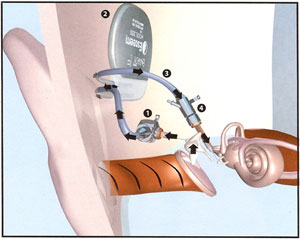 The technology behind the digital implant utilizes a sound processor to translate vibrations into electrical signals. However, there’s no microphone or speaker involved to capture and broadcast sounds. The implant is placed beneath the skin making it invisible to anyone else and no external hardware,like a hearing aid, is required to make it work. The outer portion of the ear takes in sound and funnels it through the ear canal. As the sounds reach the eardrum and causes it to vibrate, the implant senses the vibrations through tiny wires and converts them into electrical signals. These signals are run through the sound processor for adjustment.
The altered signals are sent to the driver which mechanically stimulates the stapes and the cochlea. These signals spark a wave that’s sent through the cochlea and the electrical signal is sent off to the brain for interpretation and understanding. After the surgical procedure, patients have to wait approximately six to eight weeks before the implant can be turned on. Since the implant is below the skin, typical activities like swimming, showing or other water activities won’t harm the digital sound processor. Typical cost of the procedure racks up to about $30,000 for the surgical procedure as well as the return visits to accurately calibrate the implant.