1. Home
  2. Space
  3. News

Hubble images a gorgeous spiral galaxy with a brightly glowing heart

Add as a preferred source on Google

Another stunning image of the wonders of space was shared this week by researchers using the Hubble Space Telescope. This Hubble image shows the galaxy NGC 1961, its spiral arms reaching out into the darkness and swirling around its bright and busy center. The galaxy is located 180 million light-years away, in the constellation Camelopardalis, or the Giraffe. This lesser-known constellation is visible from the northern hemisphere and is large but faint.

This particular galaxy is notable for its active galactic nucleus, which is the very bright region at its heart. Active galactic nuclei or AGNs are targets of study because they are brighter than can be explained by the presence of stars there, with large amounts of radiation being produced as material falls into the supermassive black hole at their centers.
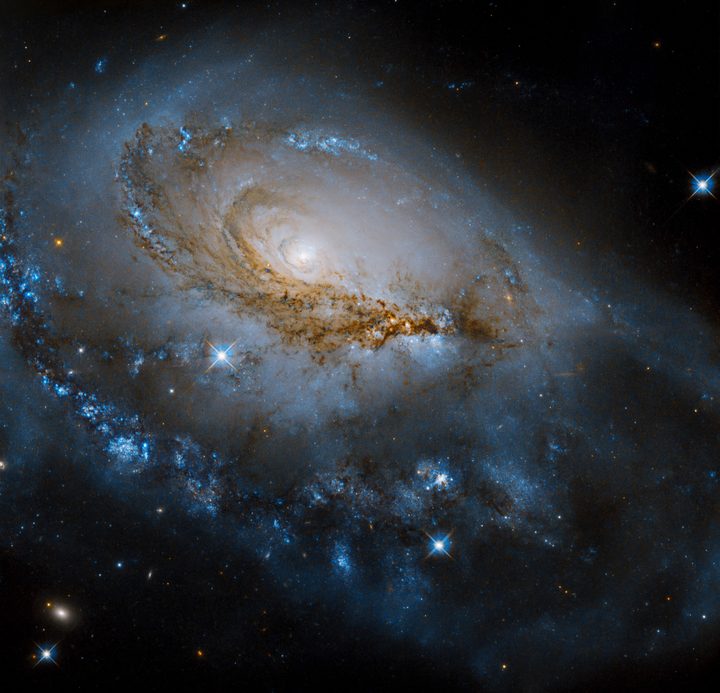
The galaxy NGC 1961 unfurls its gorgeous spiral arms in this newly released image from NASA’s Hubble Space Telescope. Glittering, blue regions of bright young stars dot the dusty spiral arms winding around the galaxy’s glowing center.
The galaxy NGC 1961 unfurls its gorgeous spiral arms in this newly released image from NASA’s Hubble Space Telescope. Glittering, blue regions of bright young stars dot the dusty spiral arms winding around the galaxy’s glowing center. NASA, ESA, J. Dalcanton (University of Washington), R. Foley (University of California - Santa Cruz); Image processing: G. Kober (NASA Goddard/Catholic University of America)

“NGC 1961 is an intermediate spiral and an AGN, or active galactic nuclei, type of galaxy,” Hubble scientists explain. “Intermediate spirals are in between “barred” and “unbarred” spiral galaxies, meaning they don’t have a well-defined bar of stars at their centers. AGN galaxies have very bright centers that often far outshine the rest of the galaxy at certain wavelengths of light. These galaxies likely have supermassive black holes at their cores churning out bright jets and winds that shape their evolution. NGC 1961 is a fairly common type of AGN that emits low-energy-charged particles.”

Recommended Videos

Even though black holes themselves are invisible because they absorb light that comes close to them, the regions immediately around the black hole can glow brightly. As dust and gas swirl around the black hole in a structure called an accretion disk, the particles of dust and gas rub together and increase in temperature. These accretion disks can reach very high temperatures, even hotter than the surface of the sun. They are bright as they give off radiation across the electromagnetic spectrum depending on the particular environment, including visible light and X-rays.


Georgina Torbet
Georgina has been the space writer at Digital Trends space writer for six years, covering human space exploration, planetary…
Space is becoming Bezos and Musk’s next data center site, and we have every reason to worry
The AI boom is coming for the night sky
How Vast's space station will look in orbit.

AI data centers already consume vast amounts of electricity and water on Earth, so Silicon Valley has begun looking somewhere considerably more spacious... literally.

Elon Musk's SpaceX and Jeff Bezos' Blue Origin, along with several other companies, have proposed enormous constellations of satellites designed to operate as orbital data centers. However, environmental groups and former space officials are now warning that putting them into orbit at the proposed scale could have severe consequences for Earth's atmosphere and the night sky.

Read more
The first possible exomoon is here, and it makes our Moon look hilariously tiny
Scientists may have found the first exomoon, except this one is the size of Jupiter
This artist’s concept depicts a potential volcanic moon between the exoplanet WASP-49 b, left, and its parent star. New evidence indicating that a massive sodium cloud observed near WASP-49 b is produced by neither the planet nor the star has prompted researchers to ask if its origin could be an exomoon.

We have already discovered more than 6,000 planets outside of our immediate neighborhood. Yet, finding a moon orbiting one of those distant worlds has proved considerably harder. Astronomers may finally have something close to the real deal, but this particular object stretches the word “moon” almost beyond recognition.

Using the European Southern Observatory’s Very Large Telescope in Chile, researchers detected strong evidence for a moon-like object in the CD-35 2722 system. Further observations are still necessary to confirm the discovery, but it could become the first confidently detected natural satellite outside our solar system. There is still one tiny complication though. This moon is apparently massive.

Read more
China’s answer to SpaceX’s reusable rockets literally catches boosters in a net
SpaceX catches boosters on legs. China just used a net.
Ammunition, Missile, Weapon

SpaceX's playbook for recovering a rocket booster generally involves legs, a precisely controlled vertical landing, and either a concrete pad or a drone ship. 

China just managed to pull off something similar, but in a slightly different way, and on July 10, it tested the method as well.

Read more