1. Home
  2. Space
  3. News

Mars Express orbiter has relayed data from seven different Mars missions

Add as a preferred source on Google

When a rover is exploring the surface of Mars, it doesn’t send data straight back to Earth. That’s for two reasons: Firstly, it would require a large, powerful antenna which would be cumbersome and expensive to add, and secondly, because of the rotations of Earth and Mars any location on the surface would be pointing in the wrong direction some of the time.

So, to get data back from Mars surface missions, we use a network of Mars orbiters, which collect data from rovers and landers and relay it back to Earth. Known as the Mars Relay Network, these orbiting spacecraft take on relay duties in addition to their scientific roles observing the red planet. Recently, one of these orbiters, the European Space Agency (ESA)’s Mars Express set a new record for relaying data from seven different Mars surface missions.
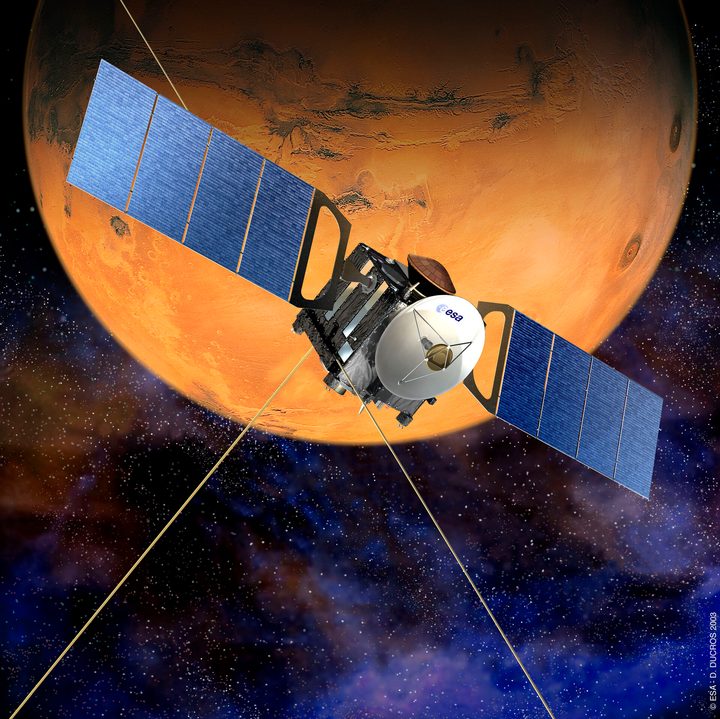
 An artist's impression of Mars Express. The spacecraft left Earth for Mars on 2 June 2003. It reached its destination after a six-month journey, and has been investigating the planet since early 2004.
An artist’s impression of Mars Express. The spacecraft left Earth for Mars on 2 June 2003. It reached its destination after a six-month journey, and has been investigating the planet since early 2004. ESA - D. Ducros

Since its arrival at Mars in December 2003, Mars Express has relayed data from six NASA surface missions (four rovers and two landers) and one Chinese rover. Spacecraft operating on Mars are designed to be interoperable with their radio communications, so surface missions and orbiters built by different agencies can communicate with each other. This level of international cooperation means that data from a rover can be relayed by whichever orbiter is nearest, even if it is from a different country.

Recommended Videos

“Data relay is an essential part of Mars exploration,” said James Godfrey, Mars Express spacecraft operations manager at ESA’s ESOC mission control center, in a statement. “We are proud that Mars Express has played a role in the interagency Mars data relay network over many years and has supported so many surface assets. This network will be vital to support future missions to the Red Planet, such as those of the Mars Sample Return campaign.”

Mars Express has relayed data from NASA’s small Spirit and Opportunity rovers, which studied the geology of Mars up close from the Phoenix and InSight landers. Those landers studied the history of water and interior of the planet. Data has also been relayed from the Curiosity and Perseverance rovers, which are currently searching for evidence of ancient life there. Last year, Mars Express also performed a communication test with the Chinese Zhurong rover, testing out a new technique for sending data in a one-way vs. two-way manner.

Georgina Torbet
Georgina has been the space writer at Digital Trends space writer for six years, covering human space exploration, planetary…
China’s answer to SpaceX’s reusable rockets literally catches boosters in a net
SpaceX catches boosters on legs. China just used a net.
Ammunition, Missile, Weapon

SpaceX's playbook for recovering a rocket booster generally involves legs, a precisely controlled vertical landing, and either a concrete pad or a drone ship. 

China just managed to pull off something similar, but in a slightly different way, and on July 10, it tested the method as well.

Read more
Dimming the sun sounds unhinged, but this new study on El Niño makes a surprisingly good case for it
A natural test case, Australia's worst-ever wildfire season, suggests the idea deserves serious consideration.
Nature, Outdoors, Sky

When I first saw "scientists propose dimming the sun," I rolled my eyes. It sounds like a science fiction movie cooked up after watching many climate documentaries. But a new study, published on July 8, 2026, in the journal Science Advances, seems to have a genuinely compelling argument.

A Super El Niño is currently forming in the Pacific, feared to be the most intense in decades. It could escalate floods, wildfires, and extreme heat events worldwide. However, Researchers at UC San Diego's Scripps Institution of Oceanography, led by climate scientists Kate Ricke and Jessica Wan, are now proposing one of the most interesting solutions I’ve come across.

Read more
You can now walk through space and gaze into a black hole at this VR exhibit
Smithsonian Starstruck lets you drift past dying stars and see the origin point of the universe for as little as $18 a person.
Smithsonian Starstruck featured

Most planetarium shows ask you to sit still and look up. The Smithsonian's new VR exhibit takes a different approach, letting visitors walk through the vast expanse of the universe, drifting past stars, planets, and a black hole to get a physical sense of its true scale.

A $29 ticket to the edge of the galaxy

Read more