1. Home
  2. Space
  3. News

South Korean lunar orbiter takes gorgeous images of Earth

Add as a preferred source on Google

The moon is so hot this year, with current or future lunar missions planned from the U.S., Russia, UAE and Japan, and India. And there’s also South Korea, which launched its first lunar mission in August 2022. The Korea Pathfinder Lunar Orbiter (KPLO) arrived in lunar orbit in December 2022, and it recently sent back a couple of stunning images of Earth as seen from the moon.

#달 상공에서 #다누리 가 보낸 인증샷📷✨
이 사진은 다누리에 탑재된 고해상도 카메라(LUTI)를 이용해 촬영하였으며, 달 크레이터들과 지구의 모습을 선명하게 확인할 수 있습니다.

📷사진 설명
1)12월 24일 달 상공 344km에서 촬영한 사진
2)12월 28일 달 상공 124km에서 촬영한 사진 pic.twitter.com/pBC5Dw5X9M

— 한국항공우주연구원 (@kari2030) January 3, 2023

The images were shared by the Korea Aerospace Research Institute (KARI) and show Earth rising over the moon’s horizon, taken using KPLO’s high-resolution camera. The spacecraft, also known as Danuri, aims to survey the moon for resources like water ice and metals.
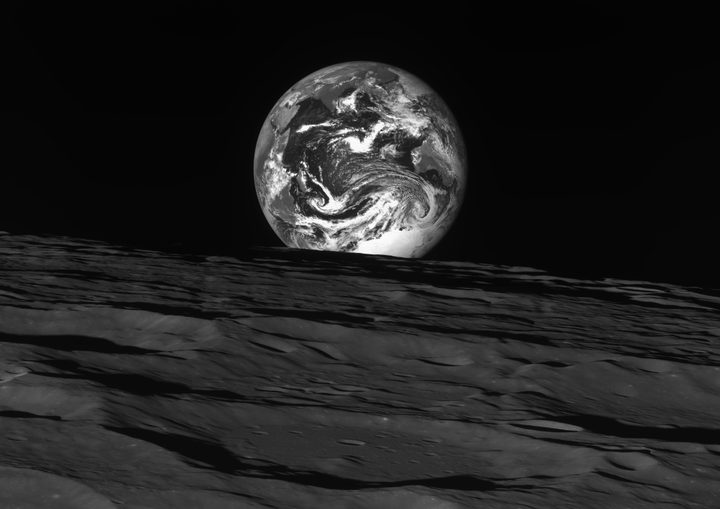
Photo taken on December 24 at 344 km above the moon
Photo taken on December 24 at 344 km above the moon. Korea Aerospace Research Institute

The images were taken on December 24 and December 28, when the craft was at 344 km and 124 km from the moon’s surface respectively. Both show the lunar terrain in the foreground with the beautiful marble of the Earth rising over the horizon, taken using the Lunar Terrain Imager (LUTI) instrument which will be used to scout out suitable locations for future missions to land. The instrument can take images of the moon’s surface with a spatial resolution of around 5 meters, and it is scouting on behalf of a planned robotic lunar lander mission from South Korea aimed for the 2030s.

Recommended Videos

According to KARI, the Danuri craft is now “currently conducting work such as checking the performance of payloads and adjusting errors, and is scheduled to carry out full-scale science and technology missions from February.” It will be working with its six science instruments, including cameras, a magnetometer, a spectrometer, and a mapping tool provided by NASA to map out the locations of water ice in areas in permanent shadow.

Another feature of the spacecraft is that it will also test out a new communications technology in a fun way. The Delay-Tolerant Networking experiment aims to create a communication system for lunar landers which can handle drops in connectivity — and it tests this out by playing one of South Korea’s greatest cultural exports, the song Dynamite by K-pop icons BTS.

Georgina Torbet
Georgina has been the space writer at Digital Trends space writer for six years, covering human space exploration, planetary…
China’s answer to SpaceX’s reusable rockets literally catches boosters in a net
SpaceX catches boosters on legs. China just used a net.
Ammunition, Missile, Weapon

SpaceX's playbook for recovering a rocket booster generally involves legs, a precisely controlled vertical landing, and either a concrete pad or a drone ship. 

China just managed to pull off something similar, but in a slightly different way, and on July 10, it tested the method as well.

Read more
Dimming the sun sounds unhinged, but this new study on El Niño makes a surprisingly good case for it
A natural test case, Australia's worst-ever wildfire season, suggests the idea deserves serious consideration.
Nature, Outdoors, Sky

When I first saw "scientists propose dimming the sun," I rolled my eyes. It sounds like a science fiction movie cooked up after watching many climate documentaries. But a new study, published on July 8, 2026, in the journal Science Advances, seems to have a genuinely compelling argument.

A Super El Niño is currently forming in the Pacific, feared to be the most intense in decades. It could escalate floods, wildfires, and extreme heat events worldwide. However, Researchers at UC San Diego's Scripps Institution of Oceanography, led by climate scientists Kate Ricke and Jessica Wan, are now proposing one of the most interesting solutions I’ve come across.

Read more
You can now walk through space and gaze into a black hole at this VR exhibit
Smithsonian Starstruck lets you drift past dying stars and see the origin point of the universe for as little as $18 a person.
Smithsonian Starstruck featured

Most planetarium shows ask you to sit still and look up. The Smithsonian's new VR exhibit takes a different approach, letting visitors walk through the vast expanse of the universe, drifting past stars, planets, and a black hole to get a physical sense of its true scale.

A $29 ticket to the edge of the galaxy

Read more