
A 30-year-old NASA-Japan Aerospace Exploration Agency (JAXA) mission has come to an end with the closing of operations on the Geotail satellite.
Launched in July 1992, Geotail was designed to study the Earth’s magnetosphere. This is the region around Earth where particles are affected by our planet’s magnetic field. It’s important for our well-being as it protects us from dangerous space radiation. As this radiation comes primarily in the form of solar wind from the sun, the magnetosphere isn’t a round bubble — instead, it has a long tail shape on the night side of the planet caused by streaming particles from the sun.
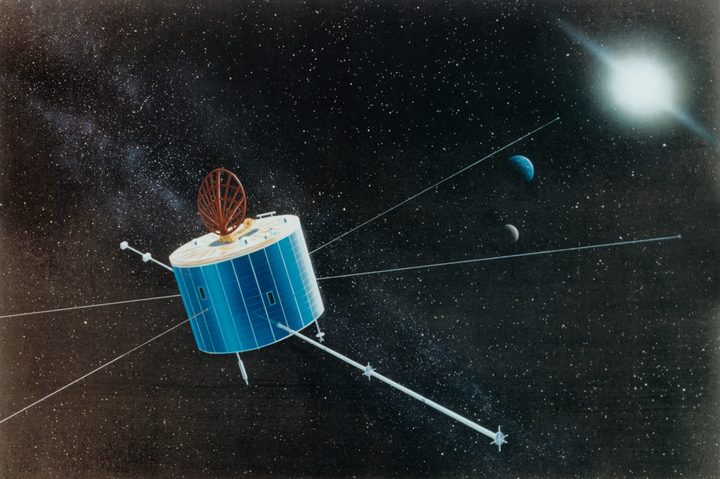
Geotail orbited the Earth in a highly elliptical orbit that allowed it to study this tail, learning about its structure and dynamics. It used instruments to monitor magnetic and electrical fields, as well as observe plasma and high-energy particles. Originally designed to operate for just four years, the satellite lasted an impressive 30 years of operation, supplying data for over a thousand scientific papers.
The mission was also notable as it was a partnership between NASA and the Japanese space agency JAXA. “Geotail has been a very productive satellite, and it was the first joint NASA-JAXA mission,” said Don Fairfield, NASA’s first project scientist for Geotail, in a statement. “The mission made important contributions to our understanding of how the solar wind interacts with Earth’s magnetic field to produce magnetic storms and auroras.”
Geotail did not have an easy time of it throughout its entire mission. In 1993, a year after its launch, one of its computers failed, and it looked as if one of the mission’s main instruments, the Low Energy Particles experiment, would be unusable. The team tried to reset the computer with no luck, so they chose a nail-biting option to adjust the satellite’s orbit by sending it around the dark side of the moon, where it would temporarily be blocked from sunlight and without power. After 10 minutes in darkness, the satellite came back out into the sunlight and the computer reset successfully.
That allowed the mission to continue as planned, but after decades of use, components began to fail. In 2012, one of its two data recorders stopped working. The second recorder worked until June 2022, when it suffered a problem and wasn’t able to be revived. Mission operations ended in November 2022, and NASA recently announced the mission is now officially over.
Geotail leaves a legacy of findings about the magnetosphere, as well traces of materials in the moon’s extremely thin atmosphere. Its work is continued by more recent missions like the Magnetospheric Multiscale mission launched in 2015.



