1. Home
  2. Space
  3. News

NASA map shows where you can see a solar eclipse across the U.S.

Add as a preferred source on Google

Some of the most fascinating astronomical events to see from Earth are solar eclipses, when the moon passes between the Earth and the sun and blocks out some or all of the sun’s light. The resulting darkness during daytime is fascinating and can lead to some stunning views — though, for safety reasons, you should never look directly at the sun and should use a tool like a pinhole camera to observe eclipses instead.

However, these eclipses happen on a rather complex schedule related to the orbit of the moon, so exactly when and where to see an eclipse can be hard to track. To help with this, NASA has created a map of the U.S. showing when and where you can see a solar eclipse in 2023 and 2024.
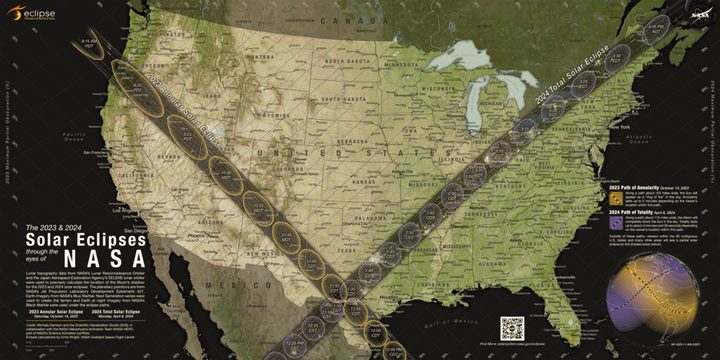
Using observations from different NASA missions, this map shows where the Moon’s shadow will cross the U.S. during the 2023 annular solar eclipse and 2024 total solar eclipse. The map was developed by NASA's Scientific Visualization Studio (SVS) in collaboration with the NASA Heliophysics Activation Team (NASA HEAT), part of NASA’s Science Activation portfolio.
Using observations from different NASA missions, this map shows where the moon’s shadow will cross the U.S. during the 2023 annular solar eclipse and 2024 total solar eclipse. The map was developed by NASA’s Scientific Visualization Studio (SVS) in collaboration with the NASA Heliophysics Activation Team (NASA HEAT), part of NASA’s Science Activation portfolio. NASA/Scientific Visualization Studio/Michala Garrison; eclipse calculations by Ernie Wright, NASA Goddard Space Flight Center

The full map shows the two upcoming annular solar eclipses and the time you’ll need to look out for them based on your location and time zone. The regions that will experience the solar eclipses are long, narrow bands because of the path that the moon’s shadow leaves on Earth. These are the regions where the sun will appear to be fully eclipsed, though those outside these regions will be able to see partial eclipses — where the moon blocks out part of the sun’s disk, but not the entire face.

Recommended Videos

Lucky skywatchers in San Antonio, Texas, will be able to see both the 2023 and 2024 eclipses, which will occur on October 14, 2023, and April 8, 2024.

The map was created by Michala Garrison, a member of the Scientific Visualization Studio (SVS) at NASA’s Goddard Space Flight Center, to help inform people about eclipses so they don’t miss opportunities to catch these exciting events.

“In 2017, I was in Maryland, so I still got to see a little bit, because I was in a partial eclipse,” Garrison said in a statement. “But I didn’t really know any of this back then. This does make me want to go to, say, Albuquerque [New Mexico] in 2023. And then, in 2024, to go more south.”

Creating the map so that it was both informative and attractive took many revisions, she said. “It took a lot of trial and error. I wanted it to be useful to the reader, but not overwhelming – and still be a pretty product to look at to catch people’s eye.”

Georgina Torbet
Georgina has been the space writer at Digital Trends space writer for six years, covering human space exploration, planetary…
Space is becoming Bezos and Musk’s next data center site, and we have every reason to worry
The AI boom is coming for the night sky
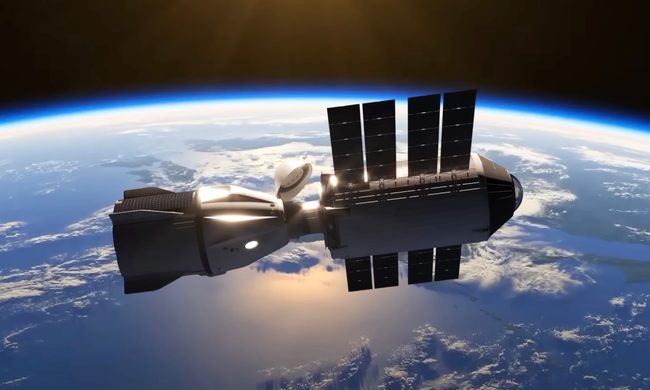
How Vast's space station will look in orbit.

AI data centers already consume vast amounts of electricity and water on Earth, so Silicon Valley has begun looking somewhere considerably more spacious... literally.

Elon Musk's SpaceX and Jeff Bezos' Blue Origin, along with several other companies, have proposed enormous constellations of satellites designed to operate as orbital data centers. However, environmental groups and former space officials are now warning that putting them into orbit at the proposed scale could have severe consequences for Earth's atmosphere and the night sky.

Read more
The first possible exomoon is here, and it makes our Moon look hilariously tiny
Scientists may have found the first exomoon, except this one is the size of Jupiter
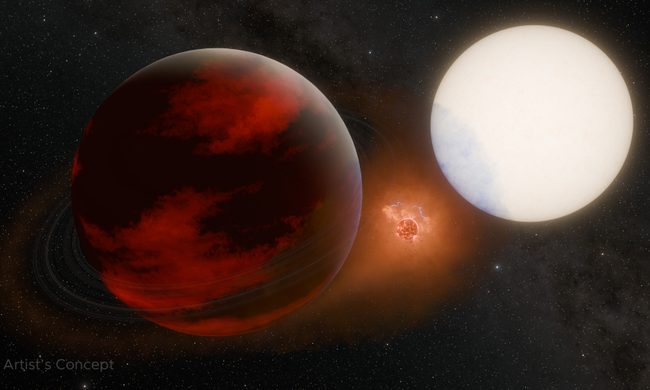
This artist’s concept depicts a potential volcanic moon between the exoplanet WASP-49 b, left, and its parent star. New evidence indicating that a massive sodium cloud observed near WASP-49 b is produced by neither the planet nor the star has prompted researchers to ask if its origin could be an exomoon.

We have already discovered more than 6,000 planets outside of our immediate neighborhood. Yet, finding a moon orbiting one of those distant worlds has proved considerably harder. Astronomers may finally have something close to the real deal, but this particular object stretches the word “moon” almost beyond recognition.

Using the European Southern Observatory’s Very Large Telescope in Chile, researchers detected strong evidence for a moon-like object in the CD-35 2722 system. Further observations are still necessary to confirm the discovery, but it could become the first confidently detected natural satellite outside our solar system. There is still one tiny complication though. This moon is apparently massive.

Read more
China’s answer to SpaceX’s reusable rockets literally catches boosters in a net
SpaceX catches boosters on legs. China just used a net.
Ammunition, Missile, Weapon

SpaceX's playbook for recovering a rocket booster generally involves legs, a precisely controlled vertical landing, and either a concrete pad or a drone ship. 

China just managed to pull off something similar, but in a slightly different way, and on July 10, it tested the method as well.

Read more