1. Home
  2. Space
  3. News

We now know what caused comet ‘Oumuamua’s strange orbit

Add as a preferred source on Google

Remember what feels like decades ago, when we were visited by a comet from another solar system in 2019? Interstellar comet ‘Oumuamua captured headlines when its cigar-shaped body was spotted following an unusual orbit through our solar system, and subsequent research suggested it might once have been part of a Pluto-like planet and was possibly pancake-shaped.

One thing particularly puzzled astronomers, though, because the comet was accelerating away from the sun in a path that seemed strange. Now, researchers say they have an explanation for its unusual pathway, and it isn’t aliens — it’s a natural phenomenon called outgassing.
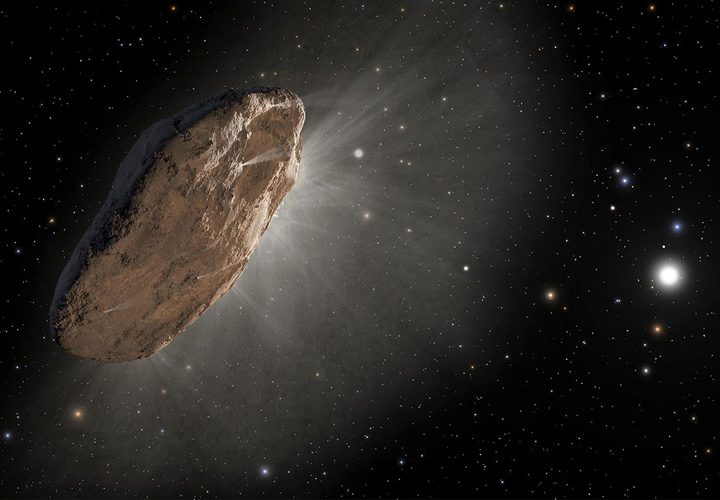
An artist’s depiction of the interstellar comet ‘Oumuamua, as it warmed up in its approach to the sun and outgassed hydrogen (white mist), which slightly altered its orbit.
An artist’s depiction of the interstellar comet ‘Oumuamua, as it warmed up in its approach to the sun and outgassed hydrogen (white mist), which slightly altered its orbit. The comet, which is most likely pancake-shaped, is the first known object other than dust grains to visit our solar system from another star. NASA, ESA and Joseph Olmsted and Frank Summers of STScI

Comets are primarily made of dust, rock, and ice, and as they approach the sun they warm up and give off water and dust particles (which form comets’ distinctive tails). We are used to observing average-sized comets which eject gases, giving the comet a tiny kick and changing its trajectory ever so slightly.

Recommended Videos

But ‘Oumuamua was much smaller than your typical comet, at just over 100 meters across, and when it was first observed, it didn’t have a tail and didn’t seem to be ejecting water. So how could its trajectory be different from the typical elliptical orbit created by gravity?

The lead researcher, an astrochemist, worked with an astronomer on the idea that the hydrogen being outgassed by the comet might have been trapped within the comet’s own ice.

“A comet traveling through the interstellar medium basically is getting cooked by cosmic radiation, forming hydrogen as a result. Our thought was: If this was happening, could you actually trap it in the body, so that when it entered the solar system and it was warmed up, it would outgas that hydrogen?” researcher Jennifer Bergner said in a statement. “Could that quantitatively produce the force that you need to explain the non-gravitational acceleration?”

The pair found that the trapping effect did happen, but only in a thin shell around a comet’s outer body. Most comets we observe are much bigger than ‘Oumuamua, at a few miles across, so the effect is almost invisible. But in tiny ‘Oumuamua, the researchers found that the effect would be significant enough to alter its orbit.

“What’s beautiful about Jenny’s idea is that it’s exactly what should happen to interstellar comets,” the other researcher, Darryl Seligman, said. “We had all these stupid ideas, like hydrogen icebergs and other crazy things, and it’s just the most generic explanation.”

The research is published in the journal Nature.

Georgina Torbet
Georgina has been the space writer at Digital Trends space writer for six years, covering human space exploration, planetary…
Dimming the sun sounds unhinged, but this new study on El Niño makes a surprisingly good case for it
A natural test case, Australia's worst-ever wildfire season, suggests the idea deserves serious consideration.
Nature, Outdoors, Sky

When I first saw "scientists propose dimming the sun," I rolled my eyes. It sounds like a science fiction movie cooked up after watching many climate documentaries. But a new study, published on July 8, 2026, in the journal Science Advances, seems to have a genuinely compelling argument.

A Super El Niño is currently forming in the Pacific, feared to be the most intense in decades. It could escalate floods, wildfires, and extreme heat events worldwide. However, Researchers at UC San Diego's Scripps Institution of Oceanography, led by climate scientists Kate Ricke and Jessica Wan, are now proposing one of the most interesting solutions I’ve come across.

Read more
You can now walk through space and gaze into a black hole at this VR exhibit
Smithsonian Starstruck lets you drift past dying stars and see the origin point of the universe for as little as $18 a person.
Smithsonian Starstruck featured

Most planetarium shows ask you to sit still and look up. The Smithsonian's new VR exhibit takes a different approach, letting visitors walk through the vast expanse of the universe, drifting past stars, planets, and a black hole to get a physical sense of its true scale.

A $29 ticket to the edge of the galaxy

Read more
Scientists warn Elon Musk’s orbital data centers could blind Earth’s biggest telescopes
A new ESO study suggests millions of satellites could make parts of the night sky effectively unusable for astronomy.
One hour of satellites over the northern Atacama Desert in Chile (October 2025)

The race to blanket Earth with satellite internet has unlocked faster connectivity for millions. But according to the European Southern Observatory (ESO), it could also make one of humanity's oldest hobbies, and one of its most important sciences, a whole lot harder. The organization warns that the rapid growth of satellite mega-constellations could severely disrupt observations made by some of the world's most powerful telescopes.

Astronomers say the night sky is reaching its limit

Read more