
“Why you can trust Digital Trends – We have a 20-year history of testing, reviewing, and rating products, services and apps to help you make a sound buying decision. Find out more about how we test and score products.“
Mercedes-Benz is one of the oldest automakers in existence, but it’s been among the quickest to launch a lineup of electric cars. It may not have the freshness of a startup, but what it does have are actual cars to sell to customers.
The 2023 Mercedes-Benz EQE SUV is the middle child of Mercedes’ electric SUV lineup, slotting between the entry-level EQB and the flagship EQS SUV, and targeting electric luxury SUVs like the Audi E-Tron, BMW iX, and Cadillac Lyriq. Like the EQS, the EQE SUV is based on an existing sedan, hence the “SUV” suffix. In a previous first drive, we found the EQE sedan to be a good balance between luxury and livability, giving the SUV version a lot to live up to.
Unlike the EQE sedan, the EQE SUV will be built in Alabama which, along with a base price of $79,050, means it has a chance to qualify for a federal tax credit under the latest rules. That base price buys you a base EQE 350 SUV with either single-motor rear-wheel drive or dual-motor all-wheel drive powertrains (we tested the latter). Premium, Exclusive, and Pinnacle trim levels, as well as a more powerful dual-motor EQE 500 model, will also be available at launch, with an AMG performance version to come.

Design and interior
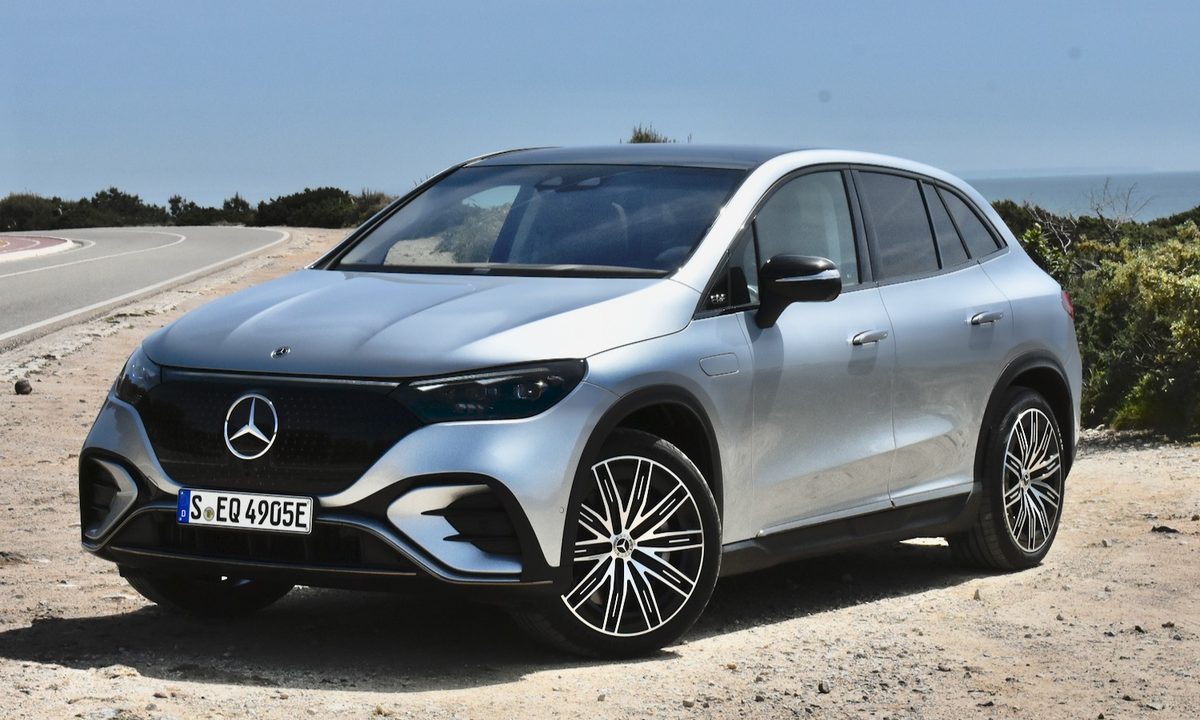
The EQE SUV closely follows the larger EQS SUV in design, which is unfortunate. The two look nearly identical, the main difference being the EQE’s smaller footprint. That’s not great for drivers of the more expensive EQS SUV, who will need the EQE SUV for scale to explain why they spent the extra money. Both designs are also pretty forgettable. The EQE and EQS sedans are polarizing, but at least Mercedes took a risk with their lozenge-like styling. The shapeless SUV models don’t even clearly communicate that they are electric; they look like designs for internal-combustion vehicles from the 1990s.
The styling is all in the name of aerodynamics, though, and the EQE SUV achieves an impressive drag coefficient of 0.25, so it requires less energy to overcome wind resistance than more conventional SUV designs. Passenger space isn’t really impacted either, as headroom and legroom are in the range of most rivals. The EQE also ditches the EQS SUV’s useless third row but offers less cargo space than similarly sized two-row luxury electric SUVs. At 14.0 cubic feet with the rear seats up, the Mercedes has about half the cargo space of a Cadillac Lyriq. Fold the rear seats down and you get 55.0 cubic feet, closer to most rivals, but still well behind the BMW iX’s 77.9-cubic-foot maximum.
The EQE SUV closely follows the larger EQS SUV in design, which is unfortunate.
The interior partially makes up for these deficiencies. Also heavily influenced by the EQS SUV, as well as the EQ sedans, the EQE SUV cabin has all of the drama one should expect in a luxury car. The tasteful application of metallic trim and nightclub-like ambient lighting are distinctive without being tacky. Some of the European-spec test cars we drove had Mercedes’ Hyperscreen setup, a trifecta of display screens that cover the whole dashboard, but even without it, the freestanding instrument cluster, reclined central touchscreen, and flat dashboard surface are very stylish.
While probably not great for efficiency, the EQE SUV can also be equipped with all of the amenities one would expect in a Mercedes, ranging from massaging front seats to a perfume spritzer. A Burmester 3D audio system with Dolby Atmos is standard, and while leather upholstery isn’t, Mercedes pitches the default leatherette upholstery as a vegan alternative to real cowhide.

Tech, infotainment, and driver assist
The standard Mercedes-Benz User Experience (MBUX) infotainment system includes a 12.8-inch central touchscreen, 12.3-inch digital instrument cluster, wireless Apple CarPlay/Android Auto connectivity, and natural language voice recognition. Wireless phone charging is standard as well, while a head-up display is optional.
The infotainment system’s key features carry over from other recent Mercedes models. The touchscreen display is based on a “Zero Layer” concept that eschews menus for tiles laid on top of the navigation map. While this makes it easy to access frequently used features like audio, you do still have to dig into menus for certain things, like settings for the car’s various warning chimes. And while the graphics remain impressive, the massive map display sometimes zoomed out too far to be useful. The EQE SUV can also be equipped with an augmented reality feature that superimposes arrows over an image of your next turn so you don’t miss it.
The standard natural language voice recognition, which is summoned to the prompt “Hey Mercedes” and responds to ordinary speech, remains one of the luxury brand’s biggest tech wins. Most rival brands still don’t have voice recognition that works this well. And while it takes a true audiophile to appreciate the EQE SUV’s Dolby Atmos-enhanced audio system, it makes sense to have this feature in an EV, where engine noises won’t get in the way of enjoying music and podcasts (Spotify, Amazon Music, and Apple Music integration is included).
Most rival brands still don’t have voice recognition that works this well.
As mentioned previously, the EQE SUV will feature the same Hyperscreen display as the EQS SUV and the EQE and EQS sedans in some markets, although it hasn’t been confirmed for the U.S. The Hyperscreen adds a front-passenger touchscreen for a total of 56 inches of screen space. The three screens are also housed under one piece of glass to look like a single continuous display. The EQE SUV makes better use of the passenger screen with new Zync integration, allowing passengers to stream videos while moving.
Mercedes offers a long list of driver-assist features, but many are restricted to the options list. Standard features include forward-collision warning, automatic emergency braking, blind-spot monitoring, and lane-keep assist. The optional Driver Assistance Package adds adaptive cruise control, active lane keeping, and Pre-Safe Plus, designed to lessen the chance of injuries in a crash by moving seats inboard and playing sounds that trigger a stapedius reflex to lessen the chance of hearing loss.

Driving experience
The EQE SUV launches with three powertrain configurations. The base EQE 350+ has a single motor sending 288 horsepower and 417 pound-feet of torque to its rear wheels. The EQE 350 4Matic adds a front motor for all-wheel drive, and ups torque output to 564 lb-ft. The EQE 500 4Matic also has dual motors, but they’re tuned to produce 402 hp and 633 lb-ft of torque. All versions have a 90.6-kilowatt-hour battery pack.
Mercedes quotes a zero to 60 mph time of 6.3 seconds for the rear-wheel drive EQE 350+, and that only improves by 0.1 seconds if you select the torquier all-wheel drive EQE 4Matic. Upgrade to the EQE 500 4Matic, and you’ll get to 60 mph from a standstill in 4.6 seconds, according to Mercedes. However, top speed is electronically limited to 130 mph across the board.
The EQE SUV met the technical requirements of a luxury car.
These figures aren’t earth-shattering. Audi says the entry-level version of its E-Tron electric SUV will do zero to 60 mph in 5.5 seconds, while the base BMW iX xDrive50 is quicker than every version of the EQE SUV, at a claimed 4.4 seconds. When it unveiled the EQE SUV, Mercedes showed an AMG performance version with up to 677 hp and capable of reaching 60 mph in a claimed 3.4 seconds, but it’s unclear when it will reach North America.
For now, the EQE SUV has a more laid-back character. Because it’s an EV, and thus applies torque instantly at the press of the right pedal, our EQE 350 4Matic test car still felt reasonably quick in a straight line. This car also had the optional air suspension and rear-axle steering, which can turn the rear wheels up to 10 degrees when needed. Thanks to the air suspension, the EQE SUV met the technical requirements of a luxury car, with a plush ride and less bouncing and jiggling than its EQS SUV sibling. The rear steer didn’t help with maneuverability as much as we expected, but the EQE didn’t feel ungainly either. Those are the only things that stuck out in a competent but uninteresting driving experience.

Range, charging, and safety
If you want to maximize range, you’ll need the single-motor rear-wheel drive EQE 350+, which Mercedes says will go 279 miles on a charge. The dual-motor all-wheel drive EQE 350 4Matic and EQE 500 4Matic are expected to get 253 miles and 269 miles of range, respectively. That’s not going to trouble the BMW iX and Cadillac Lyriq, which both top 300 miles in at least one configuration.
Standard 170-kilowatt DC fast charging can complete a 10% to 80% charge in 32 minutes, according to Mercedes. Still, Level 2 AC charging takes 9.5 hours for a 10% to 100% charge. The real differentiator here may be the planned Mercedes-operated charging network coming online later this decade. With the incentive of keeping its customers happy, perhaps Mercedes will improve on the less-than-ideal experience of most current public charging stations.
Crash-test ratings aren’t available for this new model, but it will get the same warranty coverage as other Mercedes EQ EVs. That includes a four-year, 50,000-mile, new-vehicle warranty and a 10-year, 155,000-mile, battery warranty.

How DT would configure this car
The good news for shoppers is that the EQE SUV narrowly skirts the $80,000 price cap for electric SUVs under new federal tax-credit rules (assuming it meets battery-sourcing stipulations), and Mercedes doesn’t charge extra for all-wheel drive. With identical horsepower and nearly identical acceleration times, the choice between a rear-wheel drive EQE 350+ and an all-wheel drive EQE 350 4Matic comes down to range versus all-weather traction.
The bad news is that the base Premium trim level for the 350 models misses out on some notable features. The Burmester audio system, ambient lighting, and a surround-view camera system is standard, but leather upholstery isn’t. The EQE 500 4Matic has standard leather seats, along with rear-axle steering, but it has a higher $90,650 base price. And to get the full array of driver-assist features, you’ll need to upgrade to the mid-tier Exclusive grade, which also adds augmented reality navigation. The top Pinnacle grade adds a 100-watt USB-C package, four-zone climate control, and a head-up display, among other features.
With 279 miles of range and most of the noteworthy tech features, an EQE 350+ Exclusive seems like the sweet spot of the lineup, even if it means missing out on all-wheel drive. At $81,150 it’s not much more expensive than the base version, and still a bit cheaper than a base BMW iX. The BMW also has more range, and is a bit more entertaining to drive, but its looks are an acquired taste. The Cadillac Lyriq is much less expensive than both German SUVs, and has 312 miles of range in single-motor rear-wheel drive form, but good luck finding one. Cadillac is still working through a backlog of pre-orders. The Audi E-Tron is about to morph into the Q8 E-Tron for the 2024 model year, so availability might also be limited as the switchover happens.
The EQE SUV matches these rivals in luxury but falls short in other areas. Mercedes’ emphasis on aerodynamic efficiency didn’t yield great range results but did create a yawn-inducing design. The Mercedes isn’t as satisfying to drive as its rivals, either. With a lower price and similar features, it also makes the EQS SUV redundant. That’s great for brand loyalists looking to get a deal, but probably not what Mercedes intended.


