I spent a good chunk of 2022 obsessed with Vampire Survivors. The action-RPG felt like an absolute revelation at the time thanks to its unique “reverse bullet-hell” premise where players upgraded a monster-killing machine that auto-attacked waves of enemies. It was the kind of genius idea that I knew other developers would be quick to riff on — and that’s exactly what happened when Brotato launched into early access last year.
The indie roguelike copies many of Vampire Survivors’ notes, expanding on its minimalistic, one-stick gameplay. The core difference is that players guide a sentient murder potato through a series of short enemy waves rather than one continuous 30-minute run. That concept earned it “overwhelmingly positive” reviews from early adopters on Steam over the past few months, and it’s about to get even more buzz. Today, Brotato is stepping out of early access for its official 1.0 launch, bringing more characters and weapons to the $5 game (and you can even get it for 20% off that price too).
While I started hearing rumblings about the game earlier this year, I’d originally written it off as an irreverent copycat. I was dead wrong. Brotato is a silly, but smart evolution of the Vampire Survivors formula that leaves even more room for wild character builds. It’s quickly becoming an addiction that is going to occupy a lot of my free time this summer.
Mr. Potato Dead
On paper, Brotato might sound like a quick Vampire Survivors cash-in, right down to its price tag. The basic premise is that players start by picking one of several potato characters, each of which has their own unique perks and a simple starting weapon. They’re dropped into a small map and enemies start to spawn in around the screen. Players only need to worry about moving their potato with one stick, as all weapons auto-fire. The more players level up and clear waves, the more they’re able to equip new weapons, items, and stat boosts that make them gradually more powerful amid increasingly tougher waves. Imagine what Vampire Survivors would have looked like as a Newgrounds game and you have the gist.
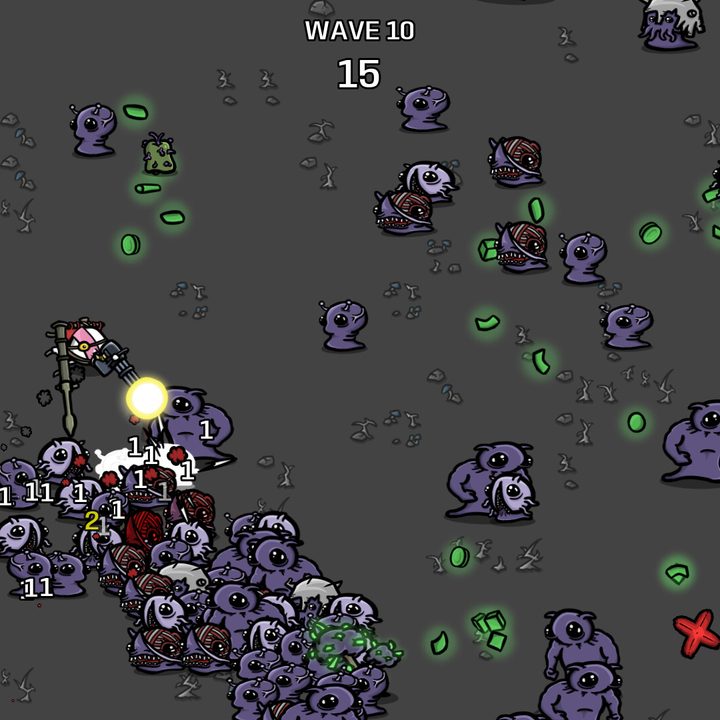
There are a lot of small changes to that formula though — ones that make a big difference. For one, an enemy wave only lasts 20 to 90 seconds rather than being one seamless gauntlet. Each time a wave ends, players get to stop for a moment to pick up new stat boosts and spend the resources they’ve collected on new tools before starting the next wave fresh at full health. That alone gives Brotato an entirely different pacing that doesn’t feel quite as relentless as Vampire Survivors. When I barely squeak by one wave, I then get a pause where I can really assess what went wrong and try to fix it in the next round by picking up smart upgrades.
In general, the structure here feels like it’s built to be a little less overwhelming. There aren’t millions of enemies on-screen at once and the single map included is just a small rectangle. That does take away some of Vampire Survivors‘ appeal, as that game is all about its mini-Dynasty Warriors spectacle, but it makes for a more laid-back couch game where I can stop and catch my breath a little every minute.
Mix and match
What really makes Brotato stand out, though, is its shockingly deep sense of character customization that makes each run feel totally unique. That’s clear right from the start of a run, as each potato hero has a very specific set of perks that call for a different playstyle. The Golem has increased health and gets buffed when his health drops below 50%, but he can’t heal in any way. The Pacifist, on the other hand, gets experience based on how many enemies are alive on-screen at the end of a wave — and they also have -100% damage to start. Each of its 40-plus characters calls for a different strategy, and I’ve had a blast trying to learn each one.
What especially makes each run so fun is that there’s so many ways to build a character. Most characters can hold six weapons at once by the end of a run, mixing and matching between standard guns and goofy melee weapons like explosive wooden planks. There are also tons of impactful relics that can be purchased after each wave that have a significant effect on a build. Those can be as simple as an energy bracelet that raises my critical percentage and elemental damage at the expense of ranged damage, or something mechanically impactful like a cyberball that has a 25% chance to deal damage to an enemy when another dies. Upgrades come fast and frequent too. At the end of each wave, I can select a few stat boosts and buy up to four items or weapons — and I can even refresh the store if I want to buy more. With each wave, it feels like I’m building up an entirely new character rather than slowly building my power over time.
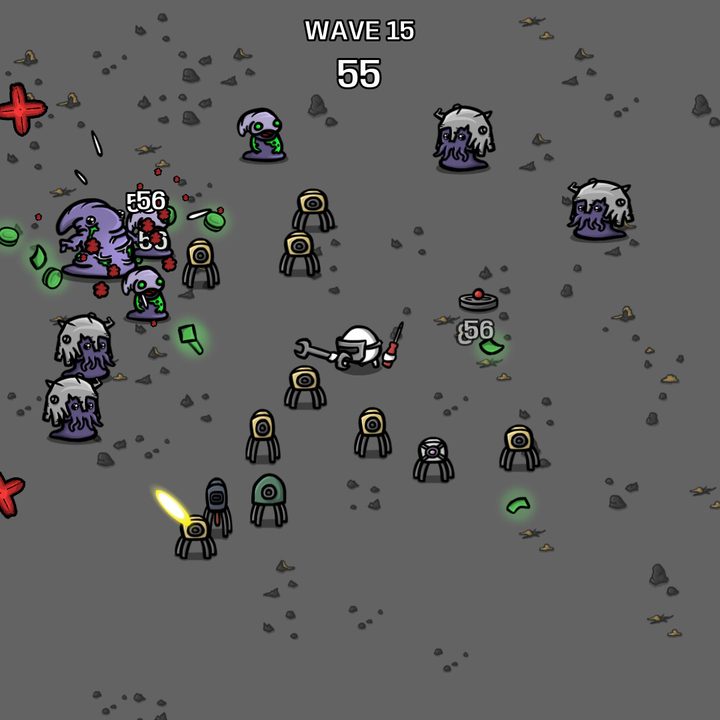
All of this gives Brotato an almost Hades-like appeal, where every run feels different. In one, I chose a character whose perks revolved around ranged attacks and improved piercing damage. I turned him into a long-range monster, buying only guns and relevant items. In another run, I went all-in on my engineering skill to create a character who could spawn and create multiple turrets around the arena. In Vampire Survivors, it often feels like I’m always hunting for the same few item combos (I’m all garlic, all the time). Here, I’m experimenting with all its tools a lot more to create runs that feel more dynamic, making for something that feels — and looks — like The Binding of Isaac.
I’m not sure if I’ll get as obsessed with Brotato as I did with Vampire Survivors. This is a true roguelike with no progression from run to run, which leaves me with one less hook to latch onto. There is plenty to do, though. New characters and tools can be unlocked by earning achievements, and there’s an incentive to beat the game with every single character. I can really see myself sinking some serious time into Brotato in July considering its a slow month for big-budget games. Regardless of how deep I get, this is one of those games that I don’t think I’ll ever uninstall from my Steam Deck.
Brotato 1.0 is now available on PC via Steam.