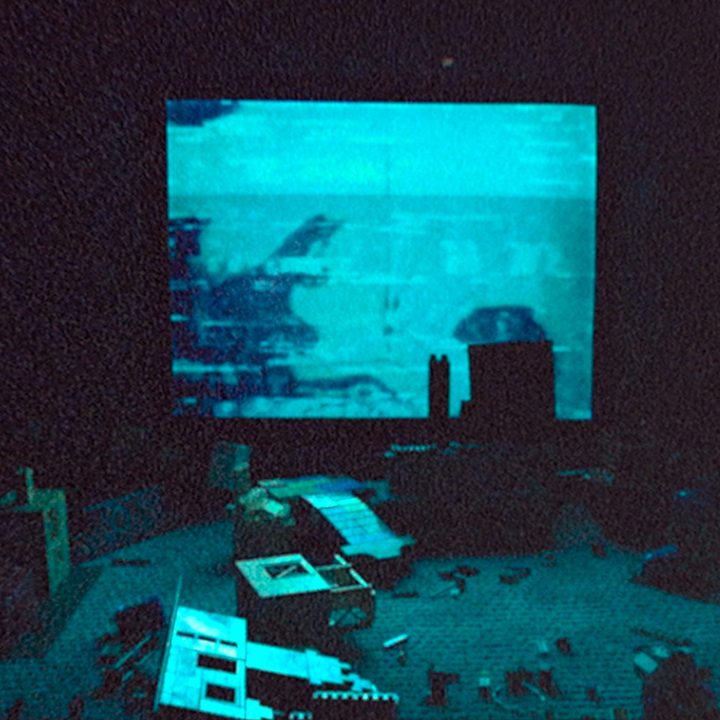
“What the hell is going on?” someone blurts out in a half-full AMC auditorium. Scattered chuckles reassure him he’s not alone in his bewilderment. It’s a chilly January evening in Chicago, and a few dozen of us have come out to see Skinamarink, a DIY horror movie about a pair of children haunted by an evil presence that’s reshaped the very layout of their home. Can any of us say with any certainty what the hell is going on in Kyle Edward Ball’s shoestring oddity, which rode a wave of viral TikTok buzz from the darkest reaches of the Canadian suburbs to theaters across America? It’s awfully experimental and radically uncommercial for a movie you can watch on a multiplex screen, Puss in Boots playing next door.
A couple of weeks later, along comes The Outwaters, a found-footage horror movie about some artists who get more than they bargained for shooting a music video in the Mojave Desert. After an hour-plus of extremely mundane vérité setup, writer-director-star Robbie Banfitch plunges us into pure psychedelic lunacy, splintering time and space through the lens of a roving, spinning handheld camera. Like Skinamarink, the film makes The Blair Witch Project look narratively conventional by comparison. What the hell is going on here?
Time keeps on slippin’, too, in Enys Men, an unusual 16mm dabble in folk horror that arrived a couple of months later still, hitting theaters in March. The film is set on an isolated English island where a lone researcher is slowly beset by strange visions. Or are they memories? The ’70s vibe is carefully cultivated and at once familiar and unfamiliar, as though director Mark Jenkin scrambled that dark hippie classic The Wicker Man into something more impressionistic and psychologically suggestive. Once again, a moviegoer might be tempted to poll his neighbors for an interpretative assist.
Taken together, these low-budget supernatural horror movies — vastly different in approach but linked by a release year, a general uncanniness, and the shared merit of an astonishing sound design — suggest a welcome sea change happening on the fringe of the genre. Each has crawled out of the shadows and the woodwork, ready to drag audiences into the unquantifiable unknown. They’re here to bring a little irrationality back to horror.
And not a moment too soon. Can we endure one more meditation on grief in the guise of a ghost story? Every decade gets the movie monster it deserves: Gothic, atomic, backwoods, torture-happy, and so on. The past 10 years have been no different, except that the kind of monster has proven less important than the insistence that it represent something. In the 2010s and beyond, a monster is never just a monster. It’s also usually a metaphor.
That’s neither a new phenomenon (just ask any student of folklore) nor an inherently lamentable one. But we’re definitely oversupplied today with horror movies that labor, above all else, to be “about something.” The best of these subtextually fraught thrillers, like the formally ingenious It Follows or the emotionally grueling Hereditary, resists simple one-to-one readings. The worst, like this month’s The Boogeyman, are basically therapy sessions with jump scares; they put horror on the couch and diagnose its power away.

There’s nothing so comfortingly digestible about Skinamarink, The Outwaters, or Enys Men. This is horror of a deliberately inscrutable nature, courting confusion for the sake of flee-floating dread. None of these films even really clarify the nature of their threats, which are all more forces of ambiguous malevolence than monsters: a disembodied voice, an unclassifiable species, or strange plant life. The real danger is of reality coming unhinged … or our perception of it bending beyond repair.
Visually speaking, Enys Men is the easiest of the trio to parse: While much of its imagery is bizarre — vegetation sprouting on flesh, ghostly figures emerging from the fog of time — you always know what you’re looking at, in brilliant celluloid color. Not so much with the other two movies, which often obscure our view of the action through impenetrably low light, unconventional angles, and extreme close-ups. Skinamarink abstracts the interior design of a house into a landscape of anxiety and confusion, making the everyday fearsome under cover of late-night darkness. The Outwaters, by contrast, turns the limited POV of a camcorder into a mind’s eye warped by the terrifying wonders of the universe; the film’s second half is borderline incomprehensible in its nonstop chaotic flurry.
All three films radically reject traditional storytelling, too. Skinamarink has a loose situation, not a plot, and its “characters” are petrified children, heard only in whispers and seen associatively, as feet on a carpet or the back of a head facing a television. The Outwaters is fairly straightforward (albeit rather numbingly uneventful) right up until the moment that it plummets into an unbroken frenzy of running, screaming, and sonic bewilderment. And Enys Men sets up a simple, nearly wordless scenario and then muddles it, collapsing the present into the past, never quite coalescing into the legible shape of a story. Summarizing what happens in these movies would be both challenging and pointless.
There’s plenty of meaning to be found in them, though — in the potent childhood insecurities evoked by Skinamarink, in the way The Outwaters grotesquely perverts the desire for “expanded consciousness” (it’s like the ultimate bad desert trip, Burning Man at the gates of the underworld), in the COVID-relevant portrait of fever-dream loneliness offered by Enys Men. Yet these are not movies that loudly belabor their themes, or hold the audience’s hand on a journey to uncover them. They cannot be reduced to a tidy thesis or mission statement. They are not about one single thing.
As to whether they’re scary, well, mileage will and has varied. The same hardcore grindhouse heads who turn up their noses at the A24 school of fashionable, “elevated” metaphorror may see something equally pretentious in the puzzling obfuscations of Skinamarink, The Outwaters, and, perhaps especially, Enys Men, which is horror in atmosphere more than content. They all risk tedium in establishing a hypnotically repetitive mood, and they all largely lack traditional midnight-movie thrills. For every genre nut unnerved by their offbeat tactics, there might be another left restless by their irresolution.
Yet a reluctance to explain themselves makes them refreshing outliers in an era of overly solvable horror. Their makers recognize that real fear lies beyond the boundaries of comprehension, in what we can’t grasp or diagnose. Isn’t Leatherface scarier without a sympathetic backstory, a simple explanation for his evil? And doesn’t mapping a horror movie to one particular issue (“The real monster … is alcoholism!”) make it safer somehow, in the way unpacking a nightmare neutralizes its hold over you?
These movies are nightmares that can’t so easily be unpacked. They adhere to the logic of bad dreams, coasting on currents of unease. They flirt with madness, a fate worse than bloody death. And in their stubborn refusal to conform to the conventions of mainstream fright flicks, they restore some mystery to a genre colonized by left-brain thinking. Submit to their irrational horror. It’s overrated, knowing what the hell is going on.
Skinamarink is now streaming on Shudder. The Outwaters and Enys Men are available to rent or purchase from major digital services. For more of A.A. Dowd’s writing, please visit his Authory page.