1. Home
  2. Space
  3. News

James Webb captures the stunning outflows from an infant star

Add as a preferred source on Google

A gorgeous new image from the James Webb Space Telescope shows a dramatic sight created by the outbursts of energy coming from a very young star. Called a Herbig-Haro object, this particular example is named HH 211 and shows the effects of huge jets of gas that are thrown out by the star and which collide with clouds of dust and gas to create stunning shapes.

The image was taken in the infrared wavelength in which Webb operates, which is ideal for observing hot objects like new stars without the view being blocked by dust, which is opaque in the visible light wavelength. The observations were made using Webb’s NIRCam instrument.
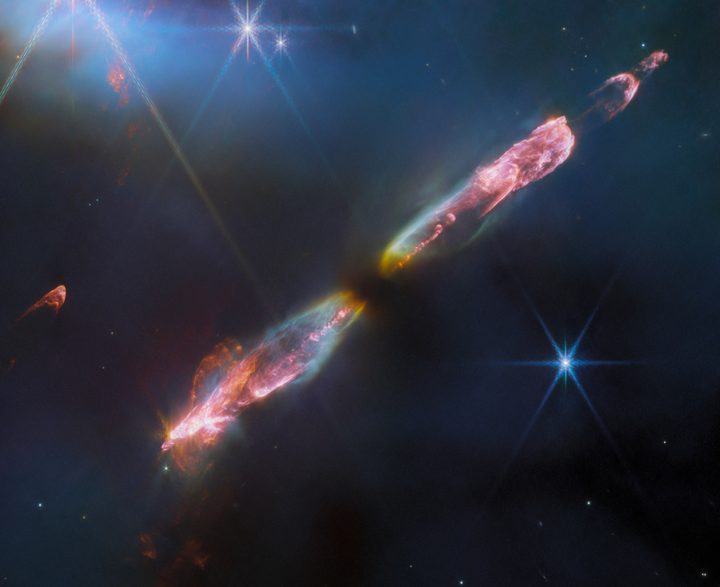
NASA’s James Webb Space Telescope’s high resolution, near-infrared look at Herbig-Haro 211 reveals exquisite detail of the outflow of a young star, an infantile analogue of our Sun. Herbig-Haro objects are formed when stellar winds or jets of gas spewing from newborn stars form shock waves colliding with nearby gas and dust at high speeds.
NASA’s James Webb Space Telescope’s high-resolution, near-infrared look at Herbig-Haro 211 reveals exquisite detail of the outflow of a young star, an infantile analogue of our sun. Herbig-Haro objects are formed when stellar winds or jets of gas spewing from newborn stars form shock waves that collide with nearby gas and dust at high speeds. ESA/Webb, NASA, CSA, Tom Ray (Dublin)

This is the second time Webb has imaged a Herbig-Haro object, as a pair of such objects called HH 46/47 were imaged in July of this year. That image was also taken with NIRCam, though it shows more background stars compared to the new image, while the recent image shows more details around the star at the center.

Recommended Videos

The star at the center of HH 211 will eventually grow up to become a star similar to our sun, but now it is just a few tens of thousands of years old, compared to our more than 4 billion year old sun. It also has a much smaller mass, at just 8% the mass of the sun. The very young age of the star is the reason for it giving off such powerful jets, as the star is gathering up material from the area around it and then flinging off a small amount of that material from its poles.

As the material travels outward at tremendous speeds of up to 60 miles per second, it creates a wave-like structure of gas that collides with other matter. This collision results in an effect called a bow shock, shaped like a curve, examples of which can be seen in both the lower-left and upper-right portions of the image.

Georgina Torbet
Georgina has been the space writer at Digital Trends space writer for six years, covering human space exploration, planetary…
China’s answer to SpaceX’s reusable rockets literally catches boosters in a net
SpaceX catches boosters on legs. China just used a net.
Ammunition, Missile, Weapon

SpaceX's playbook for recovering a rocket booster generally involves legs, a precisely controlled vertical landing, and either a concrete pad or a drone ship. 

China just managed to pull off something similar, but in a slightly different way, and on July 10, it tested the method as well.

Read more
Dimming the sun sounds unhinged, but this new study on El Niño makes a surprisingly good case for it
A natural test case, Australia's worst-ever wildfire season, suggests the idea deserves serious consideration.
Nature, Outdoors, Sky

When I first saw "scientists propose dimming the sun," I rolled my eyes. It sounds like a science fiction movie cooked up after watching many climate documentaries. But a new study, published on July 8, 2026, in the journal Science Advances, seems to have a genuinely compelling argument.

A Super El Niño is currently forming in the Pacific, feared to be the most intense in decades. It could escalate floods, wildfires, and extreme heat events worldwide. However, Researchers at UC San Diego's Scripps Institution of Oceanography, led by climate scientists Kate Ricke and Jessica Wan, are now proposing one of the most interesting solutions I’ve come across.

Read more
You can now walk through space and gaze into a black hole at this VR exhibit
Smithsonian Starstruck lets you drift past dying stars and see the origin point of the universe for as little as $18 a person.
Smithsonian Starstruck featured

Most planetarium shows ask you to sit still and look up. The Smithsonian's new VR exhibit takes a different approach, letting visitors walk through the vast expanse of the universe, drifting past stars, planets, and a black hole to get a physical sense of its true scale.

A $29 ticket to the edge of the galaxy

Read more