1. Home
  2. Space
  3. News

A galaxy with layers like an onion shines in Dark Energy Camera image

Add as a preferred source on Google

A new image taken by the Dark Energy Camera shows a “galactic onion,” a shell galaxy with multiple layers that are spread out over a distance of 150,000 light-years. At around twice the size of the Milky Way, the galaxy NGC 3923 is large, but even larger is a nearby galaxy cluster that has so much mass that it is bending space-time, making the light from distant galaxies behind it bend like a magnifying glass in a process called gravitational lensing.

The Dark Energy Camera is ground-based instrument located at the Víctor M. Blanco 4-meter Telescope in Chile and was originally built to observe many galaxies as part of a project called the Dark Energy Survey. Now, it is also used for other observations such as imaging dwarf galaxies, merging galaxies, and more.
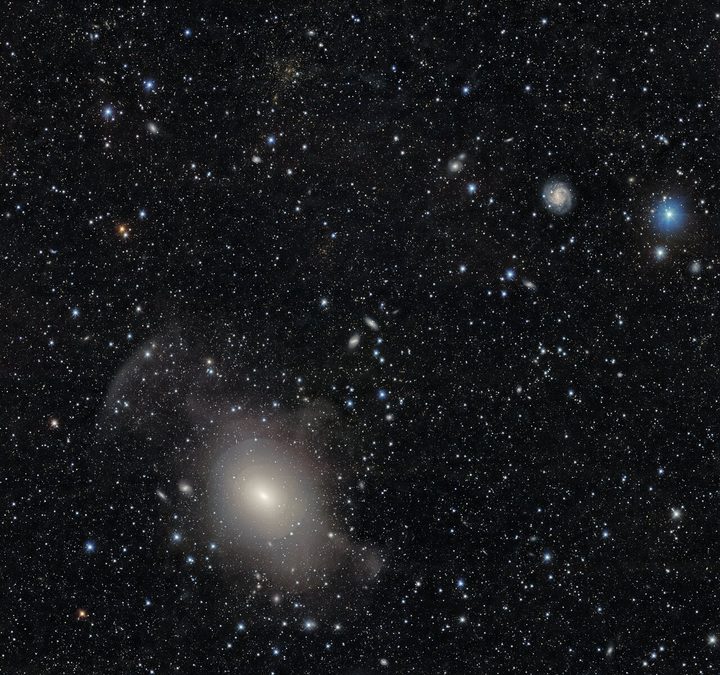
The symmetrical, onion-like layers of shell galaxy NGC 3923 are showcased in this galaxy-rich image taken by the US Department of Energy’s (DOE) Dark Energy Camera mounted on the National Science Foundation’s (NSF) Víctor M. Blanco 4-meter Telescope at Cerro Tololo Inter-American Observatory in Chile, a Program of NSF’s NOIRLab. A nearby, massive galaxy cluster is also captured exhibiting the phenomenon known as gravitational lensing.
The symmetrical, onion-like layers of shell galaxy NGC 3923 are showcased in this galaxy-rich image taken by the U.S. Department of Energy Dark Energy Camera mounted on the National Science Foundation’s (NSF) Víctor M. Blanco 4-meter Telescope at Cerro Tololo Inter-American Observatory in Chile. A nearby, massive galaxy cluster is also captured exhibiting the phenomenon known as gravitational lensing. DESI Legacy Imaging Surveys/LBNL/DOE & KPNO/CTIO/NOIRLab/NSF/AURA Image processing: T.A. Rector (University of Alaska Anchorage/NSF’s NOIRLab), M. Zamani (NSF’s NOIRLab), R. Colombari (NSF’s NOIRLab) & D. de Martin (NSF’s NOIRLab)

The main feature of this image is the shell galaxy, which is a type of elliptical galaxy in which the stars are not spread evenly, but are instead arranged into shell-like structures. Spiral galaxies like the Milky Way don’t have this arrangement of stars, but it is thought that around one-tenth of elliptical galaxies do, and that the structure is created when two galaxies merge and a larger galaxy absorbs a smaller companion.

Recommended Videos

Two galaxies merging was what happened here, as NOIRLab explains: “As they merged, the larger galaxy’s gravitational field slowly peeled off stars from the smaller galaxy’s disk. Those stars began to gradually mix with the larger galaxy’s outer halo, forming concentric bands, or shells. A simple analogy is adding a drop of food color to a bowl of batter that you’re slowly stirring. The drop gets stretched out in a spiral that remains visible for a long time before completely mixing.”

The other important feature of this image is harder to see, but is located at the top center. A massive galaxy cluster called PLCK G287.0+32.9 is bending space-time and warping the light coming from distant galaxies, making them appear stretched out.

To see the image in its full glory and to appreciate all the details, a large zoomable version of the image is available on the NOIRLab website.

Georgina Torbet
Georgina has been the space writer at Digital Trends space writer for six years, covering human space exploration, planetary…
Space is becoming Bezos and Musk’s next data center site, and we have every reason to worry
The AI boom is coming for the night sky
How Vast's space station will look in orbit.

AI data centers already consume vast amounts of electricity and water on Earth, so Silicon Valley has begun looking somewhere considerably more spacious... literally.

Elon Musk's SpaceX and Jeff Bezos' Blue Origin, along with several other companies, have proposed enormous constellations of satellites designed to operate as orbital data centers. However, environmental groups and former space officials are now warning that putting them into orbit at the proposed scale could have severe consequences for Earth's atmosphere and the night sky.

Read more
The first possible exomoon is here, and it makes our Moon look hilariously tiny
Scientists may have found the first exomoon, except this one is the size of Jupiter
This artist’s concept depicts a potential volcanic moon between the exoplanet WASP-49 b, left, and its parent star. New evidence indicating that a massive sodium cloud observed near WASP-49 b is produced by neither the planet nor the star has prompted researchers to ask if its origin could be an exomoon.

We have already discovered more than 6,000 planets outside of our immediate neighborhood. Yet, finding a moon orbiting one of those distant worlds has proved considerably harder. Astronomers may finally have something close to the real deal, but this particular object stretches the word “moon” almost beyond recognition.

Using the European Southern Observatory’s Very Large Telescope in Chile, researchers detected strong evidence for a moon-like object in the CD-35 2722 system. Further observations are still necessary to confirm the discovery, but it could become the first confidently detected natural satellite outside our solar system. There is still one tiny complication though. This moon is apparently massive.

Read more
China’s answer to SpaceX’s reusable rockets literally catches boosters in a net
SpaceX catches boosters on legs. China just used a net.
Ammunition, Missile, Weapon

SpaceX's playbook for recovering a rocket booster generally involves legs, a precisely controlled vertical landing, and either a concrete pad or a drone ship. 

China just managed to pull off something similar, but in a slightly different way, and on July 10, it tested the method as well.

Read more