  1. Home
  2. Space
  3. News

NASA’s Lucy spacecraft snaps not one, but two asteroids during flyby

Add as a preferred source on Google

NASA’s Lucy spacecraft is on its way to the orbit of Jupiter to study the asteroids there, called Trojans. Recently, while on its trip, it made a quick flyby of another small asteroid called Dinkinesh. The spacecraft confirmed its flyby of the asteroid this week, but when it returned the images it took, there was a surprise in store: a second, even smaller asteroid tucked up next to Dinkinesh.

Lucy took images using its Lucy Long-Range Reconnaissance Imager (L’LORRI) camera, which confirmed that the larger asteroid is around 0.5 miles across and the smaller asteroid is just 0.15 miles across. As the spacecraft approached Dinkinesh, the Lucy team had wondered if it might be part of a pair, called a binary system, because of the way its brightness changed over time. When the spacecraft flew by and snapped its images, this speculation was confirmed.
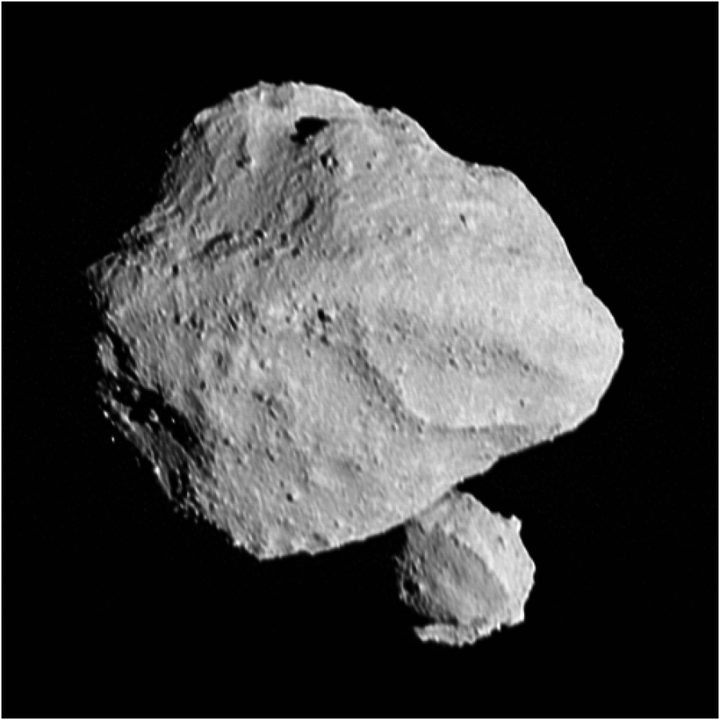
This image shows the “moonrise” of the satellite as it emerges from behind asteroid Dinkinesh as seen by the Lucy Long-Range Reconnaissance Imager (L’LORRI), one of the most detailed images returned by NASA’s Lucy spacecraft during its flyby of the asteroid binary. This image was taken at 12:55 p.m. EDT (1655 UTC) Nov. 1, 2023, within a minute of closest approach, from a range of approximately 270 miles (430 km). From this perspective, the satellite is behind the primary asteroid. The image has been sharpened and processed to enhance contrast.
This image shows the “moonrise” of a satellite asteroid as it emerges from behind asteroid Dinkinesh. It was taken by the Lucy Long-Range Reconnaissance Imager (L’LORRI). The image has been sharpened and processed to enhance contrast. NASA/Goddard/SwRI/Johns Hopkins APL/NOIRLab

The pair are similar to the asteroid binary that NASA deliberately crashed a spacecraft into last year for the DART mission, according to the team.

Recommended Videos

“We knew this was going to be the smallest main belt asteroid ever seen up close,” said Keith Noll, Lucy project scientist from NASA’s Goddard Space Flight Center, in a statement. “The fact that it is two makes it even more exciting. In some ways, these asteroids look similar to the near-Earth asteroid binary Didymos and Dimorphos that DART saw, but there are some really interesting differences that we will be investigating.”

As well as being a first opportunity to study these asteroids, the flyby was also used as a test of Lucy’s ability to lock onto an asteroid and point its instruments at the target.

“This is an awesome series of images. They indicate that the terminal tracking system worked as intended, even when the universe presented us with a more difficult target than we expected,” said Tom Kennedy, guidance and navigation engineer at Lockheed Martin. “It’s one thing to simulate, test, and practice. It’s another thing entirely to see it actually happen.”

Dinkinesh means “marvelous” in Amharic, an Ethiopian language, and it was chosen because it is the Ethiopian name for the human ancestor fossil Lucy that the mission is named after.

“Dinkinesh really did live up to its name; this is marvelous,” said Hal Levison of the Southwest Research Institute, who is the principal investigator for Lucy. “When Lucy was originally selected for flight, we planned to fly by seven asteroids. With the addition of Dinkinesh, two Trojan moons, and now this satellite, we’ve turned it up to 11.”

Georgina Torbet
Georgina has been the space writer at Digital Trends space writer for six years, covering human space exploration, planetary…
Scientists warn Elon Musk’s orbital data centers could blind Earth’s biggest telescopes
A new ESO study suggests millions of satellites could make parts of the night sky effectively unusable for astronomy.
One hour of satellites over the northern Atacama Desert in Chile (October 2025)

The race to blanket Earth with satellite internet has unlocked faster connectivity for millions. But according to the European Southern Observatory (ESO), it could also make one of humanity's oldest hobbies, and one of its most important sciences, a whole lot harder. The organization warns that the rapid growth of satellite mega-constellations could severely disrupt observations made by some of the world's most powerful telescopes.

Astronomers say the night sky is reaching its limit

Read more
Amazon’s Starlink rival just crossed a major milestone, but don’t expect perfect internet just yet
Amazon finally showed up to the space internet party
Amazon Leo satellite layout across all launch vehicles

Amazon has taken a significant step toward launching its long-awaited satellite internet service. Following its latest rocket launch, the company now has 396 Project Kuiper satellites in low-Earth orbit, enough to begin offering continuous service across select regions. The milestone keeps Amazon on track for its previously announced goal of launching commercial service by mid-2026.

https://twitter.com/Weber44Chris/status/2072575499461963938?ref_src=twsrc%5Etfw%7Ctwcamp%5Etweetembed%7Ctwterm%5E2072575499461963938%7Ctwgr%5Ed727a1b853cbf519585e7bf2655943afb2f91bb8%7Ctwcon%5Es1_&ref_url=https%3A%2F%2Fwww.theverge.com%2Fscience%2F960563%2Famazon-leo-service-tipping-point

Read more
Amazon’s Starlink rival is set to launch satellite internet later this year
After launching nearly 400 satellites, Amazon says its Leo broadband service will go live later this year.
Atlas V launches 29 Amazon Leo satellites from Cape Canaveral, Florida

Amazon's long-awaited answer to SpaceX's Starlink is finally nearing liftoff. According to an exclusive report from Reuters, the company plans to begin offering its Leo satellite internet service later this year, after its latest rocket launch pushed the constellation to 394 satellites in orbit.

The pieces are finally falling into place for Project Kuiper

Read more